Showing posts with label public understanding of science. Show all posts

Friday, May 06, 2011

Scientists of the world, unite!

Last week, I mentioned that scientists - in this case, specifically anthropologists - need to develop strategies to better control the narratives about their research that get circulated in popular media. To me, the need to do so is spurred by both the public interest in anthropological research as well as the need to make science relevant, interesting and exciting to a broader swath of society than it currently is. I also think that scientists have a duty to reach out to the public and talk about what it is they do and why it matters. Really, we need to be able to do this no matter how narrow and specialized our specific field on inquiry. In part, I feel it's the minimum we can do considering the amount of public funding most of us get for our research. As well, if we hope to get the public excited about the scientific inquiry and kids about careers in science, making efforts and taking steps to reach broader audiences should not only be commendable, it should be a professional imperative.

The fine folks at Scientific American seem to be thinking along very similar lines. Under the aegis of the Nature Publishing Group, they're spearheading an effort called "1,000 Scientists in 1,000 Days" that "aims to help with all of those goals by making it easier for scientists and teachers to connect. The idea is simple. We seek scientists who are willing to volunteer to advise on curricula, answer a classroom's questions, or visit a school." They have a sign-up sheet for interested scientists - including a category specifically for anthropologists! - and they'll take care of matching interested parties with interested schools in their area. Sounds like a win-win to me, and you only have to volunteer as much as you are comfortable or able to. Get to it, folks!


Monday, May 02, 2011

Things to kill when you're original, affluent and social...

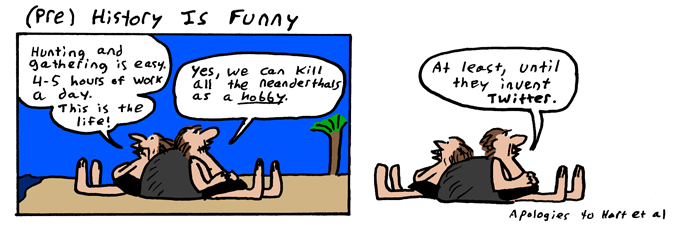
I have to admit this made me laugh.

© http://www.quickdraw.me/1169

So, it's kind of a silly comic, definitely good for a few chuckles. Yet, when you take a second to think about it, there's a lot packed into it. In two little panels, the cartoonist manages to bring up two of the biggest misconceptions about prheistoric hunter-gatherers: 1) that hunter-gatherers spend only a small amount of time a day foraging for food and have an abundance of leisure time to devote to other pursuits; and 2) that modern humans actively killed off Neanderthals.

Now while some people still believe that confrontational, violent interactions occurred at least some of the time when modern humans and Neanderthals crossed paths (e.g., Mellars 2005), faithful AVRPI readers will know by now that this view not only glosses over a ton of inconvenient evidence, but also doesn't really jive with what we know about how groups of hunter-gatherers really compete with one another (cf. O'Connell 2006).

The first component, though - the 4-5 hours of work thing - is more interesting. It taps into a now outgrown view of hunter-gatherers as having comparatively easy lives, where only a few hours a day were spent procuring food. This idea derives from the notion of the "original affluent society" first promulgated by M. Sahlins during the Man the Hunter conference (Sahlins 1968). That conference was held in Chicago in 1966 and was published as an edited volume by the same name in 1968 (Lee and de Vore 1968). Using some of the data on foraging returns that Lee had collected, Sahlins argued that foragers like the Kalahari San groups only spent a few hours a day foraging for food, spending the rest of their time gossiping or involved in assorted leisure activities.

This was pretty revolutionary for the time. Up to that point, hunter-gatherers had been seen by most anthropologists as perpetually living difficult, physically demanding lives and as always living on the brink of starvation. Sahlins' perspective, on top of having a catchy name, was the perfect foil to that traditional view, on top of providing a view of 'people closer to nature' as living what was in many ways possibly a better life than 20th post-industrial Westerners that fit in well with some of the counter-culture ideas in vogue at the time.

However, in spite of its conceptual and socio-political sexiness, the 'original affluent society' was just as unrealistic a view as that of perpetually hungry foragers. For one thing, it was based on observations made on a handful of forager societies, and even if it had been true for them, it would have been unwarranted to transpose it to all hunter-gatherers in all times and places. Second, Sahlins ignored the fact that several hours were also employed processing the food resources gathered in the 2-4 hours he saw as a typical work day for hunter-gatherers. Thorough reviews and criticisms of the OAS model include those written by Bird-David (1992:26-28) and Kelly (1995:15-19).

Anyhoo, all of this to say that, in addition to being funny on the face of it, this little comic is doubly funny to the informed reader, since it also capitalizes (maybe unwittingly) on two anthropological idea that have very much outlived their original usefulness. 

References

Bird-David, N. (1992). Beyond "The Original Affluent Society": A Culturalist Reformulation Current Anthropology, 33 (1) DOI: 10.1086/204029

Lee, R.B., and I. DeVore. 1968. Man the Hunter. Aldine, Chicago.

Kelly, R.L. 1995 The Foraging Spectrum. Smithsonian Institution Press, Washington, D.C.

Mellars, P. (2005). The impossible coincidence. A single-species model for the origins of modern human behavior in Europe Evolutionary Anthropology, 14 (1), 12-27 DOI: 10.1002/evan.20037

O'Connell, J.F. 2006. How did modern humans displace Neaderthals? Insights from hunter-gatherer ethnography and archaeology. In When Neanderthals and modern humans met, (N. Conard, ed.), pp. 43-64. Tubingen: Kerns Verlag.

Sahlins, M. 1968. Notes on the Original Affluent Societies. In Man the Hunter, (R. Lee and I. DeVore, eds.), pp. 85-89. Aldine, Chicago.

Thursday, April 28, 2011

Stone Age ≠ Caveman!!! Archaeology, science, the media, and some tangential thoughts on the 'gay caveman' story

By now, you've surely heard all the media hoopla about the alleged 'gay caveman' found in the Czech Republic that's been all over the news and internet for the past few weeks. Ugh! Y'know, I just got done reading Ben Goldacre's fantastic book Bad Science in which he bemoans (and entertainingly skewers!) the way medical findings are consistently distorted in the media, where flashy headlines seem to be more important than the actual facts. Well, I'm sure Ben would be (un)happy to know that this kind of media hype also sadly characterizes the way many archaeological findings are presented to the public at large.

This post might turn into something of a rant, cause there's a lot to talk about surrounding all of these issues, so let me start by the beginning, namely the find itself. It's a Corded Ware burial of a skeleton sexed as male found lying on its left side, with the head pointing to the West. That position is usually associated with females in that prehistoric culture, as are the various pots the burial contained. So, archaeologically, that's a neat find. Something unusual that does suggest - if the sexing is correct - that the individual might have had a distinct identity in that cultural context, which to be fair is pretty much all the archaeologists actually said about it. And that's good, because without more info, it's really impossible to say anything more about that person's identity. Yet, all the media reports are talking about "the first known gay caveman" so what gives? Well, truth of the matter is, the find has been misinterpreted, indeed distorted by the media. Shocking, I know. All. Sorts. Of. Wrong. You wanna know how bad the distortion has been? Read this story on LiveScience. Then read the posts on the topic by Rosemary Joyce, Bone GirlJohn Hawks and the very thoughtful post by Eric Michael Johnson which provides a really good discussion of third genders and the range of sexual identities present and accepted in many cultures.

You know, the mess the media have made here of confusing biological sex, gender, identity and sexual orientation is a perfect example of why people need to be exposed to at least some anthropology, even before college. Without going into detail here, let me just state they're not the same thing. They can be related, obviously, but they're not the same, and the distinctions matter, especially when you're using one of these dimensions (in this case biological sex) to infer some of the other ones. It gets even more problematic when bones and archaeological remains (i.e., a biased sample of all the evidence you would need to intelligently discuss these issues) are all you have to go on. Let's be clear: I'd be more than happy if we could get at an archaeology of homosexuality, as there is every reason to believe it was a fact of life in the past just as it is today (see Eric's post mentioned above). It's just that this particular story doesn't get it right, and that rubs me the wrong way, especially given how the media has sensationalized their spin on the discovery

To me, the most aggravating aspect of this media circus is what wasn't actually discussed in any of the breathless "OMG gay caveman" reports. What I mean here is that, had this story actually been true - let's assume for a second that we did have a gay caveman, or whatever - not one of the reports bothered to discuss the broader implications of the find. This is one grave found among many others, so what does it means that this clearly distinct individual was casually buried among many other Corded Ware individuals? Given the bigotry that is all too pervasive in today's society and all the ranting and raving about 'traditional' and 'normal' values that seeps into the political and social spheres, you'd think that finding evidence that people in the 'olden days' did not bother to marginalize gay individuals is even more noteworthy. But apparently, this kind of story just doesn't seem to be as interesting as catchy headlines today. Absurd.

One thing that several bloggers have seized on is the mischaracterization of this burial as somehow representing a caveman. I mean, by all that is unholy, the dude(tte) was buried with pottery, the very anathema of cavepersonhood! I think Rosemary hits the nail on the head here when she points out that the term was likely chosen to elicit the most visceral kind of contrast-based reaction between stereotypical views of cavemen and homosexuals in the public at large. My beef here is how the hell did the slip from pottery-using Neolithic person to 'caveman' happened. Reading the news reports, you see a lot of emphasis on the fact that the Corded Ware culture begins at the tail end of the Neolithic and last into the Copper Age of Central Europe. And I think that this is where we have the 'wormhole' (which, given my penchant for naming things right in Stone Age archaeology, you know I'm going to dive into): Neolithic refers to the "New Stone Age", where ground stone technology becomes ubiquitous, in contrast to the chipped stone tools that dominate the Paleolithic or "Old Stone Age". You see where this is going: do you think a reporter on the trail of of juicy story is going to let the distinction between a 'new' and and 'old' Stone Age get in the way of the fact that this individual can somehow be tied to the Stone Age as a whole? Of course not! So this burial goes from being Neolithic to belonging to the Stone Age, and from there, you're one lowly step away from cavemen... and a great headline! This is another reason why you need qualified people writing about archaeology. This is all the more true in cases where it ties to issues as volatile in their socio-political echoes as sexual identity. So, again, goes to show people need at least some background in anthropology and archaeology, if only so they can make out the general outlines of our species' evolutionary history and how given finds fit therein.

At the SAA meetings, I had a good talk with a friend about how news stories on archaeological research so often get their facts wrong. It echoed a discussion we had in our department earlier this term when Jim Potter came and gave a talk on his recently published work on the Sacred Ridge assemblage of human remains that showed evidence of perimortem processing (Potter and Chuipka 2010). Somehow, a sober archaeological analysis of these patterns got translated into the media as evidence for widespread cannibalism in the prehistoric US Southwest, when nothing of the sort was actually said, either in the paper itself or in interviews by the researchers. In fact, the paper itself argues that cannibalism is not the best explanation for the patterns they identified! How the topic veered so dramatically away from the archaeological reality is anyone's guess, but the need for a good story seems to be rather importantly involved.

This, to me, suggests that it may be time for anthropologists and archaeologists to get some actual formal training in PR or media relations as part of their education. We bemoan that we too often lose control of the narrative of the stories published on our work, yet we're the ones who are most intimately familiar with the studies that get reported on. Are people who are not trained in anthropology really the best ones to 'translate' our results and their significance for the public at large? Hardly. We should be able to express why something's important without having to transit through a middleman who all too often lacks the proper background to really fully digest anthropological research.

My own experience with this has been limited to dealing with my university's PR office, and I have to say that it was pretty good. The reporter I dealt with, David Kelly, was really enthusiastic and did not hesitate to ask questions, and likewise, I didn't hesitate to correct misunderstandings, etc. I think that we developed a good back and forth built on mutual trust, and that the news story was, as a result, quite a bit better than many I've read on similar topics. On talking to other colleagues that have had their work covered by the popular press, I also get the feeling that my experience as a whole was more positive than most. Maybe it has to do with the process being conducted 'in house' where both parties had something to gain from this being done right. I think that this also set the stage for positive interaction with members of the media who later contacted me, since they had a good, reliable base on which to build.

So, how does this all relate to 'gay cavemen'? Basically, we need to be careful about how we phrase things when presenting them to the public in order to steer the public narrative in a way we are comfortable with. This means that we somehow need to become better at (re)taking control over the narrative about our work that gets circulated in the media. To paraphrase an argument made by Goldacre, people aren't stupid, and they can follow fairly complicated argument, if given the chance. Not only that, but there also is a large amount of interest in anthropological research writ large. So, there is no need to dumb it down to the point where the story bears almost no resemblance to the original research, and such distortions are clearly not just the price to pay to have our stories get coverage in the media. We can and must do better.

Reference:

Potter, J., & Chuipka, J. (2010). Perimortem mutilation of human remains in an early village in the American Southwest: A case for ethnic violence Journal of Anthropological Archaeology, 29 (4), 507-523 DOI: 10.1016/j.jaa.2010.08.001

Sunday, February 27, 2011

Maggie Koerth-Baker on better scientific communication

I just got done watching a video of a recent talk by Maggie Koerth-Baker (science editor at Boing Boing) entitled "Six things scientists can learn from science journalists" which she recently gave at the University of Wisconsin. It's about an hour long, and I found it to be a really lucid overview of strategies scientists of all stripes should be using when talking about their research to the public at large and to reporters. The key points she makes are focused on the need to:
  1. present your work in an engaging way through the use of examples or analogies your audience can relate to or use to remember what you're saying; 
  2. develop a dialogue with your audience to understand where they're coming from and what their background on a topic is; 
  3. try to put yourself in the shoes of someone who has no background in your field; 
  4. relate given findings to broader issues to underscore their relevance; 
  5. be forthcoming about potential issues with your own research; and 
  6. write and talk in an accessible way instead of wrapping yourself in disciplinary technicality.
It may look as thought I've summarized the talk, but I really haven't - it's like saying that you've had dinner by looking at the menu. So click on over and treat yourself, there's a ton of really good info on how to put some of these concepts into practice.If you're at all interested in how to make science accessible to a broader audience, even if you're not a scientist yourself, you'll be doing yourself a major service by watching this video.

To me, the most significant point she makes had to do with relating scientific research to concerns outside of a narrow scientific interests, and to try to seize on issues of general interest as an anchor of sorts for your research. By doing this (one example she gives is research on overeating resonating better with people by linking it toThanksgiving), it becomes easy to underscore the significance of even minor developments and, most importantly, make people care about them. I really loved this sentence that encapsulates her general feeling:

"Science is bigger than single discoveries and if we can make people understand that, they're going to trust scientists a lot more and they're going to be a lot more interested in science."


Friday, June 11, 2010

New Paleoindian site in Keene, NH

It appears that a new Paleoindian site has been uncovered during the construction of a new middle school in Keene, New Hampshire. The report present a good overview in layman's terms of what has been uncovered so far

So far the artifacts have been found in oval clusters. Goodby speculates that these areas were where the people pitched tents or other shelters.

Primarily, the explorers have found a variety of stone tools that would have been used for processing animal hides, such as scraping tools. They've also found tools for making things out of bone and antlers as well as tools for engraving and splitting. But what's even more significant is what the stone tells the archeologists about the people who used them.

"We're learning for one thing that they had connections that extended all over Northern New England," Goodby said. "They were getting their stone from quarries as far away as northern Maine. And from sources in far north New Hampshire." He said there's evidence some of the stone may have come from Berlin and Jefferson.

He said they may have gotten this by following the caribou migratory routes, as that was their main game animal. He also said it may indicate that they were connected to other bands of people at this time so the stone moved from family to family.

Goodby also believes the type of stone they are finding in Keene as compared to the stone found in Swanzey in the 1970s, will ultimately prove the Keene site is even older than the Swanzey site.

Another exciting find was a stone fireplace that still had remnants of burnt fire wood in it. Next to the hearth, the archeologists also discovered what they believe to be burnt caribou bone. Goodby said testing will be done on the bone to determine the animal and the wood to determine what species of trees were in the area when these people lived there.

That's all well and good, and the report provides a nice example of how observation and interpretation can be woven together during archaeological research to develop solid working hypotheses. What struck me most about the report, however, is how the material recovered during excavation will be put to use in the coming years and use the shape part of the school's own curriculum. It appears that the school administrators have very sagely decided to use this material to provide students with an awareness of the deep past.

He said school officials will be building the finds into the curriculum so that students will understand the importance of the history right there in their backyard. He also said replicas of the stone tools will be on permanent display inside the school.

"The curriculum has been a little bit lacking when it comes to the original inhabitants in New England," Gurney said. "Now the students will be able to hold replicas of the actual artifacts in their hands and see exactly what the real tools looked like and touch and hold them…. It's just great."

If you ask me, that's a really fantastic manner of both underscoring the importance of archaeology to a young audience as well as of introducing students to the fundamental principles that allow people to study the human past and, more broadly, an array of 'paleo' disciplines by familiarizing them, for starters, with how dating methods work and the long history of human-environment interactions. Given the recent rise of the worst of obscurantist tendencies in some quarters, this can only be a good thing.

Tuesday, March 16, 2010

Mad Neanderthals, peer review and scholarly publication

There's been a growing rumble in the world of scientific publishing for the past several months, focusing especially on the nature and practices of the journal Medical Hypotheses. Briefly put, MH is a non-peer-reviewed journal that publishes original, controversial ResearchBlogging.organd thought-provoking ideas ("hypotheses" defined in the broadest possible sense, I guess you could say) about the medical realm sensu lato. Now, as reported by Science Insider, MH's editor, Bruce Charlton (here's his blog presenting his position on this affair), has all but been been fired as lead editor of the journal (unless MH is completely reorganized), mainly as a result of the brouhaha and subsequent fall-out over MH having accepted to publish a paper denying the link between HIV and AIDS. Indeed, some have gone so far as to wonder whether MH might be labeled "the most hated journal in science."

Orac provides a thoughtful dissection of some of the problems with MH and of the impact of publishing some of what was published in that venue in recent years. I doubt I could do much better than that in terms of providing background and context to the 'regime change' underway at MH. That said, I figured I'd throw out my two cents about this, given two things: 1) I've recently published something in MH; 2) what it means for the public understanding of scientific arguments; and 3) Elsevier's role in all this.

First, two years ago, a short commentary of mine was published in MH (Riel-Salvatore 2008), I hasten to add in response to a paper they had published, which I felt was very poorly argued and completely unsupported by the available data (Underdown 2008). To MH's credit, the process of publishing my reply was very smooth, transparent and, importantly, very quick. My comment was based on a post I first had up on AVRPI, a process I chronicled in detail before, and it took all of three months from the blog-to-published-comment process to unfold, which I was personally quite happy about. Likewise, I have to say that my impression throughout this process was that MH was quite open to even very 'vigorous' criticism of papers it published. It was also nice that you didn't have to pay to publish a comment, whereas you have to pay 'page fees' to publish an actual paper in MH (itself a questionable practice, especially if it doesn't result in open access to the paper in question, but that's another post for another time).

That said, there was a good reason why I felt the need to publish that comment, even though, as a non-peer reviewed piece on a non-peer reviewed piece, it was essentially a double net loss to my research productivity, especially since I had no personal stake in this, i.e, it didn't portray any of my own work negatively. That reason was the amount of play the original paper had received in the popular press. And this, fundamentally, is the issue I have with journals like MH. To the public at large, reading that a 'study' or a 'new paper' has been published in a 'journal' (especially if it is by someone described as a professor or researcher affiliated with a bona fide university), implies that it is a serious contribution to the literature on given debates. In this case, the 'mad Neanderthal' meme as a credible explanation for their disappearance went full-steam ahead, with no real detractors on the record. I suspect that this acceptance was due in no small part to the fact that it had been published in a 'journal', never mind the facts that authors basically need to pay to have their research published in MH, with no resulting public access, and the that, contrarily to most research on Neanderthals that makes its way to the popular press, this paper was not critically evaluated by peers of the author. This is not to say that non-peer reviewed publications don't have their own raison d'être, but rather that they need to be explicitly recognized as such, especially before results published in such sources get fed to the media.

As it is, to the non-specialist, MH certainly has the appearance of a peer-reviewed journal. For one thing, it's a 'journal.' For another, it's published by Elsevier, which touts itself as "the world’s leading publisher of science and health information" (from their website). With such backing, why wouldn't someone assume that MH is a reputable source? It's even got 'medical' right there in the title! Hell, I hadn't heard of MH before reading Underdown's paper, and my first reaction upon seeing it was an Elsevier pub certainly was that it was most likely a peer-reviewed journal. Plus, as this post's inclusion on Research Blogging shows, it even has a doi and everything, making the contents of MH appear as legitimate peer-reviewed publications, as does their inclusion in scientific databases like Web of Science. This is not to exculpate people who don't do their homework, but MH certainly has all the outside appearance of a peer-reviewed publication.

This leads to the third point, namely the business practices of Elsevier, who bought MH in 2002 (the journal was created in 1975). I think an important question to ask is why Elsevier bothered to acquire MH in the first place? Given its current double-take on MH's worth as a scientific publication, it kind of makes one wonder whether the goal of dominating as much of the scientific publishing market as possible made the higher-ups at Elsevier ignore the nature of that journal in their continuing efforts to take over an increasing share of the publishing world, no matter what the costs... I very much doubt that they had as their ultimate goal to make MH into a full-blown peer-reviewed publication (if so, why wait 8 years?), so what's the story here? I think we may be witnessing an instance of Elsevier's business model backfiring, and though they're clearly trying to shift the fall-out solely on MH, I think it ultimately highlights the hypocrisy that grows from the tensions between the mission of scientific publication and the business realities faced by publishing conglomerates within which individuals become increasingly faceless entities conceived more as profit-making devices than conduits for the wide and timely dissemination of scientific knowledge. I think this is all the more grating given that scientists are essentially forced to give away their work to be published in the 'right' Elsevier journals - and those of other large publishing companies - (even if in many cases their reputation far precedes their incorporation by Elsevier) for purposes of getting tenure, professional prestige, etc.

In any case, my point here is not to say that MH is all sorts of awesome and that Elsevier isn't. In fact, my only involvement with MH came as a reaction to a paper that I thought was of pretty low academic quality (which echoes some of the problems that precipitated the current fiasco) and which they nonetheless elected to publish, even though it echoed another short paper written almost 35 years prior (
Wolbarsht 1975). It also isn't that it is not a peer-reviewed journal - even Nature publishes some non-peer reviewed comments that are downright wretched (see a nice takedown here)and which I'm sure the yahoos who write them bandy about as "publications in Nature!" (hey they have doi's and issue/page numbers and everything!). Rather, I think that this whole situation points to some systemic problems in academic publishing, especially as practiced by large conglomerates increasingly detached from the goals and individual realities of the given journals they opt to take over, largely in the name of lucre more than any actual scientific mission.

References

Riel-Salvatore J (2008). Mad Neanderthal disease? Some comments on "A potential role for Transmissible Spongiform Encephalopathies in Neanderthal extinction". Medical hypotheses, 71 (3), 473-4 PMID: 18524493

UNDERDOWN, S. (2008). A potential role for Transmissible Spongiform Encephalopathies in Neanderthal extinction Medical Hypotheses, 71 (1), 4-7 DOI: 10.1016/j.mehy.2007.12.014

Wolbarsht, M. L. 1975. The Demese ef the Ne'enderthels: Wes Lengege E Fecter? Science 187:600-601.

Tuesday, March 02, 2010

Faces of human evolution

The Smithsonian Magazine has a very nice online feature that presents seven reconstructions of various extinct hominins that John Gurche crafted for the new National Museum of Natural History’s David H. Koch Hall of Human Origins that opens in two weeks.

The piece describes how he "dissected the heads of modern humans and apes, mapping patterns of soft tissue and bone. He used this information to fill out the features of the fossils. Each sculpture starts with the cast of a fossilized skull; Gurche then adds layers of clay muscle, fat and skin."

I especially liked the quote about how he "even molds the hominids’ eyes out of acrylic plastic, eschewing pre-fabricated versions. "If you want the eyes to be the window to the soul,” Gurche says, “you have to make them with some depth."

To give you an idea of the quality of the reconstructions, here's one of his reconstructions, that of a Neanderthal male (what else!).


From http://www.smithsonianmag.com/science-nature/A-Closer-Look-at-
Evolutionary-Faces.html?c=y&page=6 ; copyright John Gurche.


These are extremely well done reconstructions, and quite accurate, IMO, and it helps that Gurche gives a bit of background on each of the hominins he reconstructed - gives a nice idea of how he approached this task. I should add that, really, the power of these reconstructions to help make human revolution more accessible to wider audiences can't be overemphasized. I once gave a presentation about what a paleoanthropologist does to a class of kindergartners, and they went absolutely nuts for this picture, mainly I think because they could more easily relate their own lives to that of a small hominin child (and since this was in Montreal, I didn't have to blur out the "boy parts")...


Of course, I didn't tell them just how accurate this picture is, what with the raptor in the upper left and the fact that there is good evidence the Taung Child bears traces that indicate he was likely killed by a bird of prey (Berger 2006)! That last image is drawn from The Last Human: A Guide to Twenty-Two Species of Extinct Humans, put out by Yale UP and lavishly illustrated with high-quality reconstructions of extinct hominins. I drew on the illustrations of the book extensively when I taught Human Evolution at McGill a few years ago... lost that book in the recent move to Denver, though. Still dearly wish I had it!

References

Berger, Lee R. 2006. Predatory bird damage to the Taung type-skull of Australopithecus africanus Dart 1925. American Journal of Physical Anthropology 131:166-168.

Thursday, November 06, 2008

Blogging for Science

Here's my quote of the day, courtesy of PZ Myers:
Peer review is only a first, preliminary hurdle for a paper to cross; passing peer review and getting published does not mean that your work is right. Some incredibly awful papers get through the review process, somehow. Getting published only means that now your paper is going to be opened up to wider criticism. Don't take the attitude that publication means vindication; I know reviewers, and I've reviewed papers, and I know that reviewers are sometimes lazy, sometimes susceptible to croneyism, and always overworked, and that publication doesn't mean you are right. (my emphasis).
Boy, don't I know it! Publishing paleoanthropologically-themed research can sometimes feel like you're entering the Thunderdome, a lesson I learned first-hand in my very first peer-reviewed publication! And Myers makes a good point: when something gets published, it only means that it's serious enough that other experts in the field recognize it's worth discussing, that other professionals can now have a go at it, if you will. Actually you should read the whole post, which is about how people think of blogs, comments on blogs, and the contribution this can make to scientific discourse. It's a thoughtful piece, and one in which PZ - whose writing style can occasionally be, errr, fiery - cogently lays out the case for the usefulness of blogging to make scientific research and its conclusions accessible to a wider audience.

And as for the writing style of blog posts, I also especially liked this quote (which came in second place for quote of the day): "Explain your answers as you would to an undergrad or bright high school student. If you can't, it implies that you aren't looking for an equal opportunity, you are looking for a way to avoid probing questions." Now, that doesn't mean you need to 'dumb it down' or that everybody needs to do this. In my view, it highlights how the web can be used to democratize and favor the diffusion of science. After all, in a time when funding for scientific research increasingly comes from public agencies, it is important to present our work in a manner that is accessible to a well-educated public. This is part of why I have this humble little blog here.

And because common ideas seem to strike different people at the same time, check out John Hawks' recent post on the issue. His take? "I wanted to point to Orac's post, since it is what the blogosphere is the best for: clear, factual critiques that focus on methods." And it's fitting that I mention Hawks here, since he was one of the parties in one of the best 'real-time' virtual debates on Early Upper Paleolithic chronology, a topic near and dear to my heart. On January 12, 2007, John blogged about a new Science paper on the EUP chronology of Kostenki, Russia, criticizing some aspects of the paper's conclusions. Four days later, on January 16, 2007, one of that study's authors, John Hoffecker wrote a reply to Hawks' post, posting it on Kris Hirst's Archaeology Blog, addressing in a detailed manner some of John's critiques. And two days later, on January 18, you guessed it, Hawks had also posted a lengthy reply to some of the points raised in Hoffecker's guest post, situating the debate in a broader context to highlight the significance of the paper he originally blogged about.

OK, lengthy summary to basically highlight that, in the span of just over one week (literally, a blink of an eye in 'journal time'), you had a serious, thought-provoking and scholarly back-and-forth debate on a paper that had just been published. If this had taken place in Science itself, it would have probably taken at least 6 months to get published, far after the paper had faded from public consciousness. Now, this would be all and well for the paleoanthropological community, but for the public at large who might have been interested in the issue, it probably provided a rarely seen instance of how scientists can disagree on details (the specifics of the chronology of the 'transition') while nonetheless agreeing on fundamental issues (that the transition was an important process in recent human evolution). So, yes, blogging can and does serve a very useful purpose in the discourse of science.

Thursday, February 28, 2008

Archaeology and the Public: A Complicated Relationship?

A. Rossi and E. Webb have a brief report in the March 2008 issue of Antiquity detailing sediment loss apparently caused by dramatic increases in the number of tourist visits at Mulka's Cave, a major rock art site in southwestern Australia. To sum up, they reconstructed changes in floor level based on dated photographs which result in the following chilling (archaeologically, at least) composite profile of the ground level at the cave's entrance:

Courtesy of Antiquity (Rossi and Webb 2008).

Here's what the authors make of this observation that the level of the cave floor has dropped roughly one meter in just over half a century!

"Comparison of photographs we took in 2004 and 2006 showed that the shape of the entrance had changed; prompting us to research datable pictures of Mulka’s Cave on file at DIA. The resulting figure (Figure 3) shows that between 1952 and 1988, 0.5m of sediment was lost. By 2004, another 0.5m of deposit had disappeared. That erosion was accelerating is shown by the amount of sediment lost between 2004 and 2006. Had the walkway not been installed, erosion would have continued unabated because the deposits outside the cave were probed to a depth of -1m, without reaching bedrock."

"We attribute this erosion to trampling (Rossi & Webb n.d.). There are few places within Mulka’s Cave where visitors can stand comfortably to view the artwork because it is full of boulders (Figure 4); while the floor at the base of the rock pile measures 2 x 7m. These limitations became a problem with increased tourism, particularly visits by commercial tours. These groups often comprise 30 people, two of whom are crowded into each square metre of floor space. We believe the resultant trampling has eroded 1m of the cave deposits in 50 years. That sediment is now spread over the slope outside, but the stone artefacts it contains lack stratigraphic context." (Rossi and Webb 2008)

These are sobering observations about the potential impact of uncontrolled tourist visits at archaelogical sites. First, there's the clear conclusion of a one-meter drop in floor level over 50 years. More alarmingly, the most recent 50cm drop took place between 1988 and 2004, or 16 years. This means that the rate of tourism-mediated erosion has tripled relative to what it was between 1952 and 1988, in tandem with increasing peaks in the numbers of visitors at the site (Rossi and Webb 2008: Figure 2).

This raises the age-old question of what the interface should be between archaeology and the public. Much archaeological research is financed by public funds of one sort or another, and archaeologists can thus be argued to have some kind of obligation to make the fruit of their work available to the public. The problem, of course, is how to do this.

There is a lot to be said for doing for science in the interest of furthering science, in the sense of refining of our understanding of various phenomena even if this understanding cannot be immediately be translated for the public at large. On the other hand, we also have a duty to make the public appreciate the importance of publicly-funded research, in this case archaeology. This is made especially salient for archaeology due to the public appeal of archaeological research and the fact that it takes place 'in the real world', that is in space most people can access and occasionally even see as part of their lived landscape. In other words, archaeology can take place, quite literally, in your backyard, making this kind of research immediately engaging to contemporary people, at least on occasion. This is a far cry from most laboratory research where unquestionably important discoveries are made in contexts far removed from people's everyday reality.

While I think public education in archaeology and history is very important, I'm still open about whether this is best achieved through access to data, access to material, or access to sites. Access to data is a great thing, and potentially the easiest of the three to effect. However, archaeological data can take a very long time to analyze fully, resulting in delays in publication and therefore in public dissemination. Additionally, archaeological data are unlikely to be the easiest to digest for the untrained public, even a comparatively educated one.

Access to materials is perhaps the best way to make archaeology accessible and "tangible" to the public at large. The conservation and display of artifacts in museums is a tried, tested and true method of doing this, provided this is done well. Badly organized displays do very little to effectively carry across the importance/relevance of given archaeological collections.

Access to sites is much more tricky - visiting a site is unique manner of experiencing what 'doing archaeology' might be like, albeit very superficially. Visiting Paleolithic sites was certainly a formative experience for me, on at least one level. Visiting ruined cities, etc, also can give a sense that "people in the past" were a lot more like you and me than one might otherwise think, which is a good realization for anyone to have in an age of growing intolerance. However, while a one-off site visit may well convey the excitement of 'doing' archaeology, it transmits little to none of the tediousness that can characterize actual fieldwork, where you might be stuck working in the same square meter unit for days on end (see this post for more on this and another one by Kris Hirst). Personally, this was something I only learned when I finally got to do fieldwork, and that's coming from someone who loves being in the field – imagine what it must be like for people who don’t enjoy digging that much!

On top of that, as Rossi and Webb’s study demonstrates, unchecked tourist access can have serious impacts on the integrity of the archaeological deposits remaining at a site. This can be true of even extremely modest and highly controlled visit regimens, as the ongoing Lascaux crisis demonstrates. I’d surmise that even very large, very resilient sites (e.g., cities, temples, and the like) deal with very similar issues albeit perhaps at a different scale. Allowing the public to visit sites is thus fraught with conservation issues, but also a unique way of making people "experience archaeology" first-hand, resulting in a sort of tug-of-war over the value of making sites accessible to visitors. That said, I’m still not sure either is necessarily the best way to get across why archeology is important as opposed to simply being a cool thing to research.

References:

Rossi, Alana M., and R. Esmée Webb. 2008. The erosive effect of tourism at an Aboriginal rock art site on the western edge of the arid zone in south-western Australia. Antiquity 82 (315): http://www.antiquity.ac.uk/ProjGall/rossi/index.html.