Showing posts with label fossils. Show all posts

Thursday, August 25, 2011

170,000 year-old human skull fragment found at Lazaret

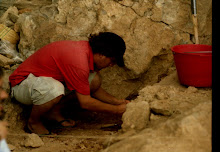
A couple of weeks ago (Aug. 13, to be precise), part of a hominin frontal skull fragment was found during excavations at Grotte du Lazaret, near Nice, France. The find was first reported in a series of French media outlets, but it wasn't removed until just a couple of days ago, after it was apparently given time to dry, as reported in the first English-language report I've seen about the find. Based on the presence of incompletely fused suture, M.A. de Lumley is quoted as saying the skull fragment belongs to an individual who died around 25 years of age.

The skull fragment in situ. Image from France3.fr.
The level in which the skull was found is described as dating to ca. 170,000BP. While the dates at Lazaret are a little bit fuzzy (see the variability and reversals in the sequence reported in Michel et al . 2008), while the level in which the cranium fragment was found is not mentioned in the reports, an age like that places it in OIS 6, which is consistent with what it known at the cave. The intriguing aspect of the report is that the skull is described as belonging to a H. erectus individual. Taxonomically, in my book at least, Europe around that time was peopled by Neanderthals, which makes a H. erectus attribution all the more intriguing. Of course, it may have to do with differences in nomenclature, whereby some researchers don't recognize H. heidelbergensis as a valid taxon, preferring to lump everything that preceded Neanderthals into the H. erectus category. Of course, the Michel (2008) paper still uses the term 'anteneanderthal' to describe the fossils found at the site, so that might have something to do with it. Still, given the recent history of human paleontological research in Europe, that's certainly a view that stands out as a bit odd. That's doubly true if you consider that 'classic' looking Mousterian assemblages such as that from Lazaret are known from throughout the continent at that time, and are often assumed to be the handiwork of Neanderthals. In any case, it'll be really interesting to see where this specimen falls, morphologically speaking, once it (and its context) are published fully. Whatever the case may be, it's certainly a very significant addition to the fossil record of the Middle/Late Pleistocene of the northern Mediterranean.

Reference:

Michel, V., Shen, G., Valensi, P., & de Lumley, H. (2009). ESR dating of dental enamel from Middle Palaeolithic levels at Lazaret Cave, France Quaternary Geochronology, 4 (3), 233-240 DOI: 10.1016/j.quageo.2008.07.003


Tuesday, March 02, 2010

Faces of human evolution

The Smithsonian Magazine has a very nice online feature that presents seven reconstructions of various extinct hominins that John Gurche crafted for the new National Museum of Natural History’s David H. Koch Hall of Human Origins that opens in two weeks.

The piece describes how he "dissected the heads of modern humans and apes, mapping patterns of soft tissue and bone. He used this information to fill out the features of the fossils. Each sculpture starts with the cast of a fossilized skull; Gurche then adds layers of clay muscle, fat and skin."

I especially liked the quote about how he "even molds the hominids’ eyes out of acrylic plastic, eschewing pre-fabricated versions. "If you want the eyes to be the window to the soul,” Gurche says, “you have to make them with some depth."

To give you an idea of the quality of the reconstructions, here's one of his reconstructions, that of a Neanderthal male (what else!).


From http://www.smithsonianmag.com/science-nature/A-Closer-Look-at-
Evolutionary-Faces.html?c=y&page=6 ; copyright John Gurche.


These are extremely well done reconstructions, and quite accurate, IMO, and it helps that Gurche gives a bit of background on each of the hominins he reconstructed - gives a nice idea of how he approached this task. I should add that, really, the power of these reconstructions to help make human revolution more accessible to wider audiences can't be overemphasized. I once gave a presentation about what a paleoanthropologist does to a class of kindergartners, and they went absolutely nuts for this picture, mainly I think because they could more easily relate their own lives to that of a small hominin child (and since this was in Montreal, I didn't have to blur out the "boy parts")...


Of course, I didn't tell them just how accurate this picture is, what with the raptor in the upper left and the fact that there is good evidence the Taung Child bears traces that indicate he was likely killed by a bird of prey (Berger 2006)! That last image is drawn from The Last Human: A Guide to Twenty-Two Species of Extinct Humans, put out by Yale UP and lavishly illustrated with high-quality reconstructions of extinct hominins. I drew on the illustrations of the book extensively when I taught Human Evolution at McGill a few years ago... lost that book in the recent move to Denver, though. Still dearly wish I had it!

References

Berger, Lee R. 2006. Predatory bird damage to the Taung type-skull of Australopithecus africanus Dart 1925. American Journal of Physical Anthropology 131:166-168.