Showing posts with label hunter-gatherers. Show all posts

Monday, May 02, 2011

Things to kill when you're original, affluent and social...

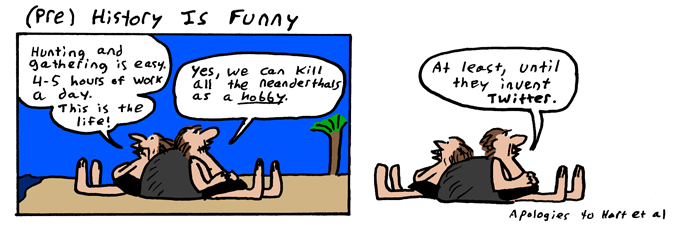
I have to admit this made me laugh.

© http://www.quickdraw.me/1169

So, it's kind of a silly comic, definitely good for a few chuckles. Yet, when you take a second to think about it, there's a lot packed into it. In two little panels, the cartoonist manages to bring up two of the biggest misconceptions about prheistoric hunter-gatherers: 1) that hunter-gatherers spend only a small amount of time a day foraging for food and have an abundance of leisure time to devote to other pursuits; and 2) that modern humans actively killed off Neanderthals.

Now while some people still believe that confrontational, violent interactions occurred at least some of the time when modern humans and Neanderthals crossed paths (e.g., Mellars 2005), faithful AVRPI readers will know by now that this view not only glosses over a ton of inconvenient evidence, but also doesn't really jive with what we know about how groups of hunter-gatherers really compete with one another (cf. O'Connell 2006).

The first component, though - the 4-5 hours of work thing - is more interesting. It taps into a now outgrown view of hunter-gatherers as having comparatively easy lives, where only a few hours a day were spent procuring food. This idea derives from the notion of the "original affluent society" first promulgated by M. Sahlins during the Man the Hunter conference (Sahlins 1968). That conference was held in Chicago in 1966 and was published as an edited volume by the same name in 1968 (Lee and de Vore 1968). Using some of the data on foraging returns that Lee had collected, Sahlins argued that foragers like the Kalahari San groups only spent a few hours a day foraging for food, spending the rest of their time gossiping or involved in assorted leisure activities.

This was pretty revolutionary for the time. Up to that point, hunter-gatherers had been seen by most anthropologists as perpetually living difficult, physically demanding lives and as always living on the brink of starvation. Sahlins' perspective, on top of having a catchy name, was the perfect foil to that traditional view, on top of providing a view of 'people closer to nature' as living what was in many ways possibly a better life than 20th post-industrial Westerners that fit in well with some of the counter-culture ideas in vogue at the time.

However, in spite of its conceptual and socio-political sexiness, the 'original affluent society' was just as unrealistic a view as that of perpetually hungry foragers. For one thing, it was based on observations made on a handful of forager societies, and even if it had been true for them, it would have been unwarranted to transpose it to all hunter-gatherers in all times and places. Second, Sahlins ignored the fact that several hours were also employed processing the food resources gathered in the 2-4 hours he saw as a typical work day for hunter-gatherers. Thorough reviews and criticisms of the OAS model include those written by Bird-David (1992:26-28) and Kelly (1995:15-19).

Anyhoo, all of this to say that, in addition to being funny on the face of it, this little comic is doubly funny to the informed reader, since it also capitalizes (maybe unwittingly) on two anthropological idea that have very much outlived their original usefulness. 

References

Bird-David, N. (1992). Beyond "The Original Affluent Society": A Culturalist Reformulation Current Anthropology, 33 (1) DOI: 10.1086/204029

Lee, R.B., and I. DeVore. 1968. Man the Hunter. Aldine, Chicago.

Kelly, R.L. 1995 The Foraging Spectrum. Smithsonian Institution Press, Washington, D.C.

Mellars, P. (2005). The impossible coincidence. A single-species model for the origins of modern human behavior in Europe Evolutionary Anthropology, 14 (1), 12-27 DOI: 10.1002/evan.20037

O'Connell, J.F. 2006. How did modern humans displace Neaderthals? Insights from hunter-gatherer ethnography and archaeology. In When Neanderthals and modern humans met, (N. Conard, ed.), pp. 43-64. Tubingen: Kerns Verlag.

Sahlins, M. 1968. Notes on the Original Affluent Societies. In Man the Hunter, (R. Lee and I. DeVore, eds.), pp. 85-89. Aldine, Chicago.

Thursday, August 26, 2010

Why flour matters

A couple of days ago, I mentioned how excavations at a Paleoindian site in Utah has revealed that the site's occupants had been milling various seeds to produce different kinds of flours. In that post, I mentioned how this discovery re-emphasized the fact that hunter-gatherers in general hunt as well as gather. In ResearchBlogging.orgfact, outside of the highest latitudes, plant foods often account for a majority of the caloric intake of ethnographically-documented forager groups, suggesting that this was also very likely the case in prehistory. This is an especially important realization for Paleoindian research, since public (and sometimes even academic) perception is that Clovis and Folsom foragers were essentially big guys with big spears killing big things, i.e., megafauna. Estbalishing that they were not only collecting plants but also processing some of them rather intensively (grinding is a very time-consuming activity, and so is the shaping of grinding implements) reinforces recent research that suggests that Paleoindian diets were as a whole much more diverse than is generally believed (Hill 2008).

Grinding plant matter into flour also has important other implications about the structure of hunter-gatherer subsistence and social life, however. To understand these, it's helpful to look at some of the earliest traces of flour production in the archaeological record, one example of which is provided by the Gravettian site of Bilancino, in Tuscany, Italy, which dates to about 25,000BP uncal. (Aranguren et al. 2007), and which I mentioned briefly earlier. Bilancino is a very interesting site: because of preservation issues, namely the acidic nature of the sediment there, no bone was preserved at all. This has forced the investigators to thoroughly investigate other kinds of archaeological remains that are not usually the focus of such intensive scrutiny in many Paleolithic studies. This includes notably charcoal, pollen and starch grain recovered from the surface of a grindstone. These efforts have paid off in spades by revealing that the occupants of Bilancino had been grinding cattail (Typha latifolia), likely its roots, as well as wild grasses to produce flour.

Aranguren et al. (2007) explicitly discuss the potential impact of flour on Paleolithic lifeways. They specificallyhighlight that it "implies the availability of an elaborate product, a flour, with high energy content, that is rich in carbohydrates, easily storable and transportable, to make a kind of bread (biscuits) or a porridge" (Aranguren 2007: 853). This means that plant material could be preserved and stored for much longer periods of time, which effectively can provide carbs during seasons such as winter during which they are normally difficult if not impossible to obtain. Also, it provides a subsistence items that serves as a buffer against the fluctuating availability of other types of subsitence resources, such as animal tissue. Lastly, because flour is easily ingested and digested, it also provides a foodstuff that both very young and very old members of a group can consume - and maybe even produce while adults are off procuring other things. This means that survival to adulthood and into old age can be facilitated, which has the potential of significantly reorganizing the way labor is divided within a society, and increasing the generational knowledge available to given forager groups.

References

Aranguren,Biancamaria, Becattini, Roberto, Mariotti Lippi, Marta, & Revedin, Anna (2007). Grinding flour in Upper Palaeolithic Europe (25000 years bp) Antiquity, 81 (314), 845-855

HILL JR, M. (2008). Variation in Paleoindian fauna use on the Great Plains and Rocky Mountains of North America Quaternary International, 191 (1), 34-52 DOI: 10.1016/j.quaint.2007.10.004

Tuesday, August 24, 2010

Anthropological items of note, Aug. 24 edition

A few items of note, not all paleo-related, that grabbed my attention over the past couple of days:

  • There's an intriguing report at Slate about the lone survivor of an 'uncontacted' (a term I abhor) native tribe in Brazil that was decimated by ranchers and loggers. The man now live in almost complete isolation in a 31-squared-mile 'safe zone' monitored by government official.The report includes an interesting allusion to ethnoarchaeological  observations on a series of huts that allowed officials to estimate the size of hiss original tribe and pinpoint the year, 1996, they were eradicated by land-settler. Chilling.
  • Gizmodo offers an interview with Timothy Taylor who discusses some aspects of his upcoming book The Artificial Ape: How Technology Changed the Course of Human Evolution. The beginning of the exchange is wrapped in one of those annoying "Darwin was wrong" tropes that is completely misleading, but the rest of the piece presents an good overview of Taylor's view that human tool-use is radically different than any behavior observed in other animals. I should have more to say about this soon.
  • BYU archaeologist Joel Janetski and his team have found evidence that prehistoric foragers ground seeds and plants into flour some 10,000 years ago at North Creek Shelter, in Utah. The milled seeds include sage, salt bush and various grasses, which were processed on grindstones. The discovery provides evidence that Paleoindian diet may have been more varied than generally acknowledged by those who focus on the 'hunter' in 'hunter-gatherer'.
  • At Neuroanthropology, Greg Downey provides a long but very interesting discussion of Pat Shipman's new paper on the human-animal connection, focusing especially on the dog-human connection in human evolution.


Thursday, January 21, 2010

Hunter-gatherer higher education

I recently discussed the call for paleoecologists and ecologists should make explicit effort to integrate their results and interpretations, and how Paleolithic archaeologists and anthropologists working with hunter-gatherers can, in a way, be considered as having made good strides in a similar direction. Since that post, I've been reflecting about my own training (received and given, since I teach a hunter-gatherer class every other year), and I realized that all the coursework I ever took on foragers was taught by archaeologists (Jim Savelle at McGill, Curtis Marean at ASU), which made me wonder if we can really speak of such good integration between the subfields of anthropology when it comes to foragers.

With that in mind, I figured I'd do a little informal polling of my readership to see whether my experience is normal or an aberration (in the nicest sense of the word, of course!). So, if you're an anthropologist, what kind of anthropologist did you get your hunter-gatherer education from? Feel free to add any comment if the options below are too constraining.

Friday, January 15, 2010

Bob Kelly archaeology lectures at CU Boulder


Robert L. Kelly, a professor of archaeology in the department of anthropology at the University of Wyoming and a leading figure in research on prehistoric hunter-gatherers and the Paleoindian is giving the Distinguished Archaeology Lecture in the CU Boulder department of anthropology at the end of this month. He's also well known for his book "The Foraging Spectrum: Diversity in Hunter-Gatherer Lifeways" which is something of a must for anyone interested in hunter-gatherer adaptations, both in archaeology and as documented ethnographically. He'll be giving two lectures, both of which should be of interest to anyone interested in prehistoric foragers, the settlement of the New World and how archaeology can help understand some dimensions of human nature. Click on the flyer above for details about the lectures and info on how to get to them.

Monday, January 11, 2010

Custodians of deep time?

Over break, I was finally able to catch up on some of the reading that had piled up on my desk. An interesting short paper was an opinion piece by Douglas Erwin (2009) entitled "A call to the custodians of deep time". In a nutshell, he makes the case for paleontologists to move away from describing and cataloging extinct species and to begin thinking about how to understand how the diversity in fossils can be integrated into broader discussions about animal biodiversity against the background of geological time. Erwin (2009:282) argues that "paleontologists are the custodians of the only record of ecosystem undamaged by human activities," hence the critical importance of understanding what fossils say about biodiversity prior to the ravages wrought by humanity.

While I agree that it's important to make every effort to relate the results of 'paleo' disciplines to ones grounded in observations of extant biological and ecological communities, I was a bit puzzled by his selection of 10,000BP as the date from which humans have been 'destroying' the Earth. It is clear that the ecological legacies of human actions have much greater time depth, as indicated in this post of a few years ago, where Neanderthals appear to have overhunted certain large mammals near Kebara Cave, Israel. In fact, much recent research on the millennia preceding the development of agriculture (e.g., Stiner and Kuhn 2006) has shown that growing human population densities appears to have been a significant stressor on all sorts of animal communities, from aurochs to limpets. This has led some researchers to dub humans as "the ultimate ecological engineers" (Smith 2007), and to highlight that human impacts on their environment stretch back considerably further than 10,000BP. Granted, human impacts on their environments are certainly more conspicuous after the adoption of agriculture, in part due to the concomitant adoption of a sedentary lifeway and to the clearing of land required by this new subsistence strategy. But that doesn't mean our ancestors weren't affecting the make-up of plant and animal communities earlier. Indeed, a good case can also be made that they were also impacting their landscapes in significant ways: ever thought about how many thousands of tons of stone have been flaked since the first stone tools were made over 2.5 million years ago? I was speaking to a colleague not too long ago who told me that the residues of one of his lithic experiments weighed over 100kg. How much stone might have people knapped in the past, when their life could, quite literally, depend on it?

In any case, the point here is that zeroing in on humans as a destructive force raises more problems than it solves, in my opinion... really, how far back should we push this? To the first modern humans? To the first Neanderthals? The first erectines? Australopithecines? What?

Fundamentally, though, Erwin's basic point is a good one: It is imperative to be able to cast the conclusions of scientific research based on extant and historical observations to prehistoric ('paleo') ones. This is to be able to relate the world we know and experience to the rest of the history of life, which is essential for an coherent evolutionary perspective to develop and to integrate evolutionary change at different timescales. This point is also the gist of a short follow-up opinion piece about Erwin's paper by Louys et al. (2009) who argue that

"The worlds of palaeoecologists and ecologists are very much apart, and dialogue between the two remains muted...

The way modern and fossil ecosystems are described will necessarily be different, but researchers should strive to see whether the rules described for modern ecosystems hold over geological time. After all, the fossil record provides the only way to study changes in ecosystems over more than centennial timescales, along with samples of non-analogous ('extinct') ecosystems and habitats." (Louys et al. 2009:847).


In a way, I feel that paleoanthropologists really are at the forefront of such efforts. Sure, there is still much effort being devoted to whether or not a given fossil represents a distinct species from broadly coeval ones or to whether or not higher bladelet proportions in an archaeological assemblage indicates a distinct technocomplex. After all, we need to have some playing pieces to explore the what Erwin (2009) likens to a 'chessboard' of ecological niches documented across the world. But increasingly, paleoanthropologists are explicitly trying to account for variability (both biological and behavioral) and placing it in ecological context. Furthermore, making inferences about past hunter-gatherer behavioral systems by drawing on both ethological and ethnographic observations made on extant communities can be highly informative, if undertaken with due caution (Wobst 1978). In fact, this is the topic of a recent volume (Papagianni et al. 2008), which I recently reviewed in PaleoAnthropology (freely accessible at the link) and which tackles the issue of integrating observations about extant and extinct forager groups at various scales. Obviously, the time scales involved may be somewhat disparate, and I don't know for certain whether the situation is truly as dismal as suggested by Erwin (2009) and Louys et al. (2009). But, on that level at least, paleoanthropology can be considered a good disciplinary example in terms of strategies for ecologists and paleoecologists and biologists and paleontologists to implement to profitably integrate their observations.

References

Erwin, D. 2009. A call to the custodians of deep time. Nature 462:282-283.

Louys, J., L.C. Bishop, and D.M. Wilkinson. 2009. Opening dialogue between the recent and long ago. Nature 462:847.

Papagianni, D., R. Layton, and H. Maschner (eds.). 2008. Time and Change. Archaeological and Anthropological Perspectives on the Long-Term in Hunter-Gatherer Studies. Oxbow Books, Oxford.

Smith, B.D. 2007. The ultimate ecosystem engineers. Science 315:1797 - 1798.

Stiner, M.C., and S.L. Kuhn. 2006. Changes in the 'connectedness' and resilience of Paleolithic societies in Mediterranean ecosystems. Human Ecology 34:693-712.

Wobst, H.M. 1978. The archaeo-ethnology of hunter-gatherers or the tyranny of the ethnographic record in archaeology. American Antiquity 43:303-309.

Monday, February 02, 2009

Quote of the day

A noteworthy passage from R.L. Kelly's The Foraging Spectrum: Diversity in Hunter-gatherer Lifeways (1995, pp. 261-262):

Though stereotyped images of hunter-gatherer social organization, especially relations between men and women (equality or inequality), are sometimes take to be ancient behavior rooted in Pleistocene adaptations, we repeat that this is not necessarily true. Modern hunter-gatherers do not live out the presumed legacy of their (and our) Plio-Pleistocene ancestors any more than we do. Instead, diversity or similarities in behavior are the result of diversity or similarities in selective pressures and enculturative environments.

Friday, October 03, 2008

Modern is as modern does?

ResearchBlogging.orgSince I last posted, there's been a lot of 'chatter' on the interwebs about the 'modernity' displayed by Neanderthals in their subsistence patterns, because they appeared to have hunted very similar ungulates than Aurignacian foragers and, especially because they have been shown to procure and consume sea mammals exactly as early modern humans at Gibraltar. All sorts of people have talked about the latter (here, and here), but there's one aspect of this discovery that's been puzzling me ever since I read the actual report (Stringer et al. 2008), and it's got me adjusting my spectacle and saying "Not so fast..."

That aspect is, quite simply, the frequency of sea mammal remains present in those assemblages. Now, the authors and commentators have been right in emphasizing that both Middle and Upper Paleolithic hominins display the same behavior and that is a big deal: it is one more solid uppercut to the jaw of the argument that Neanderthals and modern humans were somehow fundamentally different from a behavioral standpoint. That this is true for subsistence patterns is especially important since, as a colleague of mine likes to emphasize, it's how much calories you can extract from an environment that allows you to have more babies and keep them alive (i.e., be reproductively successful)! So, showing that people in the late Middle and early Upper Paleolithic procured resources similarly is an important observation indeed. This is the basis on which people can somewhat legitimately claim that Neanderthals could act in 'modern' ways.

In contrast, my view is that the sea mammals from Gorham's and Vanguard Caves do not support the idea that Neanderthals acted in a recognizably modern way. But here's the catch: neither did the early Upper Paleolithic, presumably modern human, foragers! In other words, yes, Neanderthals and early modern humans acted in comparable manners, but no, that behavior is not what we can really consider modern, based on what we know from historic and prehistoric hunter-gatherers.

What leads me to this conclusion is the proportion of sea mammals to other animals at those sites. I consider the mollusks uncontroversial, since there's plenty of evidence they were exploited by coastal Neanderthal and early modern humans as far back at OIS 6. So, focusing on sea mammals and fish, what do we get?

We get a really weird pattern! Let's start with the material from Vanguard Cave (Stringer et al. 2008: Table 1). We have a NISP (number of identifiable specimens - I could use MNE's instead, but the results are only marginally different, and laden with their own peculiar problems) of 9, with NISP's of 172 for terrestrial herbivores and 20 for carnivores. This means that herbivore remains are almost 20 times more abundant than those of sea animals. Perhaps even more interestingly, carnivore remains are twice as abundant as those of sea animals. The authors talk about the low rate of carnivore gnaw marks on the sea and land mammals at the site (in addition to the absence of traces of human processing on the carnivore remains), implying that carnivores and humans probably occupied the cave at different times. That being the case, it means that carnivores that were not accumulated by humans are twice as frequent as the sea mammal remains.

Before discussing what I think this means, let's turn to Gorham's Cave, where modern human behavior is presumably also documented, in Level III (Stringer et al. 2008: Table 4). In this case, for Neanderthals (Level IV), if you lump together seal and fish (NISP = 3), it means that herbivores (NISP = 49) are 16 times more frequent than sea animals. As for carnivores (NISP = 36, again assumed to be non-accumulated by humans), they are 12 times more frequent than sea critters. In Level III, the sea animal NISP is 5, while that of herbivores is 186 (37 times more frequent than sea animals!) and that of carnivores is 30 (or six times the amount of sea critters). There are also some interesting patterns of small game use at Gorham's, which I'll return to in a bit.

But first why is this pattern of relative representation of sea animals important? Because this is not how ethnographically documented foragers that depend on sea animals. In fact, foragers that have access to sea mammal tend to focus on them a lot! The data I summarized above suggest that the sea mammal:herbivore ratio of the Gibraltar assemblages is as follows:

Vanguard: 172:9 = 19.1
Ghoram's IV (Neanderthal): 49:3 = 16.3
Gorham's III (H. sapiens): 186:5 = 37.2

In contrast, for ethnographically-documented forager groups that depend to sea animals and land mammals, the same ratio ranges from 0.16 (meaning sea animals are six times more frequent than land mammals in the group's diet) to 12 (where land mammals are 12 times more frequent than sea resources) (this is based on data summarized in Kelly 1995: Table 3-1). That latter figure is probably an overestimate, however, since the one group that is associated with the ratio value of 12- the Aeta - procures extra amounts of meat to trade for carbohydrates with neighboring agriculturalists, a situtation that is clearly inappropriate for the comparison being undertaken here. Shifting to the next group down the list of most 'meat vs. fish', we get the Nunamiut, with a ratio of 8.7. This allows us to complete the table above thusly:


Assemblage Ratio
Vanguard 19.1
Ghoram's IV (Neanderthal) 16.3
Gorham's III (H. sapiens) 37.2
Most sea mammal focused hunters 0.16
Least sea mammal focused hunters 8.7/12


Whether we go with the Aeta or the Nunamiut, the picture is the same: the ratio of land to sea resources of hunter-gatherers is much lower than that documented in any of the three assemblages presented by Stringer and colleagues (2008). Notably, the ratio for those foragers that heavily depend on sea resources is smaller by orders of magnitudes than that found in any of the Gibraltar assemblages. Perhaps most importantly, the Gibraltar ratios are much, much higher than those of those hunters that target the least amount of sea mammals in their diets.

Plainly put, this means that when foragers exploit sea animals, they exploit a hell of a lot more of them than is documented in Vanguard and Gorham's Caves. One may quibble about the fact that I overlooked the Vanguard mollusks in this analysis, but since these are absent from the Gorham's Cave faunal assemblages discussed here, for the purposes of comparing early H. sapiens and Neanderthal behavior, the case stands nevertheless. In short, what we're seeing at Gibraltar bears departs significantly from the subsistence strategies of known forager groups.

Now, obviously, we have to be careful not to impose on the past observations from the present, the old "tyranny of the ethnographic record" (Wobst 1978). However, there is a reason why people focus on sea animals when they have access to them: they are often full of sweet, delicious fat. So, when they know when, where and how to procure sea animals (even if it's only on a yearly basis, when they are most likely to be found beached), hunter-gatherers will preferentially target them, and accumulate them in large numbers. Most critically, the Gibraltar pattern departs significantly from that of those foragers that depend the least on sea critters, which should give one some serious pause.

Stringer et al. (2008: 14323) argue that the presence of sea mammal remains in all the levels of Vanguard Cave and in the Neanderthal and H. sapiens deposits of Gorham's Cave reflects

"that Neanderthals were not only systematically exploiting terrestrial mammals but also marine mollusks, pinnipeds, and cetaceans. Their distribution through the stratigraphy suggests that securing marine mammals was not an accidental or isolated practice, but a focused behavior possibly repeated seasonally or over longer periods... Significantly, the range of species exploited and the age distribution pattern of the prey strongly indicate that the coastal exploitation of resources by Neanderthals was not a sporadic and isolated occurrence but one that required a knowledge of the life history of prey and its seasonality."


Color me skeptical here, and this in spite of my opinion that the behavioral capacities are still systematically underappreciated in contemporary paleoanthropology. But overall, we're talking about numbers of sea animal remains that are absolutely dwarfed by the preponderance of land mammals and that in all cases are significantly rarer than even those of carnivores that occupied the site when humans were absent. Call it what you will, but this is not a behavior that is modern in any real way.

The take-home message here is that, just because some behavior is associated with morphologically 'modern' humans, it does not mean that it is actually modern. In the end, who knows, maybe Neanderthals and early European H. sapiens did exploit sea mammals seasonally - but empirically, the evidence presented by Stringer et al.(2008) rather points to unsystematic, opportunistic acquisition of parts of beached carcasses. But the fact that the Gibraltar data are so odd in light of everything we know about the subsistence patterns of sea-oriented foragers underlines the importance of always defining what is meant by 'modern behavior' and of situating behavioral reconstructions of Neanderthals and early H. sapiens in the broader context of the hunter-gatherer behavioral record. Doing so usually yields some very interesting results indeed!

References

Kelley, R. L. 1995. The Foraging Spectrum. Smithsonian Institution Press, Washington.

Stringer, C. B., J. C. Finlayson, R. N. E. Barton, Y. Fernandez-Jalvo, I. Caceres, R. C. Sabin, E. J. Rhodes, A. P. Currant, J. Rodriguez-Vidal, F. Giles-Pacheco, J. A. Riquelme-Cantal (2008). From the Cover: Neanderthal exploitation of marine mammals in Gibraltar Proceedings of the National Academy of Sciences, 105 (38), 14319-14324 DOI: 10.1073/pnas.0805474105

Wobst, H. M. 1978. The Archaeo-Ethnology of Hunter-Gatherers or the Tyranny of the ethnographic record in Archaeology. American Antiquity 43:303-309.
Monday, February 04, 2008

Quote of the day

"Moreover, because the academic payoff to finding exceptions to any rule is quite high, we can be confident that cases to the contrary have been reported." (S. Kuhn and M. Stiner. 2006. What's a Mother to Do? Current Anthropology 47: 955).

Tuesday, January 15, 2008

Recent research pertaining to the 'Kalahari Debate'

We were talking about the 'Kalahari Debate' and its unfolding over the past 20-25 years, yesterday in my hunter-gatherer seminar. Basically, it boils down to whether one considers some Kalahari Bushmen (I'm aware of the debate over the name here, just using this one for convenience) to be 'true' hunter-gatherers or to have been forced into a hunting-gathering subsistence by the geopolitics of the region as they unfolded over the past centuries.

There's an interesting paper by Alan Barnard (available as a freely downloadable pdf on the Social Anthropology journal web site) that summarizes the debate up to now, and inserts it in the broader debate over the notion of 'indigenous peoples,' as recently rekindled by Kuper (2003). The paper's pretty comprehensive in its historical coverage and does a nice job of situating the various debates in their intellectual contexts. Here's the abstract:
The debate on the notion of ‘indigenous peoples’ is one of the newest facing anthropology. Yet its theoretical foundation is not new. It is implicit in both Kalahari revisionism and its opposite, the ecological approach that treats hunter-gatherers as exemplars of primal culture. It is also reminiscent of the earlier views of Wilhelm Schmidt, whose vision of the earliest culture circle was represented by living hunter-gatherers. That said, the notion of ‘indigenous peoples’ is more complex than earlier models; and its opponents, such as Adam Kuper, must struggle against both philosophical premises (which are relatively easy to challenge) and practical arguments in favour of keeping the notion (which are more resilient). This paper focuses on the ‘indigenous peoples’ debate in Africanist anthropology, but its wider aspects include the interconnections of theoretical premises within diverse schools in the discipline and the general relation between anthropological theory and practical politics. (Barnard 2006)
Focusing more narrowly on recent research dealing specifically with the 'Kalahari Debate', there's also a paper by Victor Grauer in the latest issue of the online journal Before Farming. Therein, he argues that genetics and musicology, two lines of evidence that haven't been used much if at all so far in this debate, independently seem to favor the 'traditionalist' perspective. Here's the abstract of that paper:
While the ‘Great Kalahari Debate’ hinged almost exclusively on the interpretation of sparse and confusing archaeological and historical data, abundant and convincing genetic evidence from the realm of biological anthropology has been largely ignored, while equally compelling cultural evidence drawn from the musical traditions of the populations in question has been overlooked entirely. In this paper, I attempt to demonstrate how genetic and musicological research can be combined to provide a compelling case for the ‘traditionalist’ position in this ongoing controversy. To this end, I draw upon an important but little known musical ‘genome’, the Cantometric database, compiled under the direction of the late Alan Lomax, at the Columbia University Bureau of Applied Social Research. (Grauer 2007)
I'm all for multiple lines of evidence informing anthropological research, so this paper certainly seems to be an innovative contribution to this ongoing, long-standing debate.

References:

Barnard, A. 2006. Kalahari revisionism, Vienna , and the “indigenous peoples” debate'. Social Anthropology / Anthropologie sociale 14: 1-16.

Grauer, V. A. 2007. New perspectives on the Kalahari debate: a tale of two 'genomes.' Before Farming 2007/2-4.

Kruper, A. The return of the native. Current Anthropology 44: 389–402.

Wednesday, January 09, 2008

Kids did the darndest things

Over at Afarensis, we find a brief discussion of a recent paper about the contribution of children to the Lower and Middle Paleolithic archaeological record (i.e., Stapert 2007 – available as a free pdf). Afarensis seems to agree with Stapert that there has been a generalized tendency to not think of children as important accumulators of artifacts – in this case stone implements – in periods prior to the Upper Paleolithic, which is a euphemism for “prior to the dominance of Homo sapiens in the fossil record.” Stapert’s paper is really quite thought-provoking and casts a new and in my view fairly convincing interpretive light on a wide range of published anecdotal remarks about ‘failed flints’ in Lower and Middle Paleolithic (as well as two Châtelperronian) assemblages.

I think that people are starting to come to grips with the idea of pre-Late Pleistocene kids contributing to the archaeological record (e.g., Shea 2006), even if this growing awareness has yet to translate into a systematic incorporation of children’s activities and learning in paleoanthropological interpretation. In spite of this, it’s worth wondering why archaeologists who have studied hominins that were the quintessential hunter-gatherers have taken so long to come to grips with the idea that their social structure and technological transmission mechanisms might parallel those of ethnographically-documented foragers. To take an example based on a prior post, if Neanderthals had life-histories comparable to those of modern humans, there is every reason to believe that the acquisition of essential skills for Upper and Middle Paleolithic foragers would have stretched over a significant period of time. The starting assumption should therefore be that children were important accumulators of likely often ‘odd looking’ archaeological remains.

Stapert highlights that researchers seem to have little problem invoking the activities of children to account for roughshod lithics in Upper Paleolithic assemblages but do not appear inclined to do so for Lower and Middle Paleolithic assemblages. As argued by Shea (2006:214):
“One possible reason for this is that for relatively simple knapping techniques there may be few differences between the byproducts of experienced adults and those of novice knappers. This argument is plausible for pebble-core components of Paleolithic industries, but seems less plausible for the prepared- core components (Acheulean bifaces, Levallois cores, prismatic blade cores, and foliate bifaces) that populate Paleolithic industries from 1.7 Myr onward.”
This being the case, Staper asks bluntly but rightly “is it harder to imagine children and their activities when one is dealing with species other than modern humans?” (2007:35).

I would argue that this is almost certainly one of the principal reasons since, to follow up on my earlier example, by not considering the role of Neanderthal children in interpretations of the Middle Paleolithic record, it becomes easier to cast those hominins as different. To a degree, this perspective is reflected by the following kind of circular reasoning: “Well, Neanderthal children surely didn’t play a significant role in the accumulation of that sub/species’ archaeological record. Therefore what we document archaeologically reflects adult, fully competent Neanderthal behavior. But that behavior departs in significant ways from how we expect fully competent, adult Homo sapiens knappers to structure their lithic production and lithotype management. Ergo, we have yet more evidence that Neanderthals were behaviorally distinct from Homo sapiens.”

And here, I think we get to at least some of the heart of the matter – paleoanthropologists as a whole have invested a great deal of time and energy in trying to show how pre-Homo sapiens hominins were distinct from Upper Paleolithic humans rather than attempting to understand them primarily as foraging hominins who were very successful at eking out a living in the Pleistocene Old World. While there are obviously good reasons to do so in certain regards, approaching Neanderthals and earlier hominins first and foremost as foragers independent of preconceptions of how different they must have been is often a very rewarding way of doing archaeology that opens up fruitful interpretive avenues. Of course, one must be careful to not swing the pendulum too far in that direction and become oblivious to the differences that do exist. However, at this stage of the game, I think that the advantages of a self-aware approach to Neanderthals that views them first and foremost as hunter-gatherers outweigh its disadvantages as far as reaching a thorough understanding of the lifeways of non-sapiens hominins – both adult and juvenile – is concerned.

References:

Shea, J. J. 2006. Child’s play: Reflections on the invisibility of children in the Paleolithic record. Evolutionary Anthropology 15: 212-216.

Stapert, D. 2007. Neanderthal children and their flints. Palarch’s Journal of Archaeology of Northwestern Europe 1(2): 16-39.

Tuesday, January 08, 2008

Hunter-Gatherer Archaeology Back-Links, Set 3

How modern are the hobbit's tools?: A discussion of how refined the technology reportedly associated with H. floresiensis truly is.

Shell-working and behavioral modernity: A critical assessment on whether working different raw materials in different ways necessarily implies 'behavioral modernity'.

Clean-toothed Neanderthals
: on some of the implications of new evidence for dental hygiene in the Middle Paleolithic of Europe and the linguistic capacities of Neanderthals.

Thursday, January 03, 2008

2008

Well, I've dug myself from under 20+ cms of snow and managed to get to a working internet connection (booooooooh Cooptel!) and here's to starting off this new year on the good foot!

During the next few months, the contents of this blog will shift ever so slightly to include a broader range of hunter-gatherer archaeology than usual , since it'll be used (I hope) as a resource for the student in my ANTH 419B class, aptly named "Archaeology of Hunter-Gatherers". I'll gradually link back to prior posts dealing with H/G archaeology, and list new and relatively recent sources dealing with that topic. So, if you're a student, welcome and feel free to roam around the archives; if you're a regular reader, welcome back; and if you're just stumbling here by chance, look around and see if you like anything. However you got here, feel free to comment on the posts or contact me with questions. I'll be more diligent about getting to the comments this year (here's a resolution worth keeping).

Happy New Year to all!

Thursday, November 15, 2007

Fighting the tyranny of the ethnographic record!

Blogging on Peer-Reviewed Research
In a short paper, R. Lee Lyman (U Missouri) shows how archaeological data can help flesh out ethnographic observations. I make a big deal about this because archaeologists dealing with prehistoric hunter-gatherers have often been accused of being interpretively 'railroaded' (not to say tyrannized) by the ethnographic record of extant hunter-gatherers (Wobst 1978).

What Lyman does in this paper is actually pretty straightforward, methodologically speaking. Briefly, having shown that the size of lower first molars can be used to distinguish males from female mink, he looks at the sex ratio seen in Mustela vison remains from the Cathlapote and Meier sites, both of which are late-prehistoric(ca. 1400-1800 AD) sites located in the Wapato Valley (in Oregon and Washington). Citing Buskirk and Lindstedt (1989), Lyman argues that "linear trap sets produce a more even sex ratio[i.e., between 1:1 and 2:1, for males], whereas traps placed in a grid catch more large-bodied individuals, typically males" (2007:92). This pattern is the result of sex-specific behavioral patterns. In his archaeological sample, the male:female ratio is at least 3.67:1 and at most 8.33:1, depending on how stringent one is with their sex-id stats. This suggests, then, that late-prehistoric foragers probably disposed traps in a grid rather than linear pattern.

This is where it gets especially neat. Since Franz Boas long ago wondered "How far can archaeological methods supplement ethnological information?" (1902:4), Lyman concludes:
Locations of traps used to take small mammals have, so far as I am aware, not been reported in the ethnographic literature for the Pacific Northwest. The archaeological data for mink recovered from sites in the Wapato Valley suggest that indeed archaeological data may supplement ethnographic data, because mink demography suggests traps were distributed in a grid-like pattern. (Lyman 2007:94)

In other words, rather than place them, say, only along waterways, late-prehistoric hunters of the Wapato Valley most likely set their traps all over the region's marshy lowlands. Given that the sites in question can be linked to the "Northwest Coast Culture Area" and given that ethnographic information available for groups derived from this culture area indicates that they trapped small mammals without specifying how that was done, this study provides a good instance of archaeological data (albeit informed by mammalogy) informing ethnographic observation. This is elegant corroboration of what Guenther (2007:374) terms "an ongoing, mutually strengthening partnership between the two disciplines [archaeology and ethnology], in their study of foraging societies."

References:

Buskirk, S. W., and S. L. Lindstedt. 1989. Sex ratio biases in trapped samples of mustelids. Journal of Mammalogy 70:88-97.

Guenther, M. 2007. Current issues and future directions in hunter-gatherer studies. Anthropos 102:371-388.

Lyman, R. L. 2007. Prehistoric mink (Mustela vison) trapping on the Northwest Coast. Journal of Field Archaeology 32:91-95.

Wobst, H. M. 1978. The archaeo-ethnology of hunter-gatherers or the tyranny of the ethnographic record in archaeology. American Antiquity 43:303-309.