One of my upcoming papers (Riel-Salvatore 2010) was written-up in a series of mainstream news outlets, including the
New York Times, the
BBC,
Discovery News,
AOLNews,
MSNBC and sundry others. The original, reproduced in
Science Daily, was published under the headline "Neanderthals More Advanced Than Previously Thought: They Innovated, Adapted Like Modern Humans, Research Shows." In the original
UC Denver press release, 
I'm quoted as saying, among other things, that this study helps 'rehabilitate' Neanderthals by showing that they were able to develop some of the accoutrements of behavioral modernity independent of any contact with modern humans. While I've caught a bit of flak from some friends and colleagues for that turn of phrase, I stand by my statement -this study helps to cast Neanderthals in a much more positive light than they have been for a long while now.
In any case, it's always exciting to see your work written-up, but also a bit daunting. In a few days, I'm going to try to put together a post on the whole 'going to the press' experience, but I figured I'd seize the opportunity to provide a bit more detail on the paper currently making the rounds in various news outlets, to clear up confusion and preemptively answer some of the questions it might raise. Here goes...
So, what is it I did? The short answer: I showed that, among, other things, around 42,000 calendar years ago (ca. 36.5 radiocarbon years BP), a new culture (better, behavioral adaptation) - the Uluzzian - emerged in southern Italy and is widely believed to have been made by Neanderthals. The thing is, the Uluzzian is associated with bone tools, stone armatures likely used as part of composite projectile weapons, shell ornaments, coloring material (ochre, limonite), and possible evidence of small game exploitation. These features are all generally associated with modern human groups, not so much with Neanderthals. Because the timing of the origins of the Uluzzian matches that of the appearance of the Aurignacian generally attributed to modern humans, many people (e.g., Mellars 2005) have argued that the Uluzzian was the result of Neanderthals being acculturated by modern humans, and creating hybrid cultures that ultimately proved to be too little, too late for the Neanderthals.
Here's the rub, though: for acculturation to be a likely explanation, two conditions need to be met, proximity in time (i.e., they need to overlap in time) and proximity in space (they need to be found next to one another). As I show in the paper, for the Uluzzian, while proximity in time to the Aurignacian is established, proximity in space isn't. That's because when the earliest Aurignacian appears in northern Italy and the Uluzzian appears in southern Italy ca. 42,000 years ago, the center of the Italian peninsula is occupied by Neanderthals making the Mousterian tools they'd been making for over 100,000 years. So, in essence, you have a 'Mousterian buffer' (and a long-lasting one at that) between the regions where the Aurignacian and Uluzzian develop. If the acculturation scenario was right in this case, you would expect the Uluzzian to first spring up immediately next to where you find the Aurignacian. Since the condition of proximity in space is not satisfied, it is very unlikely that acculturation is the explanation for the origins of the Uluzzian.
Given that the Uluzzian is assumed to have been made by Neanderthals, this implies that Neanderthals developed it on their own, independent of modern human influence. If that's the case, though, a natural follow-up question is why the Uluzzian should emerge at the same time as you first see the Aurignacian implant itself in northern Italy. To answer this, in my view, you have to consider the ecology of that time period. To keep it short, it's one of the most climatically turbulent periods of the Late Pleistocene, which was climatically turbulent to begin with. In southern Italy, this translated into cooler, more arid conditions that stand in contrast to the Mediterranean scrub-woodland that characterized the region earlier. Given the suddenness with which conditions shifted between one and the other (there was a lot of fluctuation), people would have had to develop behavioral strategies that allowed them to cope with uncertainty so as to minimize the risk of not being able to find the resources they needed to survive. The Uluzzian seems to fit that description, what with stoneworking strategies that minimize production waste; new tools that would have allowed people to better hunt at a distance; mobility patterns that reflect a conscious effort to provision hospitable spots with resources they may have lacked; the exploitation of a wider range of animals; and the development of artifacts to ease social friction when other groups were encountered.
It's hard to establish with certainty a link between paleoenvironments and behavioral innovation. In fact, naysayers would probably point out that Neanderthals were perfectly able to survive shift of the magnitude of those documented ca. 42kya. That's true but it ignores the fact that what Neanderthals hadn't been faced with previously, however, is the close spacing at which these fluctuations started happening ca. 42kya (Finlayson and Carrion 2007) -
that was something new, and something that would stress any population, setting the stage for a moment where technological innovation could have been selected for. Now, this is an interpretation based on correlation as opposed to causation; however, any explanation for the origins of the Uluzzian (and the Aurignacian in northern Italy for that matter) that doesn't at least take them into consideration is likely oversimplistic.
Overall then, what I'm proposing in this paper is that climatic instability selected for behavioral innovation, one manifestation of which was the Uluzzian in southern Italy. If Neanderthals are responsible for the Uluzzian, that means they reacted in very 'modern' ways to these conditions by developing some of the very same innovations that seem to have made modern humans so evolutionary successful in the long term.
On to the preemptive questions and answers to them...
OK, but the paper's 33 pages long, is that all you're saying?
The short answer to that is no. The paper is an effort to use
niche construction theory (Odling-Smee et al. 2003) as a conceptual framework in paleoanthropology to yield new insights on how to best integrate behavioral, ecological and biological evidence. It's by using that approach, however, that I'm able to propose an alternative explanation for the emergence of the Uluzzian that accounts for its timing, the lack of spatial proximity to the Aurignacian, and the paleoecological evidence. Because it explains more of the evidence, I argue that it's a much more parsimonious explanation than any of the ones that have been proposed in the past, which mostly focus on social factors.
The main advantage of using NCT as a conceptual framework here is that it encourages people to move beyond the identification of single prime movers to explain the Middle-Upper Paleolithic transition and the eventual disappearance of Neanderthals from the fossil record. Specifically, I argue that it's only by documenting the changing relationship between behavioral, ecological and biological dimensions of the record that we're likely to get at how this process really unfolded. In this case, I suggest that we can identify three phases of the transition interval, each of which is characterized by distinct dynamics between these three systems of inheritance, that are in part influenced by the interactions between them in earlier phases.
I get it... so is this the same mechanism that accounts for the origins of the Chatelperronian of the Franco-Cantabrian region?
Not exactly. The situation of the Chatelperronian, another 'transitional' industry attributed to Neanderthals and for many decades argued to be the result of their acculturation by modern humans, is slightly different. In that case, the condition of proximity in space is met. In other words, you find Chatelperronian sites in and next to regions where Aurignacian assemblages are found. What people like d'Errico and Zilhao have shown, however, is that the condition of proximity in time is
not met, since the earliest Chatelperronian appears to predate the appearance of the Aurignacian in those regions by several thousand years (d'Errico et al. 1998, Zilhao 2006).
Therefore, while an origin independent of modern human influence can be postulated for both the Uluzzian and the Chatelperronian, the evidence for why this is the case is different in the two cases. For the Uluzzian, the reason is that, geographically, its only neighbors appear to have been Neanderthals. It is perhaps not surprising that a consideration of ecological conditions has come to the forefront in models for the development of these 'transitional' industries, which are called transitional, because they fall within the interval of the Middle-Upper Paleolithic transition, starting some 45,000 years ago.
But wait! Aren't there reports of Uluzzian occupations in northern Italy? How does this affect your conclusions?
Peresani and colleagues have recently been making a case for an Uluzzian presence in level A3 and A4-I at Grotta di Fumane, in the Veneto region of NE Italy (Peresani 2008; Higham et al. 2009). I talk about Fumane briefly in the paper, but let me discuss it in a bit more depth here. These are intriguing data. I've seen the material described as Uluzzian presented at a conference but I'm still uncertain about how closely it compares to what is found in southern Italy, since I haven't had a chance to see a detailed typological and technological publication of these objects and since I don't feel right using figures/numbers based on ongoing analyses that I've only seen fleetingly during a talk. Chronologically, they'd fit right in, no question. But there are a number of possibly contemporaneous assemblages in northern Italy associated with some evidence bipolar technology and with backed knives that somewhat resemble Uluzzian crescents (e.g., La Fabbrica, Paina) but that otherwise more closely align themselves with Late Mousterian assemblages, notably La Fabbrica (Bietti and Negrino 2007). So for the time being, it's not really possible to exclude that the Fumane assemblages claimed to be Uluzzian belong to this distinctive Mousterian tradition.
That said, let's consider for a moment what it might mean if Fumane A3 and A 4-I were to be shown to be Uluzzian. For one thing, it doesn't invalid the gist of what I have argued, namely that the Uluzzian could very well be an independent development. That's because in this case, while the condition of spatial proximity would be met (i.e., there are Aurignacian assemblages in the vicinity), the condition for proximity in time wouldn't since the earliest Uluzzian (dated to about 43,000BP) predates any Aurignacian assemblage in the region by as much as 2,000 years (Higham et al. 2009). Furthermore, the Uluzzian in southern Italy lasts until almost 35,000 calibrated years BP, while it would seem to not last beyond 40,000 BP at Fumane. This raises the question of the relationship of the Uluzzian in the two regions, and why it isn't found at all in Central Italy. Could the Uluzzian have originated in northern Italy? If so, how did it reach southern Italy? One obvious explanation would be to argue that people with Uluzzian technology sprinted down the Northern Adriatic Plain exposed during OIS3. However, since that area is now under water, we're unlikely to ever be able to demonstrate this one way or the other. Additionally, it still doesn't explain why Central Italy wouldn't have been explored by these people. The argument that they stuck to the coast is pretty weak in light of the fact that in southern Italy, Uluzzian assemblages are found along the
Western coast of the Salento peninsula in the Bay of Uluzzo, and in southwestern Italy, in the foothills of the Alburni Moutains.
One possible explanation is that the Uluzzian originated somewhere else and diffused both in northern and southern Italy from that original homeland. The assemblage from Level 5 at Klisoura Cave, Greece has been proposed as one such potential source of origin. There are two problems with this, however: First, technologically, Klisoura 5 is very different from the Uluzzian in southern Italy. Notably, it displays much less bipolar technology, an almost complete reliance on blade technology, many more microliths, and a different way of making microliths. Second, in light of new dates from Fumane, the timing might be a problem since the assemblages would be almost contemporaneous. Third, there is nothing even remotely resembling an Uluzzian assemblage between the Peloponnese and the Italian peninsula. On the basis of current evidence, then, there is little solid data on which to base a solid link between Level 5 at Klisoura and the Uluzzian as a whole (Papagianni 2009). If that's the case, there are currently no assemblages on which to base the notion of an extra-Italian origin of the Uluzzian.
I'll buy that. But if Neanderthals were so smart and able to innovate in the face of change, what happened to them and their Uluzzian culture?
That's a good question, and before I answer it, let me highlight a few things. First, the Uluzzian is by no means a flash in the pan... currently available dates indicate that it lasted some 7,000 years. If a generation lasts 20 years, that's 350 generation of 'Uluzzians' - that's a hell of a long time, if you think about it, almost as long as the entire Gravettian. That means that, just because it disappears doesn't mean that the Uluzzian wasn't a successful adaptation. So there's that. Second, what I propose in the paper is that the Uluzzian is ultimately supplanted by a series of assemblages that have traditionally been called 'proto-Aurignacian' (a label for the earliest Aurignacian along the Mediterranean coast), but that really bear little in common with 'proto-Aurignacian' assemblages from northern Italy. For one thing, the proto-Aurignacian is characterized by very high frequencies of retouched bladelets in their tool inventories. In fact, as I detail in the paper, formal tools in most proto-Aurignacian assemblages in northern Italy on average comprise about two-thirds retouched bladelets. "Proto-Aurignacian" assemblages in southern Italy, in contrast, comprise on average only about 25% of retouched bladelets. In fact the bladelet frequency of the most bladelet-rich southern assemblages doesn't even surpass that of the least bladelet-rich northern assemblage. In addition, southern Italian 'proto-Aurignacian' assemblages tend to be associated with proportionally more evidence of bipolar technology (an Uluzzian trait in the region). These observations suggest that whatever comes after the Uluzzian in southern Italy may not, in fact, be the same as the proto-Aurignacian in the north, but really more of an amalgam or a form of cultural 'middle ground' between the two traditions.
This means that the makers of the Uluzzian probably weren't dispatched by people making proto-Aurignacian technology. Rather, it seems they were probably absorbed in the growing population from the north that would have been slowly spreading southwards over many millennia. This 'incorporation' makes sense of both the archaeological record, fossil evidence that there was some interbreeding between modern humans and Neanderthals (Trinkaus et al. 2003), and recent genetic research that shows that Neanderthals contributed a small portion (1-4%) of modern non-African populations (Green et al. 2010).
I only see the dates you mention in support of your argument for a lack of geographical proximity graphed in Fig. 2. Are the raw dates available?
All of the dates used in Fig. 2 are already published (see Riel-Salvatore and Negrino 2009, Table 1), with the exception of a series of dates from Grotta del Cavallo. These are reported in my PhD dissertation (Riel-Salvatore 2007), which is available upon request. These new dates will soon be published in full with colleagues from the University of Siena. In the meantime, they're presented here in graphical form to underscore a point, but since they're not the central thesis of the paper, the raw dates are not included in the paper itself.
What about recent claims that the Chatelperronian wasn't made by Neanderthals? Do they have any impact on your conclusions?
The short answer here is not directly. I'm the first one to admit that the fossil evidence for the 'transition interval' in Italy is extremely scant. The attribution of the proto-Aurignacian to modern humans is based on a couple of loose while the attribution of the Uluzzian to Neanderthals is based on three milk teeth from two layers in one site, Grotta del Cavallo. The only certainty seems to be for central Italy, where Neanderthal remains are associated with some of the Late Mousterian assemblages. In the past, the consensus view - no doubt in part informed by the Chatelperronian situation - has been that some of those teeth from Cavallo display some affinities to Neanderthals, in spite of the lowermost tooth originally having been described as more modern in appearance (Palma di Cesnola and Messeri 1967), although recent revisions suggest that it falls within the Neanderthal range (Churchill and Smith 2000).
Whatever the case may be, the fossil record is extremely thin here, and while people have traditionally been comfortable with the proto-Aurignacian = modern human and Uluzzian = Neanderthal equations, my own preference is to remain agnostic about who made what industry during the transition interval in the Italian peninsula (Riel-Salvatore 2009). However, because the generally accepted view is that the Uluzzian was made by Neanderthals, I've used it as an operating assumption in this new paper, even though I derive none of my hypotheses from that assumptions. In fact, I think that considering whoever made the Uluzzian first and foremost as foragers helps to avoid predetermining interpretations about what the Uluzzian was, how it came to be and how it disappeared.
That said, it's worth considering what the implications would be for my new paper of a modern human authorship. First, would it alter my main conclusion, that the Uluzzian was developed independent of proto-Aurignacian influence. Here, the answer is a clear no. Authorship has no fundamental impact on what the Uluzzian was. Even if it turned out to have been made by modern humans, it would seem to emerge in southern Italy independently of whatever was going on in the north at that time. The only wrench modern human authorship really would throw in my interpretation would relate to where those modern humans would have come from - in that case, people would probably start looking east towards Klisoura with renewed attention, but as I've detailed earlier, this is an unlikely source for the Uluzzian, unless we're willing to accept that modern humans diffused along the northern coast of the Mediterranean without a single defining industry. While not impossible, this scenario opens a whole new can of worms, though, because then you need to demonstrate the modern human authorship of everything between the Peloponnese and southern Italy, which would be no small feat.However, given that the homogeneity of most new cultures associated with modern humans during the transition is generally interpreted as a positive indication of their adaptability (Roebroeks and Corbey 2000), we'd then have to explain why this feature was not selected for in that specific region, and why/how the Uluzzian grew out of this strategy to last for several millennia. As a thought exercise, though, it is interesting to ponder the ramifications of what it might mean if the Uluzzian had been made by modern humans in the context of the traditional acculturation scenario, since
Homo sapiens-Homo sapiens confrontation is not usually taken to be a feature of the transitions... (Riel-Salvatore 2009: 390-391)
OK, I'm posting this now so that it's available for interested readers to peruse in order to complement the press coverage this has been getting... if you have questions/comments, feel free to leave them below, and I'll answer them in short order... if they're substantive enough, I might even incorporate them in the list of questions comprised in this post!
References
Bietti, A. and F. Negrino. 2007. ‘‘Transitional’’ Industries from Neandertals to Anatomically Modern Humans in Continental Italy: Present State of Knowledge. In
Transitions Great and Small: New Approaches to the Study of Early Upper Paleolithic ‘Transitional’ Industries in Western Eurasia, edited by J. Riel-Salvatore and G. A. Clark, pp. 41–59. Archaeopress, Oxford.
Churchill SE, & Smith FH (2000). Makers of the early Aurignacian of Europe. American journal of physical anthropology, Suppl 31, 61-115 PMID: 11123838
d'Errico, F., Zilhao, J., Julien, M., Baffier, D., & Pelegrin, J. (1998). Neanderthal Acculturation in Western Europe? A Critical Review of the Evidence and Its Interpretation Current Anthropology, 39 (S1) DOI: 10.1086/204689
FINLAYSON, C., & CARRION, J. (2007). Rapid ecological turnover and its impact on Neanderthal and other human populations Trends in Ecology & Evolution, 22 (4), 213-222 DOI: 10.1016/j.tree.2007.02.001
Green, R., Krause, J., Briggs, A., Maricic, T., Stenzel, U., Kircher, M., Patterson, N., Li, H., Zhai, W., Fritz, M., Hansen, N., Durand, E., Malaspinas, A., Jensen, J., Marques-Bonet, T., Alkan, C., Prufer, K., Meyer, M., Burbano, H., Good, J., Schultz, R., Aximu-Petri, A., Butthof, A., Hober, B., Hoffner, B., Siegemund, M., Weihmann, A., Nusbaum, C., Lander, E., Russ, C., Novod, N., Affourtit, J., Egholm, M., Verna, C., Rudan, P., Brajkovic, D., Kucan, Z., Gusic, I., Doronichev, V., Golovanova, L., Lalueza-Fox, C., de la Rasilla, M., Fortea, J., Rosas, A., Schmitz, R., Johnson, P., Eichler, E., Falush, D., Birney, E., Mullikin, J., Slatkin, M., Nielsen, R., Kelso, J., Lachmann, M., Reich, D., & Paabo, S. (2010). A Draft Sequence of the Neandertal Genome Science, 328 (5979), 710-722 DOI: 10.1126/science.1188021
Higham, T., Brock, F., Peresani, M., Broglio, A., Wood, R., & Douka, K. (2009). Problems with radiocarbon dating the Middle to Upper Palaeolithic transition in Italy Quaternary Science Reviews, 28 (13-14), 1257-1267 DOI: 10.1016/j.quascirev.2008.12.018
Mellars, P. (2005). The impossible coincidence. A single-species model for the origins of modern human behavior in Europe Evolutionary Anthropology: Issues, News, and Reviews, 14 (1), 12-27 DOI: 10.1002/evan.20037
Odling-Smee, F.J., Laland, K.N. & Feldman, M.W. 2003.
Niche Construction: The Neglected Process in Evolution. Monographs in Population Biology. 37. Princeton University Press.
Papagianni, D. 2009. Mediterranean southeastern Europe in the Late Middle and Early Upper Paleolithic: modern human route or Neanderthal refugium? In
The Mediterranean Between 50-25,000 BP: Turning Points and New Directions, edited by M. Camps i Calbet and C. Szmidt, pp. 115-136. Oxbow, Oxford.
Peresani, M. (2008). A New Cultural Frontier for the Last Neanderthals: The Uluzzian in Northern Italy Current Anthropology, 49 (4), 725-731 DOI: 10.1086/588540
Riel-Salvatore, J. 2007.
The Uluzzian and the Middle-Upper Paleolithic Transition in Southern Italy. Unpublished PhD Dissertation, Arizona State University, 351 pp.
Riel-Salvatore, J. 2009. What is a 'transitional' industry? The Uluzzian of southern Italy as a case study. In
Sourcebook of Paleolithic Transitions, (M. Camps, P. Chauhan, eds.), pp. 377-396. Oxbow, Oxford. DOI 10.1007/978-0-387-76487-0_25.
Riel-Salvatore, J. (2010). A Niche Construction Perspective on the Middle–Upper Paleolithic Transition in Italy Journal of Archaeological Method and Theory DOI: 10.1007/s10816-010-9093-9
Riel-Salvatore, J. and F. Negrino. 2009. Early Upper Paleolithic Population Dynamics and Raw Material Procurement Patterns in Italy.
In The Mediterranean Between 50-25,000 BP: Turning Points and New Directions, edited by M. Camps i Calbet and C. Szmidt, pp. 205–224. Oxbow, Oxford.
Roebroeks, W. and R. Corbey. 2000. Periodizations and double standards in the study of the Palaeolithic. In
Hunters of the Golden Age (W. Roebroeks, M. Mussi, J. Svoboda and K. Fennema, eds.), pp. 77-86. Leiden University, Leiden.
Trinkaus, E. (2003). An early modern human from the Pestera cu Oase, Romania Proceedings of the National Academy of Sciences, 100 (20), 11231-11236 DOI: 10.1073/pnas.2035108100
Zilhão, J. (2006). Neandertals and moderns mixed, and it matters Evolutionary Anthropology: Issues, News, and Reviews, 15 (5), 183-195 DOI: 10.1002/evan.20110


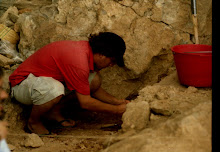

 View of the inside of Fumane Cave.


