The last three issues of the 2009 volume of L'Anthropologie are dedicated to prehistoric art, and one the papers contained in that special volume concerns five vault fragments from Fumane Cave (Veneto region, Italy) that were recovered during excavation and that bear designs made in red ochre. The art itself is already well known and has been published in great detail as part of a monograph a few years ago (Broglio and Dalmieri 2005), but this study presents some new data on the likely age of the fragments, as well as on the composition of the pigments from which they're made.
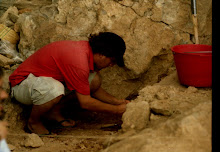
 View of the inside of Fumane Cave.
http://www.grottadifumane.it/FOTOGALLERY-DELLA-GROTTA.html
The issue with these fragment has been to precisely determine how old they are, since they are in secondary position, that is to say, they were not found where they were painted. It seems that during a cold snap following the moment on which the designs were painted on the cave, the vault surface spalled off and the fragments fell on deposits that were, logically, more recent than the paintings themselves. The oldest fragment (Fragment I in the figure below) bears a representation of some kind of quadruped was recovered in Unit A2, which is the base of the Aurignacian deposits at the site, whereas Fragment II ("the shaman", so called because the anthropomorphic figure it bears also shows some horn-like features) was recovered from the a pile mound of stones located at the cave's mouth, while the other decorated blocks were recovered in later (i.e., more recent) Aurignacian and Gravettian layers. In Italy, the Gravettian is securely attributed to modern humans, who are also widely thought to be the makers of the Aurignacian, and its earliest expression, the Protoaurignacian.

The five decorated vault fragments from Grotta di Fumane.
From: Broglio et al. (2009:756, Plate 2).
From: Broglio et al. (2009:756, Plate 2).
The main issue, chronologically speaking, has been to determine when the figures were painted on the cave vault, since the layers in which they were recovered only provide a terminus ante quem for their age, in other words, an upper limit for their age. So, at first glance, there is no evidence for the age of these paintings beyond that of the layers in which they were recovered. However, in this study, Broglio et al. (2009) make the case that all the paintings date to the earliest Aurignacian at the site, that is to level A2. Historically, the dating of the earliest Aurignacian at Fumane has been hotly debated, but the authors present new dates for previously dated charcoal samples that have undergone, for the new dates, a new, more thorough pretreatment (i.e., ABOx SC). This has provided two statistically equivalent age determinations of 35,640 +/- 220 and 35,180 +/- 220 BP for level A2. Interestingly, and fittingly in light of my recent post on the presentation of calibrated and uncalibrated radiocarbon dates, they conclude that, by reference to the calibration curve based on the Cariaco Basin data and the GISP2 Greenland ice core, that "the chronological data show that Protoaurignacian Unit A2 dates to between 43,250 to 40,500 BPGISP2, with an age of 41,000BPGISP2 being statistically more likely" (Broglio et al. 2009:760; my translation, emphasis added).
What allows them to tie the paintings to that age determination is the study of ochre found in Unit A2. The base and top of that layer include conspicuous concentrations of red ochre, and some ochre crayons were also recovered from A2. The clincher is that these crayons are made of the same ochre as that which was used for the parietal art. This is demonstrated by a brief compositional analysis of the pigments using various methods, that also indicates that these ochres are circum-local in provenience, being found in the Lessini Mountains, at the southern edge of which Fumane sits.
In sum, while the decorated pieces themselves were not dated directly, this study provides some strong circumstancial evidence for their being of early Aurignacian age. If this attribution is correct, it provides us with some solid data about some of the iconographic canons and artistic techniques used by early Aurignacian foragers in northern Italy and some insights into the variability in artistic behavior within this cultural tradition at the beginning of the Upper Paleolithic.
update (01/18/2009: 12:20PM): Image of the paintings is now fixed.
References
Broglio, A., and G. Dalmieri (eds.). 2005. Pitture paleolitiche nelle Prealpi venete: Grotta di Fumane e Riparo Dalmieri. Memorie del Museo Civico di Storia Naturale di Verona, 2 serie. Sezione Scienze dell'Uomo. Verona, Italy.
Broglio, A., De Stefani, M., Gurioli, F., Pallecchi, P., Giachi, G., Higham, T., & Brock, F. (2009). L’art aurignacien dans la décoration de la Grotte de Fumane L'Anthropologie, 113 (5), 753-761 DOI: 10.1016/j.anthro.2009.09.016