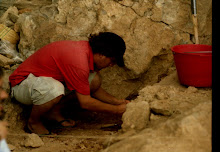
I'm rereading a terrific paper by Kathryn W. Arthur (2010), in which she describes the acquisition

and development of stone tool manufacture and maintenance among a group of Konso women in SW Ethiopia (the stone tools they produce they subsequently use in hideworking) . While I'll have much more to say about it in its own right, since I've been doing a bit of thinking about prehistoric heat treating of lithic raw material these past few days, I was struck by this passage:
The majority of hideworkers using chalcedony and milky
quartz begin production by heat treating the raw material to
make it more brittle for reduction. The hideworker places
the raw material on top of a broken piece of pottery with
an insulator such as leaves, domesticated animal hair, wool,
cotton, or additional pottery sherds in a pit under her hearth.
There she leaves the stone for as little as 12 hours and up to three months. Once she “cooks” the stone, she then lets
it cool for at least one day. Konso women knappers use
different heat-treating methods based on the size, type, and
quality of the raw material to increase the flakeability of the
stone. (Arthur 2010: 234, emphasis added)
If this account is at all a reflection of what went on in prehistory, this is a huge span of time during which material is exposed to heat. And this observation got me to thinking about the recent study by Brown et al. (2009), where they determined that Middle Stone Age hominins in southenr Africa by 72,000 years BP at the site of Pinnacle Point 5-6 (and maybe as far back as 164ky BP in the area as a whole), used 'pyrotechnology' to alter the properties of locally obtained silcrete to make it easier to work, notably to produce fine bifacial points. Brown et al.'s study is especially noteworthy in that they propose what are, to my knowledge, the first set of objective criteria that can be used to both identify heat treatment as well as to quantitatively assess how much more 'flakable' stone becomes after heat treatment. These include thermoluminescence, archaeomagnetism, and gloss/reflectance. This in itself is a big step forward for future studies of heat treatment as they set a new level of analytical rigor that now has to be matched by future studies interested in demonstrating that heat treating took place in the past. It also establishes the need for experimental protocols in such efforts.
Going back to the Arthur (2010) paper, though, I was struck by this section of the supplementary material provided for their study by Brown et al. (2009), in which they discuss their experimental protocol to replicate the effect of heat treating on silcrete:
Two methods were employed to heat treat experimental silcrete samples. In the first, we placed raw material and a thermocouple probe (type K) within a sand bath approximately 2-3 cm below the surface. A fire was then built over the sand containing the silcrete. The temperature of the silcrete was slowly built up to ~350º C over a period of approximately 5 hours and then gradually cooled to ~40º C (usually overnight) before the blanks were removed from the sand. Temperature was monitored and recorded using a J-Kem HHM-40 handheld temperature meter and data logger. Fires required approximately 20 kg of dried hardwood per 3 kg of stone. In the second method, we heated samples in a Gallenkamp muffle furnace fitted with an external J-Kem programmable temperature controller (Model 360/Timer-K). The controller was programmed to slowly ramp the temperature of the furnace to 350º C over 5 hours. This temperature was held constant for 12 hours and then dropped slowly to 40º C before removal of the blanks. (Brown et al. 2010: S2-3)
Now, this is clearly a different setting under which to heat material. Further, Arthur's ethnoarchaeological observations don't indicate how hot is the fire that lithic nodules are exposed to, not whether or not the 12 hours is more frequent than the three months she mentions as one extreme of the spectrum of heating duration. She also doesn't describe how much better the stone was after heating, or after different lengths of exposure to heat, and the raw materials being heated in both studies are also very different. These factors mean that it's not possible to directly assess the comparability of the Konso observations to those from the MSA at Pinnacle Point. However, if they are at all comparable, it does suggest that the lengths of time employed in Brown et al.'s replicative work woulf fall at the lower end of the durations for which lithic raw material must be heated to acquire better properties.
Why does this matter? It matters because it has important implications for how long fires must have kept going in the past for heat treating to be effective. This, in turn, has implications for how much fuel must have been available for heat treatment to be a feasible undertaking. Perhaps most importantly, it also has implications about the labor that must have gone into tending these fires to make sure they didn't go out. If stone was heated continuously for, say, 24 or 48 hours, it implies that someone must have remained relatively close to that hearth for that duration, which imposes some limitations about how mobile that person (or those persons) might have been. If, as Arthur (2010) argues, women may have been in charge of some aspects of lithic production such as heat treating, it implies that males and females may have had different economic roles going back quite a ways in the Late Pleistocene, a
topic we've discussed at AVRPI before.
References:
Arthur, Kathryn Weedman (2010). Feminine Knowledge and Skill Reconsidered: Women and Flaked Stone Tools American Anthropologist, 112 (2), 228-243 : 10.1111/j.1548-1433.2010.01222.xBrown, K., Marean, C., Herries, A., Jacobs, Z., Tribolo, C., Braun, D., Roberts, D., Meyer, M., & Bernatchez, J. (2009). Fire As an Engineering Tool of Early Modern Humans Science, 325 (5942), 859-862 DOI: 10.1126/science.1175028