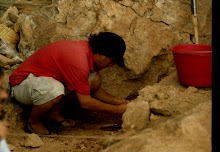
This is a pretty monumental discovery, in that it pushes back the evidence for the use of stone tool technology by about 800,000 years, and associates it fairly convincingly with A. afarensis (or, at least, as convincingly as can be done for those time frames). John Hawks and Greg Laden have interesting posts on some of the more salient aspects of the paper, which you should read if you're interested in this.
In a nutshell, McPherron and colleagues analyzed the bones using secondary electron imaging (SEI) and energy dispersive X-ray (EDX) to establish that the marks were, in fact, made in deep time before the bones fossilized. Having determined this, they then examined the morphology of the marks on the bone using ESEM (environmental scanning electron microscopy) and optical microscopes to establish that it was most similar to those of experimentally replicated marks made with stone tools used to cut flesh off a bone and crack bones open. I've looked at my share of cut marks over the years, and like Greg, I also agree with the authors that the DIK-55 cut marks look like marks made by stone tools. You'd have to never have looked at cut marks to argue with a straight face that the marks on the DIK-55 specimens look more like croc tooth marks than cut marks.
Given that the marks really seem to be genuine stone tool cut and percussion marks, the question then becomes one of establishing the age of the mark-bearing bones. As Hawks underlines, we're dealing with only four bones here, out of an unspecified total sample. So, we don't really know how common they were at DIK-55, since they do not meet the criteria usually used for collection - basically, they were collected because field observations suggested they might bear cut marks. And as Laden mentions, it'd be better if the bones in question had been collected in primary context, as opposed to from the surface next to their associated depositional context. This is important because there's always the possibility that they might have washed in or been somehow transported from another, potentially younger locality. That said, based on the absence of adhering sediment and the location of the specimens, their most likely provenience is from a sandy formation with a minimum age of 3.24 million years and a maximum age of 3.42 million years. The sample size issue is an interesting one to consider, but really, in this case the noteworthy feature of these bones is that they bear unambiguous traces of modification with stone tools, so their proportional importance is somewhat secondary.
OK, so, we have bones bearing marks made by stone tools that are older by some 800ky than the earliest known stone tool assemblages, which date to about 2.6-2.5mya (Semaw et al. 1997). What does it mean? Well, the most obvious conclusion is that the use of stone tools must be quite a bit older than has generally been assumed, and since A. afarensis is the only hominin associated with deposits that age in the region, they are the best candidates for having used them.
Here's the rub, though: there are no stone tools at DIK-55. Furthermore, the closest source of rocks that could have been used as stone tools is about 6km away. What does that mean? It means that, if A. afarensis really did use stone implements to process these remains, they must have brought them from a little ways away. That, in and of itself, is not earth shattering an observation. Sea otters, for instance, are known to carry rocks in skin folds next to their forepaws to use them in area where clams, crabs and abalones are present but rocks aren't. In that sense, the DIK-55 provide evidence for some basic planing depth, though not much more than in some other tool-using animals.
The big question relating to the stone tools here is whether A. afarensis made some or opportunistically used naturally occurring sharp pieces of stone. McPherron et al. (2010) remain agnostic on that one, as well they should given that they've already rocked the boat enough with this discovery and speculating would undermine their case. I also remain undecided on the issue, though I will say that there could be a case for the evidence presented in the paper to indicate that A. afarensis manufactured stone tools. This is based on two lines of observation: 1) there are no large rocks at DIK-55, the largest rocks found there being about 8mm in maximum size; and 2) the bones described in the paper bear both cut marks and percussion marks. Now, cut marks need to be made with a sharp stone edge, something like a flake, or a cobble with at least one flake knocked off. In contrast, percussion marks are made by blunt objects, usually a hammerstone similar to those used to knock flakes off of cobbles or cores. This distinction is usually not given much thought in discussion of human agency on bones because, by and large, if humans have flakes, they have a hammerstone to knap them off with. In fact, even at Gona, the earliest known stone tool assemblage, hammerstones, cores and flakes co-occur (Semaw et al. 1997; Stout et al. 2005).
In this case, however, the distinction is noteworthy because it implies that at least two different implements were brought in to DIK-55 to process the tools. Remember that there are no stones larges than 8mm at this locality, and try as it might, not even a Floresian hobbit would be able to use such small pebbles as tools with much success. It also means that there could be no 'crime of opportunity' in which an australopith just picked up a large rock that was just lying there to smash open a bone. In short, it means that both a blunt stone object (i.e., a hammerstone) and a sharp one must have been transported to DIK-55. Granted, it might simply be that hominins were carrying both unmodified cobbles and naturally occurring sharp pieces of stone with them. But if you understand that whacking a bone with a hammerstone will break it open (and create sharp edges on the bone as a result) and that sharp objects can be helpful in slicing meat off a bone, a parsimonious explanation might be that your lithic technological behavior includes the use of hammerstone to produce stone flakes. This would also make sense from the perspective of lithic technology where percussors and flakes are part of even the simplest toolkits.
Granted, this last bit is speculative, but what is certain is that people will be looking at 3.4-2.6mya deposits with renewed interest and attention in the coming years. What comes out of these investigation should allow us to flesh out the range of possible scenarios brought up by this new discovery from Dikika, which is proving to be an immensely rewarding area from a paleoanthropological standpoint.
References:
McPherron, S., Alemseged, Z., Marean, C., Wynn, J., Reed, D., Geraads, D., Bobe, R., & Béarat, H. (2010). Evidence for stone-tool-assisted consumption of animal tissues before 3.39 million years ago at Dikika, Ethiopia Nature, 466 (7308), 857-860 DOI: 10.1038/nature09248
Semaw S, Renne P, Harris JW, Feibel CS, Bernor RL, Fesseha N, & Mowbray K (1997). 2.5-million-year-old stone tools from Gona, Ethiopia. Nature, 385 (6614), 333-6 PMID: 9002516
Stout D, Quade J, Semaw S, Rogers MJ, & Levin NE (2005). Raw material selectivity of the earliest stone toolmakers at Gona, Afar, Ethiopia. Journal of human evolution, 48 (4), 365-80 PMID: 15788183