Wednesday, June 01, 2011

The Arabian Middle Paleolithic and the southern route of human dispersal

In a comment on my last post, Maju who's a regular commenter on this blog, pointed out that recent finds in the Arabian Peninsula and the Persian Gulf suggest that modern humans might have been present in the Middle East by the time Shanidar 3 was killed. Some of the specific evidence in support of this that has come out in the past year include that presented by Armitage et al. (2011) and Rose (2011), and a more recent paper by Petraglia et al. (in press), which he briefly discussed in a post of his own. Here, I just want to provide some additional thoughts about this series of papers, and what they tell us about the modern human population dynamics in the region.

Armitage et al. (2011) report a series of three stratified assemblages from the site of FAY-NE1, in the Jebel Faya in SW Arabia, near the Straits of Hormuz. The interesting thing about these assemblages is their age, and the fact that their typology suggests affinities - or lack thereof - to assemblages from other regions. The oldest assemblage dates to ca. 125kya (dated through single-grain OSL), and the authors argue it shows affinities to assemblages of similar age in East Africa. On that basis, they argue for an early dispersal of modern humans out of Africa along the so-called 'southern route', which comprises the southern coast of the Arabian Peninsula and Indian subcontinent. They link this, in turn, to a potential early population of modern humans in Indian prior to the Toba super-eruption ca. 74kya (Petraglia et al. 2011 and references therein). The later assemblages from FAY-NE1 are older than ca. 40kya, and show little to no affinities to either the MSA/LSA or the Levantine Paleolithic. Armitage and co. interpret this as evidence of their not having been made by Neanderthals, but don't really explore this issue in great depth. They conclude that human occupation of FAY-NE1 and Arabia more broadly would have been tethered to humid periods that made it hospitable to humans, who would have disappeared from the interior of the peninsula during arid periods.

Rose (2010), on the other hand, argues that one area that humans might have found refuge in during these hyper-arid periods would have been the Persian Gulf. Because it is comparatively shallow, arid periods (which correspond with colder periods associated with decreased sea level) would have effectively exposed much of the gulf, which would have been associated with perennial sources of water, which would have acted as a drawing force for human populations from surrounding areas. In a nutshell, the 'Gulf Oasis' would have provided something of a safe haven for humans at times where both Arabia and parts of Iran would have been too inhospitable for humans to occupy. If modern humans were present in the region by 125kya, it stands to reason that the people who would have congregated in the 'Gulf Oasis' would have been modern humans, who could have in turn recolonized the areas to the E and W of the Gulf during wetter periods. The prolonged isolation of people in the Gulf Oasis during prolonged (multi-millennial) episodes of dessication would have lead to cultural drift, perhaps explaining the unique configuration of Assemblages A and B from FAY-NE1 (Armitage et al. 2011).

While these new data are very interesting, they still concern the potential presence of humans mainly along the coasts. What this means is that they tell us little about whether or not humans ventured far inland and/or northwards, and what this implies about their interactions with other, putatively 'archaic' human populations in those areas. A new paper by Petraglia et al. (in press), however, helps shed some light on this situation. These authors present a preliminary report on the site of Jebel Qattar 1, located near Jubbah, Saudi Arabia, on the shores of a paleo-lake. This places the site smack-dab in the center of northern Saudi Arabia, hundreds of kilometers from any coastal area. The site dates to ca. 75kya (OSL), which associates it with comparatively moist conditions that would have made the region habitable by humans.

Overall, the presence of JQ1 agrees with the scenario for human occupation of inland Arabia proposed in the previous two papers. Namely, it shows that people would have ventured far inland only during comparatively moist periods. What is really interesting here, however, is that the assemblage found at JQ1, in contrast to those from FAY-NE1 (Armitage et al. 2011), fits well within what Petraglia and Alsharekh (2003) have described as the Arabian Middle Paleolithic, which shows some affinities to the Levantine Mousterian. However, as the authors state

"Given the current absence of pre-Holocene hominin fossils in Arabia, and the fact that Levantine Mousterian assemblages are associated with both early modern humans and Neanderthals, caution is warranted in attributing a maker to the JQ1 and other Arabian Middle Paleolithic assemblages." (Petraglia et al. 2011: 4)

Here, I just want to point the contrast between this assemblage, and those from FAY-NE1, who show affinities either to the MSA or to no other known industries to the West. What this means for the presence of modern humans in the northern Zagros, close to Shanidar, remains an open question. It may well be, however, that what was happening along the coast of the Indian Ocean during the Late Pleistocene may have been quite different from what was happening in the interior of the landmasses it borders on, with attendant implications for scenarios about modern human dispersals. I close with words by Petraglia et al. (2011:4, references excised) to that effect:

"If modern humans were responsible for the early Arabian toolkit, then our findings contradict the argument that the dispersal of Homo sapiens out of Africa was accompanied by a microblade technology 60 ka ago. Furthermore, the presence of JQ1 in the interior of northern Arabia, 500 km from the nearest coast, indicates that an exclusive coastal corridor for hominin expansion out of Africa can no longer be assumed."

Hat tip: For what they were... we are.

PS: I should also mention here that Michael Petraglia and his team have a blog, Ancient Indian Ocean Corridors, where they post about the Indian and Arabian Paleolithic , issues related to their ongoing research in those areas.

References

Armitage, S., Jasim, S., Marks, A., Parker, A., Usik, V., & Uerpmann, H. (2011). The Southern Route "Out of Africa": Evidence for an Early Expansion of Modern Humans into Arabia Science, 331 (6016), 453-456 DOI: 10.1126/science.1199113

Petraglia, Michael D., & Alsharekh, Abdullah (2003). The Middle Palaeolithic of Arabia: Implications for modern human origins, behaviour and dispersals Antiquity, 77 (298), 671-684

Petraglia, M., Alsharekh, A., Crassard, R., Drake, N., Groucutt, H., Parker, A., & Roberts, R. (2011). Middle Paleolithic occupation on a Marine Isotope Stage 5 lakeshore in the Nefud Desert, Saudi Arabia Quaternary Science Reviews DOI: 10.1016/j.quascirev.2011.04.006

Rose, J. (2010). New Light on Human Prehistory in the Arabo-Persian Gulf Oasis Current Anthropology, 51 (6), 849-883 DOI: 10.1086/657397


Monday, May 30, 2011

Who really killed Shanidar 3?

Fun with footnotes, today at AVRPI!! You'll remember that a couple of summers ago, a study by Churchill et al. (2009) tried to argue that the cut marks on a rib from the Shanidar 3 Neanderthal were the result of a wound inflicted by a modern human on that poor sap. Naturally, the science press had a field day with this, although several commentators argued that the evidence presented by Churchill and co. had been stretched way too thin, and that there really was no way to know who (what?) had killed Shanidar 3.

I just finished reading a paper by Trinkaus and Buzhilova (in press) on the death of the Sunghir 1. Sunghir 1 was an old man dating to the Early Gravettian (somewhere b/w 28-24kya) who was buried with an extremely lavish set of grave goods, including ornaments comprising several thousands of mammoth ivory beads, ivory bracelets, a schist pendant and a lot of red ochre spread over the entire burial. There is no question that this is one of the most remarkable Upper Paleolithic burials know.

How does that relate to Shanidar 3, you ask? Well, beyond the fact that Shanidar 3 has been argued to be an intentional burial, Trinkaus and Buzhilova report that, during a renewed inventory of the Sunghir 1 remains undertaken in 2009 which included a careful cleaning of the remains, they identified "an oblique defect, medial-caudal to lateral-cranial, on the left ventral corner of the body" of the Sunghir 1 first thoracic vertebra (T1). I'll return to the details of the Sunghir 1 injury in an upcoming post, but suffice it to say here that they are able to show that the lesion is indicative of a wound inflicted by a sharp implement and that would have been lethal to Sunghir 1.

OK, so returning to our dead homies Neanderthals, this study provides the third most ancient case of a weapon-inflicted wound leading to the death of a Paleolithic forager, the other two being Saint-Cesaire 1 and Shanidar 3, in decreasing order of age. Both of these have been described by Churchill et al. (2009) has resulting from inter-specific violence by modern humans on Neanderthals. However, Trinkaus and Buzhilova argue that "[i]n neither of them is there sufficient evidence, given current geochronology and available technology to meaningfully hypothesize intergroup aggression.". Their justification for this different assessment is then provided in one of the most epic and detailed footnotes I've come across, which I quote in full here:

Churchill et al. (2009) have argued that the injuries to Shanidar 3 and Saint-Césaire 1 are likely to have been perpetrated on these Neandertals by early modern humans. They argue for probable regional sympatry of Shanidar 3 with early modern humans in southwest Asia and certain sympatry for Saint- Césaire 1 in western Europe and superior projectile technology among early modern humans with respect to the Middle Paleolithic Shanidar 3. However, their argument, despite caveats, requires distortions of the relevant geochronology, misrepresentation of the available technology, and special pleading. In western Europe, there is no evidence for (presumably modern human associated) Aurignacian levels stratified below those of the (Neandertal associated) Châtelperronian (Bordes, 2003; Zilhão et al., 2006), as it is at Saint-Césaire (Lévêque et al., 1993), and all of the reliable dates place the Châtelperronian prior to the Aurignacian (Zilhão & d’Errico, 2003). The one radiometric date for the Saint-Césaire Châtelperronian level, a TL date (36 300±2700 cal BP) (Mercier et al., 1991), has a sufficiently large standard error to make it inappropriate to date the burial relative to Châtelperronian or Aurigiacian levels in the region. There is therefore no evidence, either paleontological or by assuming that the earliest Aurignacian was made by modern humans, that there were modern humans in western Europe at the time of Saint-Césaire 1. Churchill et al.’s assessment of the relative ages of Shanidar 3 and early modern humans in southwest Asia confuses radiocarbon and calendar years and makes unwarranted assumptions of who was responsible for which technocomplex; a reassessment of the available dates for diagnostic human remains, plus the stratigraphic position of Shanidar 3, clarifies the chronology. Shanidar 3 derives from near the top of Level D of Shanidar Cave, but stratigraphically well below the radiocarbon dates of ~47 and ~51 ka 14C BP (~51 and ~56ka cal BP) (Trinkaus, 1983). The youngest Middle Paleolithic modern humans within southwest Asia (at Qafzeh and Skhul) are MIS 5c in age (~90–100 ka cal BP) (Valladas et al., 1988; Stringer et al., 1989), and hence much older. Modern human remains do not reappear in southwest Asia until at least 35 ka 14C BP (~40 ka cal BP) (Bergman & Stringer, 1989), ~15 000 years later. In the Zagros the Baradostian technocomplex, the more recent phases of which are associated with modern humans (Scott & Marean, 2009), is dated to ~36 ka 14C BP (~41 ka cal BP) (Otte & Kozlowski, 2007). In addition, contra Shea & Sisk (2010), there are no diagnostic human remains associated with the eastern Mediterranean littoral IUP, that is ~35 ka 14C BP (~40 ka cal BP); Qafzeh 1 and 2 are undated, Ksar Akil 1 is younger, and the few IUP Üçağızlı teeth may well be Neandertals (Neuville, 1951; Bergman & Stringer, 1989; Gulec et al., 2007). One must go to equatorial Africa to find roughly contemporaneous modern humans (Haile-Selassie et al., 2004). With respect to technology, either Châtelperronian or Aurignacian lithics could have inflicted the frontal wound on Saint-Césaire 1. Although Middle Paleolithic spears appear to have mostly had relatively thick lithic points (Shea, 2006), thinner tools capable of producing the Shanidar 3 injury are represented in the Shanidar (and southwest Asian) Middle Paleolithic (Skinner, 1965). Moreover, one has to go to southern Africa to find evidence for contemporaneous ‘advanced’ projectile weaponry (Shea, 2006; Lombard & Phillipson, 2010; but see comments and caveats in Villa & Soriano (2010) and Lombard & Phillipson (2010)). Therefore, contra Churchill et al. (2009), the Shanidar and Saint Césaire Neandertals had the technology available to inflict their respective wounds, and there is no evidence (direct or indirect) for synchronous and sympatric modern humans. It is inappropriate to infer that individuals responsible for the Shanidar 3 and Saint-Césaire1 injuries were other than Neandertals." (Trinkaus and Buzhilova, in press: 7).

So, in a nutshell, there is no good reason to assume that the wounds sustained by Shanidar 3 were inflicted by modern humans. In fact, all of the available evidence points to Shanidar 3 having lived at a moment when only Neanderthals were kicking around the Zagros, and that they had access to technology that could well have left the mark found on the Shanidar 3 ribs.

Why does this matter? Well, for one thing, setting the record straight on this destroys any evidence for the interactions between Neanderthals and modern humans having been strictly inimical and violent. For another, it provides up a fascinating and heretofore underappreciated glimpse into the range of interpersonal relations Neanderthals could have had with other Neanderthals. Given the tendency by many to see Neanderthal behavior has homogeneous and monotonous, emphasizing that their interactionswith others of their kind were occasionally violent to the point of being lethal contributes to showing them to have been all too humans in certain respects.

References:

Churchill, S., Franciscus, R., McKean-Peraza, H., Daniel, J., & Warren, B. (2009). Shanidar 3 Neandertal rib puncture wound and paleolithic weaponry Journal of Human Evolution, 57 (2), 163-178 DOI: 10.1016/j.jhevol.2009.05.010

Trinkaus, E., & Buzhilova, A. (2010). The death and burial of sunghir 1 International Journal of Osteoarchaeology DOI: 10.1002/oa.1227

Friday, May 06, 2011

Feelgood Friday feature

How's this for an inspirational story? A professor suffering from terminal cancer insisted on giving his current students their last lecture, even though he'd be hospitalized, so he did it via Skype, hospital gown, tubes and all. Hard not to be moved moved by Prof. Kielhorn's dedication to his students and his teaching.

At 79, Kielhorn was just one class short of finishing 45 years of teaching without missing a single day.With his perfect attendance at risk, Kielhorn reminded his oncologist at Good Shepherd Medical Center in Longview, Texas: "I have class tomorrow at 3 o'clock." That's when his daughter, Martha Croft, and granddaughter, Courtney Bellamy, came up with a plan and started making arrangements for Kielhorn to give his last class via teleconference from the hospital. "Either we were going to break him out or they were going to bring the Skype in," Croft said with a laugh.

45 years of teaching without missing a single class?  So much for university professors not giving a damn about students and/or teaching. That kind of devotion to university education is incredible, and something to aspire to. I for one already can't claim that distinction, so hats off to you, sir!

Scientists of the world, unite!

Last week, I mentioned that scientists - in this case, specifically anthropologists - need to develop strategies to better control the narratives about their research that get circulated in popular media. To me, the need to do so is spurred by both the public interest in anthropological research as well as the need to make science relevant, interesting and exciting to a broader swath of society than it currently is. I also think that scientists have a duty to reach out to the public and talk about what it is they do and why it matters. Really, we need to be able to do this no matter how narrow and specialized our specific field on inquiry. In part, I feel it's the minimum we can do considering the amount of public funding most of us get for our research. As well, if we hope to get the public excited about the scientific inquiry and kids about careers in science, making efforts and taking steps to reach broader audiences should not only be commendable, it should be a professional imperative.

The fine folks at Scientific American seem to be thinking along very similar lines. Under the aegis of the Nature Publishing Group, they're spearheading an effort called "1,000 Scientists in 1,000 Days" that "aims to help with all of those goals by making it easier for scientists and teachers to connect. The idea is simple. We seek scientists who are willing to volunteer to advise on curricula, answer a classroom's questions, or visit a school." They have a sign-up sheet for interested scientists - including a category specifically for anthropologists! - and they'll take care of matching interested parties with interested schools in their area. Sounds like a win-win to me, and you only have to volunteer as much as you are comfortable or able to. Get to it, folks!


Wednesday, May 04, 2011

The raw and the cooked, caveman redux

A few months ago, Henry et al. (2011a) published a truly remarkable study that analyzed the phytoliths and starch grains that had gotten encrusted in the dental calculus (i.e., plaque) of three Neanderthal individuals, two from the site of Spy (Belgium), and another from the site of Shanidar (Iraq). Their study provided the first direct evidence that plant foods were an integral part of the Neanderthal diet by identifying phytoliths (the microscopic silicate 'skeletons' of plant parts that are unique to each plant species) of date palms in the calculus of Shanidar III, and starch grains attributed to various species of wild barley and legumes. The Spy I and II specimens yielded no phytoliths, but did yield starch grains that indicate they consumed water lily corms as well as some variety of sorghum and five other types of plants. The fact that these plant microfossils were found on the teeth of both Spy specimens is a strong indicator that these plants were part of the diet of that group as a whole, too. And the fact that Neanderthals from such distinct ecological settings preserve direct evidence of plant consumption suggests that it was a widespread dietary behavior, an observation that contrasts markedly with the 'Neanderthals as super-carnivore' idea that's been growing in the literature.

As if that wasn't enough, however, some of the starch grains found in the calculus of Shanidar III also had a peculiar morphology ("partly gelatinized") that matched that of experimental cooked barley starch grains. Further, Henry et al. (2011:487) observe that "The overall pattern of damage to the starch grains matches most closely with that caused by heating in the presence of water, such as during baking or boiling, rather than “dryer” forms of cooking like parching or popping (38). The finding of cooked Triticeae [barley] starches on the Shanidar teeth reinforces evidence from other studies that suggest that Near Eastern Neanderthals cooked plant foods." In other words, not only can we tell that Neanderthals cooked some of the plants they consumed, we can even get an idea of how they cooked them, most likely through boiling or baking. To me, this is doubly (triply?) neat because it also tells us something about the cooking technology this very likely required, namely some kind of cooking vessel, made out of either leather or wood.

However, Collins and Copeland (2011) now have a letter in press at PNAS that argues that Henry et al. (2011a) did not properly account for alternative manners in which starch grains can become partly gelatinized through various forms of diagenesis, that is post-depositional chemical or physical alteration, or what we commonly think of as decomposition. This diagenesis could have been triggered by both the presence of water in the cave sediments and/or their exposure to high heat.

I'm happy that PNAS actually gave Henry et al. (2011b) a chance to respond to this letter at the same time. In their reply, they point out, first,  that the heat and humidity required to prompt 'spontaneous' gelatinization would be extremely unlikely to be present in cave sediment. They also indicate that complementary analyses of starch grains on stone tools from some of the same contexts from which teeth associated with altered starch grains are not altered, in contrast to what would be expected if these processes were affecting whole archaeological layers. Specifically, it suggests that lithics were used to process uncooked plant matter that was then cooked and later consumed by Neanderthals. Overall, the evidence therefore continues to indicate that Neanderthals not only ate plants, but also cooked them to both facilitate their consumption and increase their nutritiousness.

References

Collins, M., & Copeland, L. (2011). Ancient starch: Cooked or just old? Proceedings of the National Academy of Sciences DOI: 10.1073/pnas.1103241108

Henry, A., Brooks, A., & Piperno, D. (2010). Microfossils in calculus demonstrate consumption of plants and cooked foods in Neanderthal diets (Shanidar III, Iraq; Spy I and II, Belgium) Proceedings of the National Academy of Sciences, 108 (2), 486-491 DOI: 10.1073/pnas.1016868108

Henry, A., Brooks, A., & Piperno, D. (2011). Reply to Collins and Copeland: Spontaneous gelatinization not supported by evidence Proceedings of the National Academy of Sciences DOI: 10.1073/pnas.1104199108


Tuesday, May 03, 2011

Osama bin Laden, sasquatch and human biogeography

Science has a post on their website about a little study (Gillespie et al. 2009) that came out a couple of years ago that applied some Editor's Selection IconThis post was chosen as an Editor's Selection for ResearchBlogging.orgkey biogeographical principles to provide a prediction of where Osama bin Laden might have been hiding. The paper was discussed in Scientific American when if first came out, but now has received a ton of attention because the authors' predicted hiding place for bin Laden ended up being only 268km away from the large compound in Abbottabad where he was dispatched by a team of US Navy SEALS a couple of days ago.

The principles that underpinned Gillespie et al.'s study are actually fairly straightforward. First, organisms tend to stay closest to areas that they are comfortable in (taken here to be the area immediately around Tora Bora). Second, within those area, organisms tend to concentrate on larger 'islands' where propitious conditions are found - in this case, it meant cities where individuals can be more inconspicuous, on top of having access to the amenities needed for both hiding and coordinating further action. Lastly, within such islands, organisms will tend to map onto localities that can support their life history characteristics, in this case the size of bin Laden's entourage and the physical space and specific resources they would need to be able to thrive.

A lot of the comments on the Science page and other places are critical of the study, saying it wasn't, in fact, very precise, and saying its findings have been misrepresented. Fair enough. But what's really interesting is that the study was still correct enough to identify the region, the kind of place (i.e., a city) and the kind of structure (a large-ish compound, not a cave!) where bin Laden was found. To focus on the fact that they didn't identify the exact city is to miss the broader point here: biogeography is useful to predict the kinds of areas that given organisms will be found in, and usually not pinpoint exact locations, though informed suggestions as to these can certainly be made. The authors' suggestion that bin Laden would be found hiding in a city within one of the provinces or FATAs (federally administered tribal areas) closest to Tora Bora (which was bin Laden's last reported position according to outside sources) basically proved correct. Detractors will say that this is so general as to be useless, but if you think about how you would structure the use of resources to track an individual in such a large region, you could do a lot worse than that as a starting point to develop a plan of action.

Now, you may well be asking why the hell am I talking about bin Laden and biogeography on this blog which usually focuses on archaeology and paleoanthropology. Well, that's because biogeography is becoming increasingly used in paleoanthropological research to map out areas that would have been best suited for the needs of various kinds of past hominin communities. Specifically, ecological niche modeling has been used to reconstruct the preferred habitats of given species or industries (Banks et al. 2006). This is done specifically by extrapolating from the ecological contexts in which given sites have been recovered what would have been the preferred ecological conditions for the hominins responsible for accumulating them. An example of this is a paper in which the potential extent of various Upper Paleolithic bifacial tools was inferred based on where they have been found over the past 150 years or so of research (Banks et al. 2009). Some members of the same team have also used this approach to reconstruct what the preferred habitats of Neanderthals and early European modern humans (Banks et al. 2010). In this case, they were able to suggest that the ecological niches most prized by both groups of hominins would have overlapped to a very large degree, implying that the two would have likely come into direct contact, leading to a situation whereby modern humans probably drove Neanderthals to extinction through some form of competitive exclusion.

Ecological niche modeling yields very interesting and though-provoking results, but it remains a means to en end, a tool rather than a be-all-end-all kind of approach. As in most models dependent on inputted information, the quality of the patterns it generates is constrained by the quality of the empirical data used in the first place. This was best demonstrated by a recent paper by Lozier et al. (2009) in which they used georeferenced sightings of sasquatch drawn from the Bigfoot Field Researchers Organization website to extrapolate the eoclogical niche and most likely range of that cryptozoid in western North America (as an aside, do check out the BFRO website, for a good look into how organized modern cryptozoology can be - and while you're there, since this week's my birthday, consider ordering a BFRO polo shirt for me!). The paper yields a convincing map of where sasquatch are most likely to be found... a distribution, which incidentally corresponds almost exactly to the modeled ecological niche of brown bears, providing one explanation for what many (if not all) sasquatch sightings may actually have really been of.

The point here is that you can model the ecological niche of any georeferenced dataset, so you need to amke sure your data are really appropriate for the question you're trying to answer. Just because you get an output doesn't mean you necessarily had reliable data on which to base it in the first place. This is a good example of the issues related to the GIGO problem (reconceptualized for non-computer scientists by M. Wolpoff here). In the case of modern humans and Neanderthals, this means specifically that you're limited to dated sites with good provenience information, which captures only part of the relevant sites. It also means that you're basing a species-level attribution on lithic assemblages, which is notoriously problematic (e.g., Clark and Riel-Salvatore 2006).

This is also true for biogeographic approaches in general, and especially as they are applied to people, who have broader sets of motivations than most other animals. Returning to 'where in the world is was Osama bin Laden', this means that to be as precise a predictive model as possible, the Gillespie et al. paper should have considered things like the distribution of religious groups in the various areas they proposed (Haider 2009). From my perspective, it's clear that the predictive potential of Gillespie et al.'s study would have been enhanced had they also considered anthropological and cultural geographic factors to make this a true study in human biogeography. For instance Haider (2009) specifically argued that it's unlikely that a Sunni Muslim like bin Laden would have sought refuge in Parachinar, which is a mostly Shiite city. On the other hand, guess which large city in the radius originally proposed by Gillespie et al. is found in a mostly Sunni province? That's right, Abbottabad. Obviously, there are others, but it goes to show that by explicitly incorporating social factors, biogeographic studies focused on humans can be that much more precise.

Edit 05/05/2011: Whoa - this has been the most popular post ever on this little blog! It was even picked as one of this week's ResearchBlogging 'Editor's Selection'. The moral of all this: obviously, I need to write about terrorism and Sasquatch a lot more frequently!

References

Banks, William E., Francesco d'Errico, Harold L. Dibble, Leonard Krishtalka, Dixie West, Deborah I. Olszewski, A. Townsend Peterson, David G. Anderson, J. Christopher Gilliam, Anta Montet-White, Michel Crucifix, Curtis W. Marean, María-Fernanda Sánchez-Goñi, Barbara Wohlfarth, and Marian Vanhaeren. 2006. Eco-Cultural Niche Modeling: New Tools for Reconstructing the Geography and Ecology of Past Human Populations. PaleoAnthropology 2006:68-83

Banks, W., Zilhão, J., d'Errico, F., Kageyama, M., Sima, A., & Ronchitelli, A. (2009). Investigating links between ecology and bifacial tool types in Western Europe during the Last Glacial Maximum Journal of Archaeological Science, 36 (12), 2853-2867 DOI: 10.1016/j.jas.2009.09.014

Banks, W., d'Errico, F., Peterson, A., Kageyama, M., Sima, A., & Sánchez-Goñi, M. (2008). Neanderthal Extinction by Competitive Exclusion PLoS ONE, 3 (12) DOI: 10.1371/journal.pone.0003972

Clark, G.A., and J. Riel-Salvatore. 2005. Observations on Systematics in Paleolithic Archaeology. In Transitions before the Transition (E. Hovers and S.L. Kuhn, eds.), pp. 29-56. Springer, New York.

Gillespie, T.W., J.A. Agnew, E. Mariano, S. Mossler, N. Jones, M. Braughton, and J. gonzalez. 2009. Finding Osama bin Laden: An application of biogeographic theories and satellite imagery. MIT International Review: http://web.mit.edu/mitir/2009/online/finding-bin-laden.pdf

Haider, M. 2009. A Response to Professors Gillespie and Agnew on "Finding Osama bin Laden". MIT International Review: http://web.mit.edu/mitir/2009/online/finding.html

Lozier, J., Aniello, P., & Hickerson, M. (2009). Predicting the distribution of Sasquatch in western North America: anything goes with ecological niche modelling Journal of Biogeography, 36 (9), 1623-1627 DOI: 10.1111/j.1365-2699.2009.02152.x

Monday, May 02, 2011

Things to kill when you're original, affluent and social...

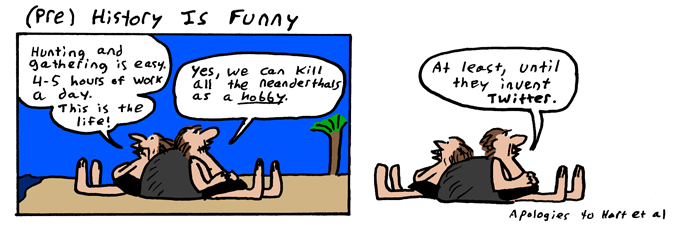
I have to admit this made me laugh.

© http://www.quickdraw.me/1169

So, it's kind of a silly comic, definitely good for a few chuckles. Yet, when you take a second to think about it, there's a lot packed into it. In two little panels, the cartoonist manages to bring up two of the biggest misconceptions about prheistoric hunter-gatherers: 1) that hunter-gatherers spend only a small amount of time a day foraging for food and have an abundance of leisure time to devote to other pursuits; and 2) that modern humans actively killed off Neanderthals.

Now while some people still believe that confrontational, violent interactions occurred at least some of the time when modern humans and Neanderthals crossed paths (e.g., Mellars 2005), faithful AVRPI readers will know by now that this view not only glosses over a ton of inconvenient evidence, but also doesn't really jive with what we know about how groups of hunter-gatherers really compete with one another (cf. O'Connell 2006).

The first component, though - the 4-5 hours of work thing - is more interesting. It taps into a now outgrown view of hunter-gatherers as having comparatively easy lives, where only a few hours a day were spent procuring food. This idea derives from the notion of the "original affluent society" first promulgated by M. Sahlins during the Man the Hunter conference (Sahlins 1968). That conference was held in Chicago in 1966 and was published as an edited volume by the same name in 1968 (Lee and de Vore 1968). Using some of the data on foraging returns that Lee had collected, Sahlins argued that foragers like the Kalahari San groups only spent a few hours a day foraging for food, spending the rest of their time gossiping or involved in assorted leisure activities.

This was pretty revolutionary for the time. Up to that point, hunter-gatherers had been seen by most anthropologists as perpetually living difficult, physically demanding lives and as always living on the brink of starvation. Sahlins' perspective, on top of having a catchy name, was the perfect foil to that traditional view, on top of providing a view of 'people closer to nature' as living what was in many ways possibly a better life than 20th post-industrial Westerners that fit in well with some of the counter-culture ideas in vogue at the time.

However, in spite of its conceptual and socio-political sexiness, the 'original affluent society' was just as unrealistic a view as that of perpetually hungry foragers. For one thing, it was based on observations made on a handful of forager societies, and even if it had been true for them, it would have been unwarranted to transpose it to all hunter-gatherers in all times and places. Second, Sahlins ignored the fact that several hours were also employed processing the food resources gathered in the 2-4 hours he saw as a typical work day for hunter-gatherers. Thorough reviews and criticisms of the OAS model include those written by Bird-David (1992:26-28) and Kelly (1995:15-19).

Anyhoo, all of this to say that, in addition to being funny on the face of it, this little comic is doubly funny to the informed reader, since it also capitalizes (maybe unwittingly) on two anthropological idea that have very much outlived their original usefulness. 

References

Bird-David, N. (1992). Beyond "The Original Affluent Society": A Culturalist Reformulation Current Anthropology, 33 (1) DOI: 10.1086/204029

Lee, R.B., and I. DeVore. 1968. Man the Hunter. Aldine, Chicago.

Kelly, R.L. 1995 The Foraging Spectrum. Smithsonian Institution Press, Washington, D.C.

Mellars, P. (2005). The impossible coincidence. A single-species model for the origins of modern human behavior in Europe Evolutionary Anthropology, 14 (1), 12-27 DOI: 10.1002/evan.20037

O'Connell, J.F. 2006. How did modern humans displace Neaderthals? Insights from hunter-gatherer ethnography and archaeology. In When Neanderthals and modern humans met, (N. Conard, ed.), pp. 43-64. Tubingen: Kerns Verlag.

Sahlins, M. 1968. Notes on the Original Affluent Societies. In Man the Hunter, (R. Lee and I. DeVore, eds.), pp. 85-89. Aldine, Chicago.

Sunday, May 01, 2011

Neanderthal use of coal

A little while ago, someone contacted me asking if there was any evidence that Neanderthals had ever used coal. This is an interesting question, and one about which there is only little available information. In fact, there is almost no evidence of Neanderthals using coal, but the proof that does exist is very intriguing. The single instance comes from the Mousterian site of Les Canalettes, France (dating to ca. 73,500 years BP), where the structure of some of the charcoal recovered by archaeologists suggests Neanderthals exploited a local outcrop of coal. Originally (Théry et al. 1996), it was suggested that Neanderthals at the site used coal (lignite) during periods when firewood might have been less abundant, that is when forest cover shrank. A few years later, however, the same authors was determined that trees would have always been sufficiently available around Les Canalettes, which indicates that Neanderthals purposefully exploited coal for a variety of potential reasons (Théry-Parisot and Meignen 2000). An English summary of this research (Goldberg and Sherwood 2006:29) concludes the following:

"Les Canalettes is a shelter in the Causse du Larzac region of France. It contains Mousterian remains dating to the last glacial, about 73.5 ka. Most interesting is the occurrence of what appears to be burned lignite, which was likely used as fuel and was available as close as 5–15 km from the site, well within the acquisition zone of raw materials. Analysis of wood remains in the site suggests that people used coal when wood was in short supply. Furthermore, experiments by Théry-Parisot demonstrated that the occupants were familiar with some of the burning characteristics of the fuel. For example, adding lignite to a fire which no longer exhibited flames added significantly to the burning duration, thus permitting rekindling of the fire at a much later stage and prolonging the ability to heat. In addition, the study found that a hearth mixed with dried wood and lignite, consumed 4 times less wood than a hearth simply using rotted wood. These results provide important insights, suggesting that Neanderthals exhibited a clear knowledge of the combustible properties for diverse fuels."

So, yes, there is evidence from a one site that Neanderthals used coal, and this evidence suggests they were fully aware of its combustible properties. However, so far it's only been found at one site, which suggests it wasn't a widespread behavior. So, it's not a ton of evidence, but it's certainly suggestive. What's especially interesting, however, is the fact that at Les Canalettes, Neanderthals were well aware of coal's properties. This indicates that, no matter where they lived, Neanderthals could develop a very thorough knowledge of the properties of the various resources that were available to them. Considering especially that Les Canalettes falls towards the later end of the Neanderthal timeline, it also fits in comfortably with the recent conclusions that Neanderthals by that time were regular fire-users, if not paleopyrotechnologists (say that ten times fast!), as based on the review of the evidence recently proposed by Roebroeks and Villa (2011).

References

Goldberg, P., & Sherwood, S. (2006). Deciphering human prehistory through the geoarcheological study of cave sediments Evolutionary Anthropology, 15 (1), 20-36 DOI: 10.1002/evan.20094

Roebroeks W, & Villa P (2011). On the earliest evidence for habitual use of fire in Europe. Proceedings of the National Academy of Sciences of the United States of America, 108 (13), 5209-14 PMID: 21402905

Théry, I., J. Gril, J.L. Vernet, L. Meignen, and J. Maury. (1996). Coal used for Fuel at Two Prehistoric Sites in Southern France: Les Canalettes (Mousterian) and Les Usclades (Mesolithic) Journal of Archaeological Science, 23 (4), 509-512 DOI: 10.1006/jasc.1996.0048

Théry-Parisot, I., and L. Meignen. 2000. Economie des combustibles dans l’abri moustérien des Canalettes, de l’expérimentation a` la simulation des besoins énergétques. Gallia Préhistoire 32:45–55.


Thursday, April 28, 2011

Stone Age ≠ Caveman!!! Archaeology, science, the media, and some tangential thoughts on the 'gay caveman' story

By now, you've surely heard all the media hoopla about the alleged 'gay caveman' found in the Czech Republic that's been all over the news and internet for the past few weeks. Ugh! Y'know, I just got done reading Ben Goldacre's fantastic book Bad Science in which he bemoans (and entertainingly skewers!) the way medical findings are consistently distorted in the media, where flashy headlines seem to be more important than the actual facts. Well, I'm sure Ben would be (un)happy to know that this kind of media hype also sadly characterizes the way many archaeological findings are presented to the public at large.

This post might turn into something of a rant, cause there's a lot to talk about surrounding all of these issues, so let me start by the beginning, namely the find itself. It's a Corded Ware burial of a skeleton sexed as male found lying on its left side, with the head pointing to the West. That position is usually associated with females in that prehistoric culture, as are the various pots the burial contained. So, archaeologically, that's a neat find. Something unusual that does suggest - if the sexing is correct - that the individual might have had a distinct identity in that cultural context, which to be fair is pretty much all the archaeologists actually said about it. And that's good, because without more info, it's really impossible to say anything more about that person's identity. Yet, all the media reports are talking about "the first known gay caveman" so what gives? Well, truth of the matter is, the find has been misinterpreted, indeed distorted by the media. Shocking, I know. All. Sorts. Of. Wrong. You wanna know how bad the distortion has been? Read this story on LiveScience. Then read the posts on the topic by Rosemary Joyce, Bone GirlJohn Hawks and the very thoughtful post by Eric Michael Johnson which provides a really good discussion of third genders and the range of sexual identities present and accepted in many cultures.

You know, the mess the media have made here of confusing biological sex, gender, identity and sexual orientation is a perfect example of why people need to be exposed to at least some anthropology, even before college. Without going into detail here, let me just state they're not the same thing. They can be related, obviously, but they're not the same, and the distinctions matter, especially when you're using one of these dimensions (in this case biological sex) to infer some of the other ones. It gets even more problematic when bones and archaeological remains (i.e., a biased sample of all the evidence you would need to intelligently discuss these issues) are all you have to go on. Let's be clear: I'd be more than happy if we could get at an archaeology of homosexuality, as there is every reason to believe it was a fact of life in the past just as it is today (see Eric's post mentioned above). It's just that this particular story doesn't get it right, and that rubs me the wrong way, especially given how the media has sensationalized their spin on the discovery

To me, the most aggravating aspect of this media circus is what wasn't actually discussed in any of the breathless "OMG gay caveman" reports. What I mean here is that, had this story actually been true - let's assume for a second that we did have a gay caveman, or whatever - not one of the reports bothered to discuss the broader implications of the find. This is one grave found among many others, so what does it means that this clearly distinct individual was casually buried among many other Corded Ware individuals? Given the bigotry that is all too pervasive in today's society and all the ranting and raving about 'traditional' and 'normal' values that seeps into the political and social spheres, you'd think that finding evidence that people in the 'olden days' did not bother to marginalize gay individuals is even more noteworthy. But apparently, this kind of story just doesn't seem to be as interesting as catchy headlines today. Absurd.

One thing that several bloggers have seized on is the mischaracterization of this burial as somehow representing a caveman. I mean, by all that is unholy, the dude(tte) was buried with pottery, the very anathema of cavepersonhood! I think Rosemary hits the nail on the head here when she points out that the term was likely chosen to elicit the most visceral kind of contrast-based reaction between stereotypical views of cavemen and homosexuals in the public at large. My beef here is how the hell did the slip from pottery-using Neolithic person to 'caveman' happened. Reading the news reports, you see a lot of emphasis on the fact that the Corded Ware culture begins at the tail end of the Neolithic and last into the Copper Age of Central Europe. And I think that this is where we have the 'wormhole' (which, given my penchant for naming things right in Stone Age archaeology, you know I'm going to dive into): Neolithic refers to the "New Stone Age", where ground stone technology becomes ubiquitous, in contrast to the chipped stone tools that dominate the Paleolithic or "Old Stone Age". You see where this is going: do you think a reporter on the trail of of juicy story is going to let the distinction between a 'new' and and 'old' Stone Age get in the way of the fact that this individual can somehow be tied to the Stone Age as a whole? Of course not! So this burial goes from being Neolithic to belonging to the Stone Age, and from there, you're one lowly step away from cavemen... and a great headline! This is another reason why you need qualified people writing about archaeology. This is all the more true in cases where it ties to issues as volatile in their socio-political echoes as sexual identity. So, again, goes to show people need at least some background in anthropology and archaeology, if only so they can make out the general outlines of our species' evolutionary history and how given finds fit therein.

At the SAA meetings, I had a good talk with a friend about how news stories on archaeological research so often get their facts wrong. It echoed a discussion we had in our department earlier this term when Jim Potter came and gave a talk on his recently published work on the Sacred Ridge assemblage of human remains that showed evidence of perimortem processing (Potter and Chuipka 2010). Somehow, a sober archaeological analysis of these patterns got translated into the media as evidence for widespread cannibalism in the prehistoric US Southwest, when nothing of the sort was actually said, either in the paper itself or in interviews by the researchers. In fact, the paper itself argues that cannibalism is not the best explanation for the patterns they identified! How the topic veered so dramatically away from the archaeological reality is anyone's guess, but the need for a good story seems to be rather importantly involved.

This, to me, suggests that it may be time for anthropologists and archaeologists to get some actual formal training in PR or media relations as part of their education. We bemoan that we too often lose control of the narrative of the stories published on our work, yet we're the ones who are most intimately familiar with the studies that get reported on. Are people who are not trained in anthropology really the best ones to 'translate' our results and their significance for the public at large? Hardly. We should be able to express why something's important without having to transit through a middleman who all too often lacks the proper background to really fully digest anthropological research.

My own experience with this has been limited to dealing with my university's PR office, and I have to say that it was pretty good. The reporter I dealt with, David Kelly, was really enthusiastic and did not hesitate to ask questions, and likewise, I didn't hesitate to correct misunderstandings, etc. I think that we developed a good back and forth built on mutual trust, and that the news story was, as a result, quite a bit better than many I've read on similar topics. On talking to other colleagues that have had their work covered by the popular press, I also get the feeling that my experience as a whole was more positive than most. Maybe it has to do with the process being conducted 'in house' where both parties had something to gain from this being done right. I think that this also set the stage for positive interaction with members of the media who later contacted me, since they had a good, reliable base on which to build.

So, how does this all relate to 'gay cavemen'? Basically, we need to be careful about how we phrase things when presenting them to the public in order to steer the public narrative in a way we are comfortable with. This means that we somehow need to become better at (re)taking control over the narrative about our work that gets circulated in the media. To paraphrase an argument made by Goldacre, people aren't stupid, and they can follow fairly complicated argument, if given the chance. Not only that, but there also is a large amount of interest in anthropological research writ large. So, there is no need to dumb it down to the point where the story bears almost no resemblance to the original research, and such distortions are clearly not just the price to pay to have our stories get coverage in the media. We can and must do better.

Reference:

Potter, J., & Chuipka, J. (2010). Perimortem mutilation of human remains in an early village in the American Southwest: A case for ethnic violence Journal of Anthropological Archaeology, 29 (4), 507-523 DOI: 10.1016/j.jaa.2010.08.001

Tuesday, April 26, 2011

New 'lion man' fragments from Hohlenstein-Stadel

Neat Aurignacian art objects keep popping up in Germany! A few years ago, the Hohle Fels 'Venus' was recovered in deposits dating to more than 30kya (Conard 2009), and now we learn that renewed excavations in the Aurignacian levels of the nearby site of Hohlenstein-Stadel have yielded new fragments of what is perhaps the most iconic piece of Aurignacian portable art, the so-called Löwenmensch, or lion-man.

http://www.panoramio.com/photo/6292707
"Over the past two years, German archaeologists have carefully excavated more of the sediment near the spot where the Lion-Man showed up. Thousands of bone fragments and some ivory pieces were found. Some of them matched the Lion-Man perfectly, a delighted Kind reported. Some of the figure's missing right side and parts of the back have already been restored as a result. "It needs a huge amount of patience," said Kind. "It's like doing a jigsaw puzzle in 3D." The work is continuing with the help of computer tomograph images of the pieces and simulation software. By next year, the Lion-Man may be complete. 
The restorers have also concluded that Lion-Man was somewhat taller than the 30 centimetres of him that currently exist. He was carved from one tusk, with the artist forming the legs from two sides of tusk's hollow root."

And here's shot of some of these fragments being refitted to the statuette originally found in 1939.

http://www.augsburger-allgemeine.de/neu-ulm/Elfenbein-macht-Archaeologen-froh-id14737516.html

It's a bit unclear from the linked story whether the refitting pieces were found in the backdirt of the original excavators or in situ in deposits left untouched by the original excavators. Regardless, a very neat find, and another clear example of why it matters to reexcavate key sites excavated in the 'golden age' of Paleolithic archaeology. Also makes you wonder what finds lie hidden in sites untouched to date...

References:

Conard, N. (2009). A female figurine from the basal Aurignacian of Hohle Fels Cave in southwestern Germany Nature, 459 (7244), 248-252 DOI: 10.1038/nature07995

Tuesday, April 19, 2011

When it rains, it pours!

Get ready for a veritable feast of anthropologically interesting talks in the greater Denver area on this coming Thursday, April 21:

  • On the Auraria campus, where UC Denver is located, Dr. Biruté Galdikas (Orangutan Foundation) is giving a talk on her research on orangs at St. Cajetans (5:30-7:00PM). The event is free, but you need to register.If you can't make that talk, she'll also be lecturing at the DMNS on Saturday, April 23.
    • Dr. Biruté Galdikas is a primatologist, conservationist, ethologist, and author of several books relating to the endangered orangutan, particularly the Bornean orangutan. Well known in the field of modern primatology, Galdikas is recognized as a leading authority on orangutans. 
  • On the DU campus, Noam Chomsky is giving a talk on "Dilemmas in US Foreign Policy", at 7:00PM. Again, free but you need to register. 
  • Finally, the Colorado Scientific Society is sponsoring a talk by Tom Strasser on "Crete before the Cretans: Paleolithic Mariners in the Mediterranean", at 8:00PM.
    • A survey in 2008 and 2009 on the southwestern coast of Crete in the region of Plakias documented 28 preceramic lithic sites. Sites were identified with artifacts of Mesolithic type similar to assemblages from the Greek mainland and islands, and some had evidence of Lower Palaeolithic occupation dated by geological context to at least 130,000 years ago. The long period of separation (more than 5,000,000 years) of Crete from any landmass implies that the early inhabitants of Crete reached the island using seacraft capable of open-sea navigation and multiple journeys—a finding that pushes the history of seafaring in the Mediterranean back by more than 100,000 years and has important implications for the dispersal of early humans.
All in all, it's going to be a busy Thursday evening! Now, though I'm a highly mobile kinda guy, there's only so much traveling I can do, so I'll be at the Strasser talk, especially considering the various posts I've put up on this humble blog about that research. I'll be very interested to learn more about the survey and the artifacts Strasser's group found. If any readers in the Denver area are in attendance, feel free to introduce yourself!

Monday, April 04, 2011

Back from the SAAs

Pretty exhausted, thought I'm actually in better shape than I am after most meetings. Don't know how I feel about Sacramento, but the meetings themselves were pretty good. Blogistically, I was really bummed out not to be able to attend the Blogging Archaeology session which ran (of course) exactly at the same time as the session I was in. On the other hand, I did get to have a nice lunch with John Hawks, engage in a roast pig-side chat at the Cotsen reception with Mike Smith, and get the chance to meet Colleen Morgan, three of my favorite bloggers, along with a long-time commenter on this very blog, so that was all very nice. If you want a flavor of what went down at the meetings, you can track down some Twitter feeds of the whole thing by going here.

I'm feeling revved up after these meetings, so let's see how productive I can be until I jet out to the Paleos in Minneapolis a week from now...

Wednesday, March 02, 2011

The Combe Capelle burial is Holocene in age

So says this Past Horizons report. This is fairly important in that it joins a bunch of other modern Homo sapiens remain long thought to have been associated with the Aurignacian to recently have been directly dated and shown to be much more recent (Churchill and Smith 2000). One recent and well publicized case was that of the Vogelherd remains, which were redated to between 3.9-5kya as opposed to the 30+kya it was originally thought to date to (Conard et al. 2004).

In the case of Combe Capelle, the redating of the skeleton to ca. 9575BP (the report doesn't give the exact age range) is especially significant for two reasons. For one thing, it's one more blow to the idea that modern humans were in Europe from the very beginning of the Upper Paleolithic. For another thing, and perhaps most importantly, it conclusively dissociates this set of modern human bones from the Chatelperronian artifacts with which it was found. As I've argued before, who made the Chatelperronian is now hotly debated, and this new piece of the puzzle just makes the question even more intriguing.

Edit Also, check out this photo (included in the Past Horizons report) of Otto Hauser, who discovered the burial, posing with the remains themselves... you just don't see photos like that in paleoanthropology anymore!


References:

Churchill SE, & Smith FH (2000). Makers of the early Aurignacian of Europe. American journal of physical anthropology, Suppl 31, 61-115 PMID: 11123838

Conard, N., Grootes, P., & Smith, F. (2004). Unexpectedly recent dates for human remains from Vogelherd Nature, 430 (6996), 198-201 DOI: 10.1038/nature02690


Obsidian blades as surgical tools

In my recent post on #hipsterscience, the quote that struck closest to home was the one about the obsidian blade. See, most of my analytical work ResearchBlogging.orgThis post was chosen as an Editor's Selection for ResearchBlogging.orghas been focused on stone tools (aka lithics) and how they were manufactured, used and managed by people in the past. Whenever it was available, obsidian seems to have been one of the preferred materials to make sharp flakes of, mainly because it is incomparably sharp among lithic raw materials!

Just how sharp is obsidian? Extremely damn frikkin' sharp! I often regale students about the first time I knapped stone myself, a sad, sordid story that ends with a fountain of blood gushing from the tip of my index finger (not that I would ever exaggerate for dramatic effect or anything). Well, that bloody geyser was unleashed by a flake of coarse flint - and obsidian is much, much sharper than that. When I've given knapping demos using obsidian and inadvertently nicked myself with little obsidian flakes, they're so sharp that I usually didn't notice I was bleeding until I smeared blood all over myself - this made knapping look pretty bad-ass to at least one group of sixth graders I once gave a demo to.

But don't take my word for it! Lithic specialists often refer to the story of Don Crabtree (one of the people directly responsible for the rebirth of knapping in the 60's and 70's) insisting that he be operated on by surgeons using scalpels tipped with obsidian blades he had expressly knapped for the purpose. Buck (1982) reports some observations on this episode, as well as on experiments comparing the obsidian to steel scalpel blades, concluding that, at 30 angstrom (i.e., 3 nanometers; that's three billionth of a meter) obsidian is much sharper than even the sharpest steel blade, the cuts it produces heal just as well if not better than those made with a steel surgical blade, and contrary to some concerns, it doesn't chip or leave residues when employed to operate on soft tissue. Specifically, he observes that

In most fields of surgery, of course, a modicum
of sharpness suffices, and one feels comfortable
with the convenience of the modem disposable
steel blade. However, in many specialized areas,
scalpel blades and razor blades leave much to be
desired. Examples that come to mind are the
debridement of nerve ends for repair, microvascular
surgery, fine plastic work on thin skin (blepharoplasty,
for example) and ophthalmologic surgery.
Though one with faith in modem technology
cannot imagine that instruments equal to these
various tasks cannot be produced today, the fact
remains that no honed metal edge has matched
that of the glass blade to date. (Buck 1982: 269)

Since the results of that brief experimental study were published almost thirty years ago, however, there hasn't been much of a push for obsidian tipped surgical instruments. My guess as to why this might be the case, beyond inertia in surgical equipment trends, is that some of the practical aspects of making obsidian blades might have been underestimated by Buck, especially those concerning standardization in shape and thickness, along with the properties of various grades of obsidian.

Edit (03/03/2001, 10:45AM): Hey! This post was included in this week's ResearchBlogging 'Editor's Selection' for the social sciences! Sweet!

References:

Buck BA (1982). Ancient technology in contemporary surgery. The Western journal of medicine, 136 (3), 265-9 PMID: 7046256

Tuesday, March 01, 2011

Anthropology meets #hipsterscience

I never really got the big deal about Twitter (nor do I really get how hashtags work, to be perfectly honest), but Drug Monkey has a blog post compiling #hipsterscience tweets, and they're pretty damn funny! A couple are paleo/anthropological in nature, so I figured I'd share them here:

drugmonkeyblog: You get a better shave with a blade you’ve freshly knapped from fair-trade, small producer obsidian @drisis #hipsterscience #hipsteranthro

cambrianexplode: Evolution? I like the early stuff but it’s all gotten so predictable now. #hipsterscience

And finally, this one made me burst out laughing and wipe off coffee from my screen:

dorsalstream: I only work with skinny genes. #hipsterscience


Sunday, February 27, 2011

Maggie Koerth-Baker on better scientific communication

I just got done watching a video of a recent talk by Maggie Koerth-Baker (science editor at Boing Boing) entitled "Six things scientists can learn from science journalists" which she recently gave at the University of Wisconsin. It's about an hour long, and I found it to be a really lucid overview of strategies scientists of all stripes should be using when talking about their research to the public at large and to reporters. The key points she makes are focused on the need to:
  1. present your work in an engaging way through the use of examples or analogies your audience can relate to or use to remember what you're saying; 
  2. develop a dialogue with your audience to understand where they're coming from and what their background on a topic is; 
  3. try to put yourself in the shoes of someone who has no background in your field; 
  4. relate given findings to broader issues to underscore their relevance; 
  5. be forthcoming about potential issues with your own research; and 
  6. write and talk in an accessible way instead of wrapping yourself in disciplinary technicality.
It may look as thought I've summarized the talk, but I really haven't - it's like saying that you've had dinner by looking at the menu. So click on over and treat yourself, there's a ton of really good info on how to put some of these concepts into practice.If you're at all interested in how to make science accessible to a broader audience, even if you're not a scientist yourself, you'll be doing yourself a major service by watching this video.

To me, the most significant point she makes had to do with relating scientific research to concerns outside of a narrow scientific interests, and to try to seize on issues of general interest as an anchor of sorts for your research. By doing this (one example she gives is research on overeating resonating better with people by linking it toThanksgiving), it becomes easy to underscore the significance of even minor developments and, most importantly, make people care about them. I really loved this sentence that encapsulates her general feeling:

"Science is bigger than single discoveries and if we can make people understand that, they're going to trust scientists a lot more and they're going to be a lot more interested in science."


Thursday, February 24, 2011

Neanderthals and ornaments, birds of a feather?


M. Peresani and colleagues (2011) report on the discovery of cut-marked bird bones from the latest Mousterian levels at Grotta di Fumane, located in the Veneto region of NE Italy. They interpret the fact that these cutmarks are almost exclusively found ResearchBlogging.orgon wing bones of only a subset of the 22 species of birds found at Fumane as evidence that Neanderthals there specifically targeted wings and feathers to be used in the manufacture of ornaments (check out Cutrona's fantastic picture of what they may have looked like just above).

Alert readers will remember that I've talked about Fumane before on this blog, mainly in reference to its early Aurignacian art and its transitional industry that's been likened to the Uluzzian. This new finding makes Fumane even more remarkable by providing strong evidence for Neanderthal use of personal ornamentation. Equally important, in my view, is that Neanderthals were somehow able to procure birds, a topic I'll return to below.

But first, let's talk ornamentation. The authors claim that a decorative use of the feathers targeted by Neanderthals is the most likely interpretation. Specifically, they rule out the use of these feathers in fletching since Neanderthal spears would not have benefited from it. Likewise, they rule out an alimentary interpretation since the cut mark are found almost only on wing bones, which yield relatively little meat. They also emphasize that some of the birds whose feathers were sought were raptors which are rarely consumed by humans. They therefore rule out the two main alternative interpretations of their findings.

To sum up, Neanderthals clearly were collecting feathers, specifically remiges, the long and sturdy flight feathers of four main types of birds, including bearded lammergeiers, red-footed falcons, common wood pigeons, and Alpine choughs. A cutmarked bone of the European black vulture was also found in a lower Mousterian level (A9) at the site. What is interesting here is that the collected feathers create a visual palette of colors that include gray, blue-gray, orange-slate gray, and black. These are visually striking but certainly more subdued colors than the reds and orange recently identified in ochres used by slightly older (ca. 50kya) Neanderthals in southern Spain (Zilhao et al. 2010), which I discussed in an earlier post and that would have been complemented by the hues of seashells. The reason why the Fumane color scheme is interesting is that it is very different from that identified for southern space. From there, it is only one step to start thinking that maybe these color preferences had some kind of cultural meaning, especially considering the much wider range of birds available around Fumane than the five species from which remiges were collected.

To expand on that idea a bit, the use of feathers as parts of ornaments at Fumane also indicate that the behavior of decorating one's body among Neanderthals was fairly flexible. Up to now, we only had evidence of coloring minerals like the ochre I just mentioned but also including manganese in SW France and of shells being used as bodily decorations. By adding feathers to the roster of items used by Neanderthals to adorn themselves, the Fumane evidence suggests that Neanderthals were able to use a fairly broad range of materials to embody and visually broadcast some dimension(s) of their identity. The fact that you see some regional variability in what material were used in what region also suggest that maybe these choices reflect social conventions bound by the resources available in specific region, maybe even in a way that anticipates similar decisions about what kinds of materials to manufacture beads from during the Aurignacian (Vanhaeren and d'Errico 2006). Admittedly, this is speculative, but the ever widening array of materials used by Neanderthals to decorate themselves certainly suggests that this was a well ingrained behavior that was filtered by locally available resources. In this, it severely undermines the credibility of the idea that Neanderthals were only able to pick up the idea of personal ornamentation from modern humans during the Transition Interval, a point Peresani et al. (2011) themselves emphasize in their conclusions.

Another thought-provoking question raised by the ca. 660 bird bones recovered from these Mousterian deposits is just how Neanderthals caught them. By all appearances, most of their hunting technology would have been, quite literally, overkill for hunting birds. Heavy spears could have also damaged the feathers that were the ultimate goal of the Neanderthals. The authors suggest that maybe they collected dead birds, though the amount of processing manifest on the bones suggests to me that this is unlikely, as all of these birds would have had to be extremely fresh if they had been scavenged, which seems a bit unrealistic. So this opens the possibility that Neanderthals were actively procuring birds, though exactly how is still very much an open question. If I had to venture a guess, I'd say it's likely that Neanderthals had some form of cordage, and that maybe they were able to fashion nets out of it.

Now, why does it matter if Neanderthals directly procured birds? It matters a great deal in the context of recently proposed views that state that Neanderthals lacked sexual division of labor (Kuhn and Stiner 2006). In large part, that view is based on the apparent lack in Neanderthal sites of plants and fast-moving small game that could reflect the labor of one segment of the population as opposed to the large game hunting practice by the other, presumably male segment. Well, if Neanderthals procured birds, that provides some fairly clear evidence of small game hunting, and when you consider the recent direct evidence for Neanderthals having consumed (and cooked!) a diverse array of plants (Henry et al. 2010), you've got some data that could be used to challenge the view of Neanderthals as lacking sexual division of labor.

And to think, all of this from some cutting, scraping and snapping marks on bird bones!

References:

Henry, A., Brooks, A., & Piperno, D. (2010). Microfossils in calculus demonstrate consumption of plants and cooked foods in Neanderthal diets (Shanidar III, Iraq; Spy I and II, Belgium) Proceedings of the National Academy of Sciences, 108 (2), 486-491 DOI: 10.1073/pnas.1016868108

Kuhn, S., & Stiner, M. (2006). What’s a Mother to Do? The Division of Labor among Neandertals and Modern Humans in Eurasia Current Anthropology, 47 (6), 953-981 DOI: 10.1086/507197

Peresani, M., Fiore, I., Gala, M., Romandini, M., & Tagliacozzo, A. (2011). Late Neandertals and the intentional removal of feathers as evidenced from bird bone taphonomy at Fumane Cave 44 ky B.P., Italy Proceedings of the National Academy of Sciences DOI: 10.1073/pnas.1016212108

VANHAEREN, M., & DERRICO, F. (2006). Aurignacian ethno-linguistic geography of Europe revealed by personal ornaments Journal of Archaeological Science, 33 (8), 1105-1128 DOI: 10.1016/j.jas.2005.11.017

Zilhao, J., Angelucci, D., Badal-Garcia, E., d'Errico, F., Daniel, F., Dayet, L., Douka, K., Higham, T., Martinez-Sanchez, M., Montes-Bernardez, R., Murcia-Mascaros, S., Perez-Sirvent, C., Roldan-Garcia, C., Vanhaeren, M., Villaverde, V., Wood, R., & Zapata, J. (2010). Symbolic use of marine shells and mineral pigments by Iberian Neandertals Proceedings of the National Academy of Sciences, 107 (3), 1023-1028 DOI: 10.1073/pnas.0914088107