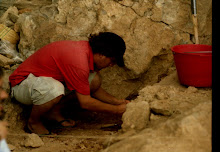
The most recent Current Anthropology contains a paper by K. Szabó and colleagues (2007) about the behavioral implications of shell working dating back to 28-32 ky bp at Golo Cave, on Gebe Island (E. Indonesia). Here's the abstract:
"The evolution of anatomical and behavioural modernity in Homo sapiens has been one of the key focus areas in both archaeology and palaeoanthropology since their inception. Traditionally, interpretations have drawn mainly on evidence from the many large and well-known sites in Europe, but archaeological research in Africa and the Levant is increasingly altering and elaborating upon our understanding of later human evolution. Despite the presence of a number of important early modern human and other hominin sites in Southeast Asia, evidence from this region has not contributed to the global picture in any significant way. Indeed, the acknowledged simplicity of lithic assemblages has led generations of scholars to assume that Southeast Asia was far from the cutting edge of behavioural evolution. Comparison of sophisticated shell tools fromlevels dated to 32,000–28,000 b.p. in eastern Indonesia with lithic artefacts recovered from the same levels and an assessment of raw material procurement suggest that using lithic technologies as markers of behavioural complexity may be misleading in a Southeast Asian context and, indeed, may be hampering our efforts to assess behavioural complexity in global and comparative frameworks."
The paper contains a very good description of the distinct technological pathways followed by the Golo Cave hominins to fashion implements out of shell and stone. While their discussion is somewhat limited by the small sample sizes with which they had to deal (51 lithic artifacts, 14 shell artifacts), they do make a strong case that the two kinds of materials were worked in different manners. Further, they adequately emphasize that the worked shell material (i.e., the opercula of Turbo marmoratus, a marine snail) was collected through targeted procurement in subtidal or lagoonal waters - not opportunistically as an expedient alternative to stone. And this, they argue, represents evidence of "behavioral modernity" because materials that were not immediately available were not worked in the same way as stone, which was worked at Golo Cave in an essentially expedient manner. That is, material that was more difficult to obtain was worked more carefully than that which was easier to procure.
They present, in my view, a solid discussion about how different this kind of shell working is from that documented in the Mousterian of Grotta dei Moscerini (Italy), where shells appear to have been collected opportunistically and worked in much the same way as stone flakes. That said, I disagree with their implication that the shell working documented at Golo Cave really is evidence of "modern behavior", at least as they seem to be conceiving it. This is a point made well in I. Davidson's comment on the paper: Szabó et al. don't clearly define what they mean by "modern behavior" which makes it difficult to situate their argument in the broader debate about this issue. From the paper, I gather that they see modern human behavior as being qualitatively different from that of non-modern hominins such as, for instance, Neanderthals. This is why they discuss the differences between their case study and the Moscerini shell artifacts. Now, as I've said, there's no question that shell working at Golo and Moscerini are very different in nature. However, the subsequent implication is that this is proof-positive that Neanderthals were not behaviorally modern, at least not in the same way as the Golo Cave foragers.
This is where I disagree with them: their argument basically boils down to claiming the fact that the Golo Cave toolmakers treated hard-to-procure material in a different, more elaborate way than more easily accessible stone is evidence of modernity (and perhaps even of symbolic behavior, though this is simply stated and not discussed in any depth in this paper). In light of this, I just want to point out that there is plenty of evidence that Neanderthals managed (i.e., knapped) different kinds of raw materials in very different manners, even within single assemblages. Talking about what I know best, in the Mousterian (and Uluzzian) of the Salento peninsula, "formal tools" were much more often made on flint, chert and quartzite, which are not available locally (i.e., were most likely procured 100+ km away). Likewise, the whole operational sequence of production is usually not documented in those sites, implying careful management and transport of these prized mineral resources. Locally available limestones, in contrast, were frequently worked, by and large in very expedient manners. A similar, though not identical, situation is documented at other Mousterian sites where long-distance raw material procurement is documented, for instance at Champ Grand, in France (which I discussed previously here), where exotic materials are found mainly as heavily retouched tools that likely doubled as portable cores (Slimak and Giraud 2007).
All in all, Szabó et al.'s study is an interesting presentation of the different technological responses of Pleistocene foragers to different kinds of raw materials. As well, their desire to transcend the essentialism of the usual 'trait list approach' to the definition and archaeological recognition of "behavioral modernity" is laudable and one with which I am in fundamental agreement. However, if their argument for behavioral modernity at Golo Cave is accepted at face value, the implication is that Neanderthals were also behaviorally modern, in at least some (important) respects...
References:
Slimak L., and Y. Giraud. 2007. Circulations sur plusieurs centaines de kilomètres durant le Paléolithique moyen. Contribution à la connaissance des sociétés néandertaliennes. Comptes Rendus Palevol 6:359-368.
Szabó, K. , A. Brumm, and P. Bellwood. 2007. Shell Artefact Production at 32,000–28,000 BP in Island Southeast Asia. Thinking across Media? Current Anthropology 48:701-723.
Thursday, September 20, 2007


Thursday, September 13, 2007
Pasta Strike!
Italy Urged to go on Pasta Strike!
Hmmm... doubt that'll work, though it is for a good cause. I, for one, abstained from consuming my almost-daily dose of semolina-based ambrosia, if only to show support for The Cause. Frankly, though, I only heard about this today - you'd think they'd have publicized it a bit better.
Hmmm... doubt that'll work, though it is for a good cause. I, for one, abstained from consuming my almost-daily dose of semolina-based ambrosia, if only to show support for The Cause. Frankly, though, I only heard about this today - you'd think they'd have publicized it a bit better.
Latest Four Stone Hearth is up and running
Run, do not walk, over to John Hawks' blog to check out the latest installment of Four Stone Hearth! Once again, there's lots of goodies gathered in there!
Wednesday, September 12, 2007
Clean-toothed Neanderthals
In case you haven't heard, two Neanderthal molars were recovered at the ca. 68.4 kya Spanish site of Pinilla del Valle, near Madrid. While finding any Neanderthal remains is always good news to me, the spin taken on those two (and, presumably, the reason which such a comparatively small find wound up being news on Reuters and El País) is that they display grooves that have interpreted as evidence for habitual toopicking. Martín Cagliani and John Hawks have already mentioned a 2003 paper by L. Hlusko to make the point that this discovery should come as no surprise since there is suggestive evidence of toothpicking going back to about 1.8 mya (on the Omo L 894-1 RP3 specimen).
I agree with them that the discovery as such should come as no surprise. However, I'd alo like to point out another CA paper on the topic of toothpicking,- this one by Agger et al. (2004), which has a set of altogether different implications. Agger et al. (2004:403)) argue "that toothpicking behavior may represent indirect evidence for the evolution of the biological capacity for language." Briefly, this is due to the presence of cranial nerve V, the largest branch of which controls (among other things) lingual movement and makes the teeth and gums extremely sensitive to various irritants. And toothpicking is one way to remove small irritants lodged between the teeth and/or in the gum. They conclude that:
So, if Agger et al. are correct, the Pinilla del Valle discovery might imply not only that Neanderthals could and did practice some form of dental hygiene, but also - and perhaps mostly importantly - that they had the capacity for speech, as is also suggested by the presence of an essentially modern hyoid bone in the Neanderthal larynx (Arensburg et al. 1989).
References
Agger, W. A., T. L. McAndrews, and J. A. Hlaudy. 2004. On Toothpicking in Early Hominids. Current Anthropology 45:403-404.
Arensburg, B., A. M. Tillier, B. Vandermeersch, H. Duday, L. A. Schepartz, and Y. Rak. 1989. A Middle Palaeolithic Human Hyoid Bone". Nature (338): 758-760.
Hlusko, L. J. 2003. The Oldest Hominid Habit? Experimental Evidence for Toothpicking with Grass Stalks. Current Anthropology 44: 738-741.
I agree with them that the discovery as such should come as no surprise. However, I'd alo like to point out another CA paper on the topic of toothpicking,- this one by Agger et al. (2004), which has a set of altogether different implications. Agger et al. (2004:403)) argue "that toothpicking behavior may represent indirect evidence for the evolution of the biological capacity for language." Briefly, this is due to the presence of cranial nerve V, the largest branch of which controls (among other things) lingual movement and makes the teeth and gums extremely sensitive to various irritants. And toothpicking is one way to remove small irritants lodged between the teeth and/or in the gum. They conclude that:
"As anyone who has had small pieces of food caught between his or her teeth or has developed a tooth chip is aware, such occurrences cause a sensation out of proportion to the size of the food matter or tooth defect. This exquisitely sensitive neural pathway for conveying proprioceptive information to higher brain centers can only be routed via a developed and functioning cranial nerve V. As a result, oral dental sensations promote the obligatory postprandial toothpick, at least in modern times and plausibly in early hominids. The proprioceptive information is not only protective but critical feedback for the tongue posturing necessary for speech.
Thus it appears that both a highly developed afferent cranial nerve V (trigeminal nerve) and VIII (auditory nerve) are needed for input to the Broadman's area along the perisylvian fissure of the human brain, the region of the brain that is critical for the formulation of speech. We hypothesize that the ability to sense and remove food particles between teeth occurred approximately 2 million years ago as a result of selective pressures driving the evolution of complex vocalization of the hominid frontal-parietal lobe." (Agger et al. 2004: 403).
Thus it appears that both a highly developed afferent cranial nerve V (trigeminal nerve) and VIII (auditory nerve) are needed for input to the Broadman's area along the perisylvian fissure of the human brain, the region of the brain that is critical for the formulation of speech. We hypothesize that the ability to sense and remove food particles between teeth occurred approximately 2 million years ago as a result of selective pressures driving the evolution of complex vocalization of the hominid frontal-parietal lobe." (Agger et al. 2004: 403).
So, if Agger et al. are correct, the Pinilla del Valle discovery might imply not only that Neanderthals could and did practice some form of dental hygiene, but also - and perhaps mostly importantly - that they had the capacity for speech, as is also suggested by the presence of an essentially modern hyoid bone in the Neanderthal larynx (Arensburg et al. 1989).
References
Agger, W. A., T. L. McAndrews, and J. A. Hlaudy. 2004. On Toothpicking in Early Hominids. Current Anthropology 45:403-404.
Arensburg, B., A. M. Tillier, B. Vandermeersch, H. Duday, L. A. Schepartz, and Y. Rak. 1989. A Middle Palaeolithic Human Hyoid Bone". Nature (338): 758-760.
Hlusko, L. J. 2003. The Oldest Hominid Habit? Experimental Evidence for Toothpicking with Grass Stalks. Current Anthropology 44: 738-741.
Friday, August 31, 2007
Yeahs and grumbles...
Not much time to post today, having spent most of it trying to figure out the SAA's "new and improved" all-electronic submission system for the 2008 meetings in Vancouver. Not too happy right now... spent most of the afternoon trying to figure this out, what a huge pain.
On the plus side, the contents of Ofer Bar-Yosef and João Zilhão's Towards a Definition of the Aurignacian are available as pdfs free of charge on the Trabalhos de Arqueologia web page or by clicking here. Some good papers in there... read 'em if you're serious about your transition studies and epistemological issues in archaeology/paleoanthropology.
Also of important note: check out the semi-final program (also available as a pdf) of the "Integrated Methodological Approaches to the Study of Lithic Technology" conference to be held in Florence, Dec. 13-15, 2007 are available on this section of the IIPP website. Looks like one that shouldn't be missed by people with rocks on the brain...
On the plus side, the contents of Ofer Bar-Yosef and João Zilhão's Towards a Definition of the Aurignacian are available as pdfs free of charge on the Trabalhos de Arqueologia web page or by clicking here. Some good papers in there... read 'em if you're serious about your transition studies and epistemological issues in archaeology/paleoanthropology.
Also of important note: check out the semi-final program (also available as a pdf) of the "Integrated Methodological Approaches to the Study of Lithic Technology" conference to be held in Florence, Dec. 13-15, 2007 are available on this section of the IIPP website. Looks like one that shouldn't be missed by people with rocks on the brain...
Tuesday, August 28, 2007
"Some sort of protohuman"
Here's a link to a report on the Discovery Channel's web page about a paper in press in the Journal of Human Evolution by R. Yeshurun and colleagues (Yeshurun et al. 2007). The paper reports on the 200 ky-old Middle Paleolithic assemblage from Misliya Cave, in Israel, and the authors principal conclusion is that, whoever deposited the assemblage, displays 'fully modern' hunting patterns (i.e., the targeting of prime-aged animals, the extraction of a maximum amount of nutrients through marrow extraction, etc.).

View of Misliya Cave (from The Zinman Institute of Archaeology's web site).
Here's my favorite quote of the report: "Because no human bones have yet been found in the cave, Yeshurun and his colleagues cannot identify which human species was responsible for the hunting. Given the early date, however, they suggest it was some sort of protohuman."
Now, I'm almost certain the authors themselves didn't use the term protohuman, which is weirdly anachronistic, though I confess to finding that it's got a nice ring to it... no? Basically, however, it implies that the assemblage could have been by Neanderthals, since there are no known modern human remains dating to this period in the Levant. If this was indeed the case, it would seem - once more - than Neanderthals were, among other things, fully capable hunters.
All kidding aside, though, this study - by avoiding discussing the taxonomic affiliation of who accumulated the Misliya Cave assemblage - further demonstrates the need to carefully decouple behavior from biology. This is a point that has been abundantly demonstrated for the past decade and a half (at least), but apparently remains a point to be established for some.
Also, there's some interesting discussing about population densities at that time, but having not yet fully read the paper, I'll reserve my thoughts on that for a bit later.
References:
Yeshurun, R., G. Bar-Oz,and M. Weinstein-Evron. 2007 (in press). Modern hunting behavior in the early Middle Paleolithic: Faunal remains from Misliya Cave, Mount Carmel, Israel. Journal of Human Evolution: doi:10.1016/j.jhevol.2007.05.008
View of Misliya Cave (from The Zinman Institute of Archaeology's web site).
Here's my favorite quote of the report: "Because no human bones have yet been found in the cave, Yeshurun and his colleagues cannot identify which human species was responsible for the hunting. Given the early date, however, they suggest it was some sort of protohuman."
Now, I'm almost certain the authors themselves didn't use the term protohuman, which is weirdly anachronistic, though I confess to finding that it's got a nice ring to it... no? Basically, however, it implies that the assemblage could have been by Neanderthals, since there are no known modern human remains dating to this period in the Levant. If this was indeed the case, it would seem - once more - than Neanderthals were, among other things, fully capable hunters.
All kidding aside, though, this study - by avoiding discussing the taxonomic affiliation of who accumulated the Misliya Cave assemblage - further demonstrates the need to carefully decouple behavior from biology. This is a point that has been abundantly demonstrated for the past decade and a half (at least), but apparently remains a point to be established for some.
Also, there's some interesting discussing about population densities at that time, but having not yet fully read the paper, I'll reserve my thoughts on that for a bit later.
References:
Yeshurun, R., G. Bar-Oz,and M. Weinstein-Evron. 2007 (in press). Modern hunting behavior in the early Middle Paleolithic: Faunal remains from Misliya Cave, Mount Carmel, Israel. Journal of Human Evolution: doi:10.1016/j.jhevol.2007.05.008
Thursday, August 23, 2007
Arrrrrr...chaeology and the quest for booty
It appears archaeologists have found the remains of Blackbeard's ship, the Queen Anne's Revenge, off the coast of North Carolina and that underwater excavations are going to take place to bring up about 30% of the remains by the end of this year. Here's the whole story.
Pirates rank in A Very Remote Period Indeed's list of things we dig (eh!) second only to archaeology and, possibly, zombies. So I couldn't help but link to this. Plus, it gives me an excuse to use the term booty in a post (let's see if it boosts traffic by drawing assorted booty enthusiasts).
The article includes some details about the schedule and logistics of this project, as well as a list of items included in "Blackbeard's booty," including cannons, gold flakes and, my personal favorite, "Metal syringes most likely used to administer mercury to treat venereal disease"... which I guess is a potential side-effect of getting too much booty! Yikes, though.
Pirates rank in A Very Remote Period Indeed's list of things we dig (eh!) second only to archaeology and, possibly, zombies. So I couldn't help but link to this. Plus, it gives me an excuse to use the term booty in a post (let's see if it boosts traffic by drawing assorted booty enthusiasts).
The article includes some details about the schedule and logistics of this project, as well as a list of items included in "Blackbeard's booty," including cannons, gold flakes and, my personal favorite, "Metal syringes most likely used to administer mercury to treat venereal disease"... which I guess is a potential side-effect of getting too much booty! Yikes, though.
Tuesday, August 21, 2007
Iceman AD 1942
Ok, this isn't quite archaeology strictly speaking, but it still is pretty cool: Climbers recently found the frozen, mummified remains of a US airman in the Sierra Nevadas, and the remains are being recovered by forensic anthropologists, presumably from CILHI, given that it's a person in uniform and all.
You can see a clip of the recovery effort by clicking here (still can't figure out this embed thing, argh!).
Hmmm... doesn't look like the recovery methods are that much better today than they were in the 90's when they recovered the original Iceman, Otzi... Still, it's pretty cool to see the stuff they found along with th body, though I'd be really interested in seeing how far around the artifacts (eh) have been scattered. Neat, though.
PS: ASU folks... is that To in the clip?
You can see a clip of the recovery effort by clicking here (still can't figure out this embed thing, argh!).
Hmmm... doesn't look like the recovery methods are that much better today than they were in the 90's when they recovered the original Iceman, Otzi... Still, it's pretty cool to see the stuff they found along with th body, though I'd be really interested in seeing how far around the artifacts (eh) have been scattered. Neat, though.
PS: ASU folks... is that To in the clip?
Monday, August 20, 2007
The great internet provider swindle...
Posts have been scant lately as I am still waiting for the gods of "the internets" to make their way to Casa Salvatore... turns out the "bundles" offered by Bell and Videotron are not so advantageous after all... figures! So, here's to hoping Cooptel is just as dandy as they promise to be! Cross your fingers, and check back soon...
Thursday, August 09, 2007
The Solutrean, 40 years later...

There's some information online about an upcoming conference on the Solutrean, to mark 40 years since the publication of P. Smith's 1966 monograph on that industry. You can find out more on this website.
Reference:
Smith, P. E. L. 1966. Le Solutréen en France. Mémoires l'Institut de Préhistoire de L'Université de Bordeaux 5. Delmas, Bordeaux
Wednesday, August 08, 2007
Stone Age Atlantis!
Or so says the headline of this BBC report on ongoing excavations at the underwater Mesolithic site of Bouldnor Cliff. Fascinating stuff about the logistics of running a Stone Age dig (or rather, the dig of a Stone Age site) under water and especially some fantastic pictures of the wealth of material preserved in water-logged hunter-gatherer sites (check out the pictures of hazelnuts and of a wooden pole with a lithic stuck in it!).


The BBC piece includes a nice quote by Garry Momber, director of the Hampshire and Wight Trust for Maritime Archaeology (which funds the project):
"It's called the Stone Age because, on land, we find stones from this period but under water a whole lot more survives... I believe these people were far more sophisticated than we give them credit for."
Indeed!
Hazelnuts!
Pole n' lithic!
The BBC piece includes a nice quote by Garry Momber, director of the Hampshire and Wight Trust for Maritime Archaeology (which funds the project):
"It's called the Stone Age because, on land, we find stones from this period but under water a whole lot more survives... I believe these people were far more sophisticated than we give them credit for."
Indeed!
Thursday, August 02, 2007
Long-distance raw material procurement in the Mousterian
There is a new paper by L. Slimak and Y. Giraud in the "in press" section of the Comptes Rendus Palevol about raw material exploitation patterns in the Mousterian assemblage from Champ Grand, in the Loire Valley (France). Slimak and Giraud use lithotype characterization (visual id, microscope and SEM) to establish that the assemblage contains pieces made on lithic raw materials available 250km to the north and 180km to the south as the crow flies, meaning that the effective distances were probably even greater as these straight lines cover some relatively difficult terrain to cross on foot. While these exotic raw materials account for only about 1% of the assemblage, the fact that such distant sources were exploited during the Mousterian (and, by extension, by Neanderthals) suggests:
"... a contact between different basins, the Loire and the Rhone ones, and therefore between the Atlantic and the Mediterranean. It is certain that these diffusions, whether they proceed directly or are the result of exchanges between populations, do not agree with the image of societies isolated in a territory. Indeed, the displacement of objects at such distances can only suggest the existence of networks structured between human groups and the existence of specific complex frames to these Middle Palaeolithic societies. The complexity of these behaviours also applies to the relationship with the raw material, in the suggested management of these mobile materials. This analysis documents circulations of lithic raw materials on geographical spaces as vast as those recognized during the Upper Palaeolithic..." (Slimak and Giraud 2007: 2-3).
Exotic raw materials were found in the assemblage mainly as retouch flakes, retouched tools and exhausted cores. The retouched tools - especially limaces - appear to have served both as tools with usable edges and as portable packages of raw material, as indicated by ventral thinning of those pieces in addition to clear retouch on the edges. This is in keeping with how exotic, prized lithotypes are managed among 'modern' hunter-gatherers.
An interesting discussion in the French part of the paper is that the Mousterian raw material procurement territory at Champ Grand is similar to that of nearby Magdalenian assemblages (i.e., much later and clearly made by modern humans), even if the frequency of exotic stone differs between the two periods is dissimilar. As the authors argue, "the differences between [the Middle and Upper Paleolithic] are to be found in the technological behavior and how lithic production was operationalized, as opposed to differences in the extent of their respective territories" (Slimak and Giraud 2007: 9; my translation).
This is a nice, succinct article that provides a nice counterpoint to typical assessments of Mousterian raw material procurement patterns and derived discussion of the smaller social geographies of Neanderthals relative to Homo sapiens sapiens (e.g., Féblot-Augustins 1997). Further proof that 'one-size fits all' characterizations of Neanderthal behavior are generally unwarranted.
References cited:
Féblot-Augustins, J. 1997. La circulations des matières premières au Paléolithique. Synthèse des données. Perspectives comportementales. Liège, ERAUL 75.
Slimak, L., Y. Giraud. 2007. Circulations sur plusieurs centaines de kilomètres durant le Paléolithique moyen. Contribution à la connaissance des sociétés néandertaliennes, C. R. Palevol , doi:10.1016/j.crpv.2007.06.001
"... a contact between different basins, the Loire and the Rhone ones, and therefore between the Atlantic and the Mediterranean. It is certain that these diffusions, whether they proceed directly or are the result of exchanges between populations, do not agree with the image of societies isolated in a territory. Indeed, the displacement of objects at such distances can only suggest the existence of networks structured between human groups and the existence of specific complex frames to these Middle Palaeolithic societies. The complexity of these behaviours also applies to the relationship with the raw material, in the suggested management of these mobile materials. This analysis documents circulations of lithic raw materials on geographical spaces as vast as those recognized during the Upper Palaeolithic..." (Slimak and Giraud 2007: 2-3).
Exotic raw materials were found in the assemblage mainly as retouch flakes, retouched tools and exhausted cores. The retouched tools - especially limaces - appear to have served both as tools with usable edges and as portable packages of raw material, as indicated by ventral thinning of those pieces in addition to clear retouch on the edges. This is in keeping with how exotic, prized lithotypes are managed among 'modern' hunter-gatherers.
An interesting discussion in the French part of the paper is that the Mousterian raw material procurement territory at Champ Grand is similar to that of nearby Magdalenian assemblages (i.e., much later and clearly made by modern humans), even if the frequency of exotic stone differs between the two periods is dissimilar. As the authors argue, "the differences between [the Middle and Upper Paleolithic] are to be found in the technological behavior and how lithic production was operationalized, as opposed to differences in the extent of their respective territories" (Slimak and Giraud 2007: 9; my translation).
This is a nice, succinct article that provides a nice counterpoint to typical assessments of Mousterian raw material procurement patterns and derived discussion of the smaller social geographies of Neanderthals relative to Homo sapiens sapiens (e.g., Féblot-Augustins 1997). Further proof that 'one-size fits all' characterizations of Neanderthal behavior are generally unwarranted.
References cited:
Féblot-Augustins, J. 1997. La circulations des matières premières au Paléolithique. Synthèse des données. Perspectives comportementales. Liège, ERAUL 75.
Slimak, L., Y. Giraud. 2007. Circulations sur plusieurs centaines de kilomètres durant le Paléolithique moyen. Contribution à la connaissance des sociétés néandertaliennes, C. R. Palevol , doi:10.1016/j.crpv.2007.06.001
Four Stone Hearth #20
Check it out, tout le monde: The 20th edition of Four Stone Hearth is currently in full swing at Afarensis featuring a past bit by your truly... I should probably mention to concerned readers and friends that haven't seen me in a while that they need not worry: I am still a man, man (to quote Mr. Powers). Hehe. Check out the FSH website for future dates and host-blogs.
Monday, July 30, 2007
Daily haha!
This is one of the best posts I've seen on an internet forum in a long time... pure gold! Now, everyone, let's get back to doing our jobs, shall we?
Prehistoric Art in Italy - Conference
The IIPP now has available on its web site the program (in pdf format) of its 42nd annual scientific meeting. This year's topic will be "Prehistoric Art in Italy," and the meeting will be held 9-13 October, 2007 in Trento, Riva del Garda and Val Camonica. Included are the titles of all the papers and posters to be presented at the conference, as well as a list of the excursions. If you're around those parts in October, this sounds like a must.
Sunday, July 29, 2007
That hill in Bosnia...
A few days ago, I noticed this item in the Chronicle of Higher Education (subscription needed, I believe) on unfortunate recent developments regarding research funding to investigate a hill claimed by a group of Bosnian enthusiasts to represent a monumental structure on par with some found in Egypt and Mesoamerica, but allegedly dating back to the last Ice Age. I've blogged about this project before and some of the reactions it prompted from actual archaeologists, and this alleged archaeological site has been argued by competent geologists and archaeologists to be nothing more than, wait for it, a perfectly normal hill! The AIA's magzine Archaeology has a page that explains why the case for 14 kya monumental archaeology on that hill is less than convincing (see also here). And recently, it had been announced that funding for this project had been revoked by the Bosnian government (see this post at Hot Cup of Joe).
However, in the Chronicle piece, C. Woodward reports that
"[The] controversial dig was halted earlier this year by Gavrilo Grahovac, minister of culture of Bosnia's Croat-Bosniak Federation, on account of its pseudoscientific nature and the "unreliable" credibility of its leaders. Mr. Grahovac withdrew the requisite permits to resume work and, according to reports in the Bosnian press, intended to withdraw public support for the project.
But last week Mr. Grahovac's decision was overruled by the federation's prime minister, Nedzad Brankovic, during an official visit to the site in Visoko, northwest of Sarajevo. "Why should we disown something that the entire world is interested in?" he told reporters. "Why don't we recognize something that is visible to the naked eye?""
Why? Because people with some legitimate competence in archaeology agree that this is not a man-made structure!! If it was truly "visible to the naked eye", wouldn't there be some support from legitimate, well-established archaeologists and geologists? And something (positive) might have been published in credible archaeology journals? You can bet your sweet rear-end that if there was any professional association backing up these claims, the "research team" would be heralding them as champions of truth and people willing to look past established paradigms. And yet, no one has boldly come out to accept these prestigious titles. What other recent "controversy" do you think this situation makes me think of? Hmmmmm....
In any case, shame on you, Mr. Brankovic, for promoting pseudo-science and for disregarding the decisions of the relevant authorities of your own country. And kudos to Mr. Grahovac for trying to do the right thing in this kind of a political climate.
PS: Any unwarranted reference to the "p-word" was dutifully avoided in the crafting of this post.
However, in the Chronicle piece, C. Woodward reports that
"[The] controversial dig was halted earlier this year by Gavrilo Grahovac, minister of culture of Bosnia's Croat-Bosniak Federation, on account of its pseudoscientific nature and the "unreliable" credibility of its leaders. Mr. Grahovac withdrew the requisite permits to resume work and, according to reports in the Bosnian press, intended to withdraw public support for the project.
But last week Mr. Grahovac's decision was overruled by the federation's prime minister, Nedzad Brankovic, during an official visit to the site in Visoko, northwest of Sarajevo. "Why should we disown something that the entire world is interested in?" he told reporters. "Why don't we recognize something that is visible to the naked eye?""
Why? Because people with some legitimate competence in archaeology agree that this is not a man-made structure!! If it was truly "visible to the naked eye", wouldn't there be some support from legitimate, well-established archaeologists and geologists? And something (positive) might have been published in credible archaeology journals? You can bet your sweet rear-end that if there was any professional association backing up these claims, the "research team" would be heralding them as champions of truth and people willing to look past established paradigms. And yet, no one has boldly come out to accept these prestigious titles. What other recent "controversy" do you think this situation makes me think of? Hmmmmm....
In any case, shame on you, Mr. Brankovic, for promoting pseudo-science and for disregarding the decisions of the relevant authorities of your own country. And kudos to Mr. Grahovac for trying to do the right thing in this kind of a political climate.
PS: Any unwarranted reference to the "p-word" was dutifully avoided in the crafting of this post.
Friday, July 27, 2007
Le Mois de l’archéologie au Québec / Québec Archaeology Month
OK... let's try this again!
Sorry for the hold-up in posts, but I am now back at the keyboard typing away at this blog, while getting used to working in my home town with my stupendously wonderful new wife after an eight-year stint in AZ! Go Montréal! Woohoo!! I'll be posting more regularly now, as my live is getting increasingly stable after a few months of insane activity!
Today, just a brief note to let the world know that August will be "Québec Archaeology Month" (i.e., "Le Mois de l’archéologie"), sponsored by Archéo-Québec. There'll be about 75 different events taking place around the province with the stated goal of making folks more aware of (and hopefully more interested in) the province's archaeological patrimony. In today's Gazette, S. Howell presents an overview of some of the events that will take place specifically in Montréal. I, for one,know that I'll be checking out at least a couple of those. Otherwise, you can also check out the rest of the activities planned for the month on the site's calendar. See you then!
Sorry for the hold-up in posts, but I am now back at the keyboard typing away at this blog, while getting used to working in my home town with my stupendously wonderful new wife after an eight-year stint in AZ! Go Montréal! Woohoo!! I'll be posting more regularly now, as my live is getting increasingly stable after a few months of insane activity!
Today, just a brief note to let the world know that August will be "Québec Archaeology Month" (i.e., "Le Mois de l’archéologie"), sponsored by Archéo-Québec. There'll be about 75 different events taking place around the province with the stated goal of making folks more aware of (and hopefully more interested in) the province's archaeological patrimony. In today's Gazette, S. Howell presents an overview of some of the events that will take place specifically in Montréal. I, for one,know that I'll be checking out at least a couple of those. Otherwise, you can also check out the rest of the activities planned for the month on the site's calendar. See you then!
Wednesday, April 04, 2007
Upcoming conference on lithic technology

The Istituto Italiano di Preistoria e Protostoria is sponsoring a conference on the topic of "Integrated Methodological Approaches to the Study of Lithic Technology" in December 2007. The keynote speakers include Eric Boëda, Eudald Carbonell, Jacques Jaubert and Steven Kuhn, all of whom have made significant contributions to the fields of lithic analysis and to Paleolithic archaeology. More information on what promises to be a very stimulating and exciting meeting can be found here, and is also available in English and in French.
.... and we're back!!
Wow, well, that interruption lasted a bit longer than anticipated! But here we are, back to trekking the information superhighway. Posts may still be kind of irregular until the end of this term, but it should be better than in the past two months! Come back and check what's new soon!
Sunday, February 04, 2007
Pause
Things are a wee bit chaotic here over here, so I don't expect to be able to post much for the next couple of weeks. Check again in a few for some new posts.
Tuesday, January 30, 2007
Paleoanthropology Society meetings
The preliminary program of the annual meetings of the Paleoanthropology Society is now online as a freely downloadable pdf. Looks like it will be, once again, a very stimulating meeting: there's a couple of papers on the 'hobbits' from Flores, a number of studies on Neanderthals and on the Middle-Upper Paleolithic transition, a study on the newly discovered Gravettian infant burials from Krems-Wachtberg, and the list goes on! Check it out.
Thursday, January 25, 2007
Gnomes!
A little non-anthro post because this is just too damn weird!
From the report in Reuters:
"It's being called the "Gnomesville Massacre"... An unknown number of attackers lopped off the heads or smashed several dozen of the pot-bellied statues this week at Gnomesville, a collection of more than a 1,000 colorful characters deep in a forest south of Perth."
You can read the whole thing here.
I don't know what's oddest about this story: the 'massacre' or the fact that Gnomesville exists in the first place!
From the report in Reuters:
"It's being called the "Gnomesville Massacre"... An unknown number of attackers lopped off the heads or smashed several dozen of the pot-bellied statues this week at Gnomesville, a collection of more than a 1,000 colorful characters deep in a forest south of Perth."
You can read the whole thing here.
I don't know what's oddest about this story: the 'massacre' or the fact that Gnomesville exists in the first place!
Wednesday, January 10, 2007
Slicing cut marks on bone: new JFA paper
I've been getting into cut mark studies lately as a result of an experimental archaeology project I got involved with here at ASU. As luck would have it, a short new paper by Haskel J. Greenfield (University of Manitoba) came out recently in the Journal of Field Archaeology
Here, Greenfield uses light optical and, especially, scanning electron microscopes to investigate the morphology of cut marks produced using a range of lithic implements. He uses experimental cut marks on planks of wood to determine the morphology, and is able to identify corresponding marks on archaeological bones from the Early Bronze Age I site of Afridar (Israel). While his archaeological sample is small, he appears to be able to distinguish between the cut marks made by unretouched blades and flakes, on the one hand, and sidescrapers, on the other. He also experiments with various raw materials, namely flint, quartzite and obsidian.
He concludes that "the shape of a tool as a stronger influence on the shape of a cut mark than does the raw material from which it was fashioned" (2006:161), and, unsurprisingly, that "no perceptible differences were observed between cut marks made by unmodified blades and flakes." (2006:153). In his sample, the main difference in cut mark morphology is between unretouched pieces and sidescrapers.
Greenfield shows that unretouched pieces produce "cut marks [that] are thin , relatively straight, and shallow. The internal morphology tends to be consistent: on one side, a groove will descend... steeply and smoothly; on the other side, the groove will descend more gradually, and will have more parallel striations (to the apex of the mark)." In contrast, "sidescrapers leave an irregular and almost wave-like profile." (2006:161). Both patterns are the results of the morphology of the edges of the two kinds of slicing implements.
I liked this paper, though it might have benefited from a more extensive application of the methods on archaeological material. The main drawback, as I see it, is that Greenfield is forced to rely on a SEM for most of this work, which prevents the inspection of large bones, indeed of elements larger than 2-3cm in size. While he gets around this by making silicone molds of the relevant cut marks which can then be broken down to appropriate size for inspection under the SEM, this makes the method impractical for inspecting large numbers of cut marks as well as for identifying the tools used to produce cut marks at lower levels of resolution. While it is clearly important to demonstrate that different tools leave distinct kinds of marks that can be identified at very high levels of resolution, it would also be useful to develop complementary low-resolution methods that are more readily usable in, say, the field lab, something maybe building on the low-res methods of Walker (1978; Walker and Long 1977).
References
Greenfield, H. J. 2006. Slicing cut marks on animal bones: diagnostics for identifying stone tool type and raw material. Journal of Field Archaeology 31:147-163.
Walker, P. L. 1978. Butchering and stone tool function. American Antiquity 43:710-715.
Walker, P. L., and J. C. Long. 1977. An experimental study of the morphological characteristics of tool marks. American Antiquity 42:605-616.
Here, Greenfield uses light optical and, especially, scanning electron microscopes to investigate the morphology of cut marks produced using a range of lithic implements. He uses experimental cut marks on planks of wood to determine the morphology, and is able to identify corresponding marks on archaeological bones from the Early Bronze Age I site of Afridar (Israel). While his archaeological sample is small, he appears to be able to distinguish between the cut marks made by unretouched blades and flakes, on the one hand, and sidescrapers, on the other. He also experiments with various raw materials, namely flint, quartzite and obsidian.
He concludes that "the shape of a tool as a stronger influence on the shape of a cut mark than does the raw material from which it was fashioned" (2006:161), and, unsurprisingly, that "no perceptible differences were observed between cut marks made by unmodified blades and flakes." (2006:153). In his sample, the main difference in cut mark morphology is between unretouched pieces and sidescrapers.
Greenfield shows that unretouched pieces produce "cut marks [that] are thin , relatively straight, and shallow. The internal morphology tends to be consistent: on one side, a groove will descend... steeply and smoothly; on the other side, the groove will descend more gradually, and will have more parallel striations (to the apex of the mark)." In contrast, "sidescrapers leave an irregular and almost wave-like profile." (2006:161). Both patterns are the results of the morphology of the edges of the two kinds of slicing implements.
I liked this paper, though it might have benefited from a more extensive application of the methods on archaeological material. The main drawback, as I see it, is that Greenfield is forced to rely on a SEM for most of this work, which prevents the inspection of large bones, indeed of elements larger than 2-3cm in size. While he gets around this by making silicone molds of the relevant cut marks which can then be broken down to appropriate size for inspection under the SEM, this makes the method impractical for inspecting large numbers of cut marks as well as for identifying the tools used to produce cut marks at lower levels of resolution. While it is clearly important to demonstrate that different tools leave distinct kinds of marks that can be identified at very high levels of resolution, it would also be useful to develop complementary low-resolution methods that are more readily usable in, say, the field lab, something maybe building on the low-res methods of Walker (1978; Walker and Long 1977).
References
Greenfield, H. J. 2006. Slicing cut marks on animal bones: diagnostics for identifying stone tool type and raw material. Journal of Field Archaeology 31:147-163.
Walker, P. L. 1978. Butchering and stone tool function. American Antiquity 43:710-715.
Walker, P. L., and J. C. Long. 1977. An experimental study of the morphological characteristics of tool marks. American Antiquity 42:605-616.
Monday, January 08, 2007
Good job, 'Cats!
Seriously, what the hell!?! This kind of imbecility makes me even less of a fan of college football or school spirit. It's even more annoying when stuff like this happens in your own backyard... I live not 5 minutes away from Tempe butte (aka A Mountain)!
"Vandals climbed Tempe butte and painted a large red "A" - the University of Arizona's color - before the annual football game between the two rivals on Nov. 25. The paint job was first spotted two days before the ASU Sun Devils whipped the Wildcats 28-14.
Pranksters also hit the Sun Devils' practice field, painting a blue "A" and "Bear Down," the University of Arizona motto, on the turf.
But the red paint on the rocks of the butte could have erased rock art that dates to 1250, city officials said. Tempe could be forced to spend thousands of dollars to fly in a petroglyph expert and have the paint tediously removed by hand."
And here I was, thinking that being in college was all about getting an education and forming responsible citizens. I realize only a handful of people did this, but sweet lord, grow up!!
"Vandals climbed Tempe butte and painted a large red "A" - the University of Arizona's color - before the annual football game between the two rivals on Nov. 25. The paint job was first spotted two days before the ASU Sun Devils whipped the Wildcats 28-14.
Pranksters also hit the Sun Devils' practice field, painting a blue "A" and "Bear Down," the University of Arizona motto, on the turf.
But the red paint on the rocks of the butte could have erased rock art that dates to 1250, city officials said. Tempe could be forced to spend thousands of dollars to fly in a petroglyph expert and have the paint tediously removed by hand."
And here I was, thinking that being in college was all about getting an education and forming responsible citizens. I realize only a handful of people did this, but sweet lord, grow up!!
New Neanderthal archaeology papers in Before Farming
This is my first post on a series of three papers in the latest issue of the online journal Before Farming, all of which deal with aspects of Neanderthal archaeology. I've read all of them, and they're quite stimulating.
I intend to post about them in greater depth shortly, but in the meantime, I'll just mention that the first paper by, J. Speth and J. Clark, documents the large mammal procurement patterns of Middle Paleolithic hominins at Kebara Cave (Israel); one of the most provocative conclusions of the paper is that the Kebara record documents overhunting of ungulates by Neanderthals. The implications of this pattern for increasing diet breadth are also discussed.
The second paper, by A. Verpoorte, deals with a theoretical model of Neanderthal energetics, and how these might have conditioned their mobility patterns relative to those of modern humans. The paper is based on a simple hypothetical model based on the concept of central place foraging, the conclusions of which are then compared to patterns in the archaeological record of European Neanderthals, which they broadly appear to match. Verpoorte concludes that Neanderthals aimed to reduce their overall mobility by adopting a behavioral (and energetic) strategy that revolved around a pattern of "frequent, short-distance movement."
The last paper, by J. Zilhão and P. Pettitt, to my knowledge, is the first peer-reviewed critique of the new, very late dates for the Mousterian of Gorham's Cave (Gibraltar) (Finlayson et al. 2006). The authors show that there are a number of logical, methodological, taphonomic, and empirical problems with Finlayson et al.'s (2006) arguments for a 28-24 kya occupation of Gorham's Cave by Neanderthals, and they conclude instead that the available dates support an age of 30-32 kya for the last Mousterian occupation of the site. Noting that the new Gorham's Cave dates came out in September 2006, this also suggest a very fast turn-around time for papers submitted to Before Farming, which can only be a positive pattern for the world of paleanthropological research.
Overall, a very nice series of papers to start the new year with!
References:
Finlayson, C, Giles Pacheco, F, Rodríguez-Vidal, J, Fa, DA, Guiterrez López, JM, Santiago Pérez, A, Finlayson, G, Allue, E., Baena Preysler, J, Cáceres, I, Carrión,
JS, Fernaández- Jalvo, Y, Gleed-Owen, CP, Jimenez Espejo, FJ, López, P, López Sáez, JA, Riquelme Cantal, JA, Sánchez Marco, A, Giles Guzman, F, Brown, K, Fuentez, N, Valarino, CA, Villalpando, A, Stringer, CB, Martinez Ruiz, F & Sakamoto, T 2006.
Late survival of Neanderthals at the southernmost extreme of Europe. Nature 443:850-853.
Speth, J.D., and J.M. Clark. 2006. Hunting and overhunting in the Levantine Late Middle Palaeolithic. Before Farming 2006/3:1.
Verpoorte, A. 2006. Neanderthal energetics and spatial behaviour. Before Farming 2006/3:2.
Zilhão, J., and P. Pettitt. 2006. On the new dates for Gorham's Cave and the late survival of Iberian Neanderthals. Before Farming 2006/3:3.
I intend to post about them in greater depth shortly, but in the meantime, I'll just mention that the first paper by, J. Speth and J. Clark, documents the large mammal procurement patterns of Middle Paleolithic hominins at Kebara Cave (Israel); one of the most provocative conclusions of the paper is that the Kebara record documents overhunting of ungulates by Neanderthals. The implications of this pattern for increasing diet breadth are also discussed.
The second paper, by A. Verpoorte, deals with a theoretical model of Neanderthal energetics, and how these might have conditioned their mobility patterns relative to those of modern humans. The paper is based on a simple hypothetical model based on the concept of central place foraging, the conclusions of which are then compared to patterns in the archaeological record of European Neanderthals, which they broadly appear to match. Verpoorte concludes that Neanderthals aimed to reduce their overall mobility by adopting a behavioral (and energetic) strategy that revolved around a pattern of "frequent, short-distance movement."
The last paper, by J. Zilhão and P. Pettitt, to my knowledge, is the first peer-reviewed critique of the new, very late dates for the Mousterian of Gorham's Cave (Gibraltar) (Finlayson et al. 2006). The authors show that there are a number of logical, methodological, taphonomic, and empirical problems with Finlayson et al.'s (2006) arguments for a 28-24 kya occupation of Gorham's Cave by Neanderthals, and they conclude instead that the available dates support an age of 30-32 kya for the last Mousterian occupation of the site. Noting that the new Gorham's Cave dates came out in September 2006, this also suggest a very fast turn-around time for papers submitted to Before Farming, which can only be a positive pattern for the world of paleanthropological research.
Overall, a very nice series of papers to start the new year with!
References:
Finlayson, C, Giles Pacheco, F, Rodríguez-Vidal, J, Fa, DA, Guiterrez López, JM, Santiago Pérez, A, Finlayson, G, Allue, E., Baena Preysler, J, Cáceres, I, Carrión,
JS, Fernaández- Jalvo, Y, Gleed-Owen, CP, Jimenez Espejo, FJ, López, P, López Sáez, JA, Riquelme Cantal, JA, Sánchez Marco, A, Giles Guzman, F, Brown, K, Fuentez, N, Valarino, CA, Villalpando, A, Stringer, CB, Martinez Ruiz, F & Sakamoto, T 2006.
Late survival of Neanderthals at the southernmost extreme of Europe. Nature 443:850-853.
Speth, J.D., and J.M. Clark. 2006. Hunting and overhunting in the Levantine Late Middle Palaeolithic. Before Farming 2006/3:1.
Verpoorte, A. 2006. Neanderthal energetics and spatial behaviour. Before Farming 2006/3:2.
Zilhão, J., and P. Pettitt. 2006. On the new dates for Gorham's Cave and the late survival of Iberian Neanderthals. Before Farming 2006/3:3.
Saturday, January 06, 2007
Radiocarbon dating the 40-60 kya interval
Jeff Pigati and colleagues have a paper in press in Quaternary International about a new protocol that enables radiocarbon dating of very old samples (i.e., between 40-60 kya in age). This should come as very good news for anyone interested in the chronology of the late Middle Paleolithic and early Upper Paleolithic, since this period has always been very tricky to date accurately. Between this, the ultrafiltration methods now being used at the Oxford lab, and advances in radiocarbon age calibration past 26 kya, it can be hoped that the chronology of that period will come into sharper focus in the next few years.
From the abstract:
"At the University of Arizona’s Desert Laboratory, we recently constructed new low background vacuum extraction and graphitization systems that are dedicated to preparing old (40-60 ka) samples for 14C dating. These systems are designed to minimize the amount of contaminant carbon, specifically atmospheric carbon, that is introduced to a sample during laboratory processing. Excluding contaminants is particularly important for 14C dating of old samples because the impact of contamination increases with sample age...
Based on the AMS results, the background level of our system is characterized by a nonlinear inverse relationship with sample mass (adjusted R2=0.75; n=24). For a 1 mg graphite target, the total procedural blank, including chemical pretreatment, combustion, cleanup, graphitization, storage, and AMS measurement, is 0.05±0.01 pMC (2σ), equivalent to a 14C “age” of 61.1±1.8 ka. This should not be taken as the upper limit of our system, however, because if the 14C activity of a sample is statistically indistinguishable from the appropriate mass-dependent blank value at the 95% confidence level (2σ), then its age is considered to be “infinite”. Thus, for a 1 mg target, the practical limit of our system is actually ~55 ka; for a 0.5 mg target, the practical limit is ~50 ka. Although our extraction system can accommodate inorganic samples (e.g., calcite, aragonite), the above limits are only applicable to geological graphite, charcoal, and organic samples that are processed via combustion. Future work will be directed toward determining the appropriate background levels for inorganic materials."
References
Pigati, J. S., J. Quade, J. Wilson, A.J. Timothy Jull, and N. A. Lifton. (in press) Development of low-background vacuum extraction and graphitization systems for 14C dating of old (40-60 ka) samples. Quaternary International: doi:10.1016/j.quaint.2006.12.006
From the abstract:
"At the University of Arizona’s Desert Laboratory, we recently constructed new low background vacuum extraction and graphitization systems that are dedicated to preparing old (40-60 ka) samples for 14C dating. These systems are designed to minimize the amount of contaminant carbon, specifically atmospheric carbon, that is introduced to a sample during laboratory processing. Excluding contaminants is particularly important for 14C dating of old samples because the impact of contamination increases with sample age...
Based on the AMS results, the background level of our system is characterized by a nonlinear inverse relationship with sample mass (adjusted R2=0.75; n=24). For a 1 mg graphite target, the total procedural blank, including chemical pretreatment, combustion, cleanup, graphitization, storage, and AMS measurement, is 0.05±0.01 pMC (2σ), equivalent to a 14C “age” of 61.1±1.8 ka. This should not be taken as the upper limit of our system, however, because if the 14C activity of a sample is statistically indistinguishable from the appropriate mass-dependent blank value at the 95% confidence level (2σ), then its age is considered to be “infinite”. Thus, for a 1 mg target, the practical limit of our system is actually ~55 ka; for a 0.5 mg target, the practical limit is ~50 ka. Although our extraction system can accommodate inorganic samples (e.g., calcite, aragonite), the above limits are only applicable to geological graphite, charcoal, and organic samples that are processed via combustion. Future work will be directed toward determining the appropriate background levels for inorganic materials."
References
Pigati, J. S., J. Quade, J. Wilson, A.J. Timothy Jull, and N. A. Lifton. (in press) Development of low-background vacuum extraction and graphitization systems for 14C dating of old (40-60 ka) samples. Quaternary International: doi:10.1016/j.quaint.2006.12.006
More on the "python"
The posts that brought the most traffic to A Very Remote Period Indeed in 2006 were arguably those having to do with the work on the MSA deposits of Rhino Cave (Botswana) by Sheila Coulson and her team. In what's probably my last mention of this until actual pubs of the work come out, I want to direct your attention to a brief feature on the work at Rhino Cave and the case for early MSA ritual published in National Geographic (picked this up on ArchaeoBlog). There's not much else on the discoveries themselves, but the piece includes some interesting comments by Stanley Ambrose, Alec Campbell, Rupert Isaacson and Larry Robbins.
2007 is the new 2006
Well, one more year has gone and been replaced by a new one. I enjoyed a wonderful 2006 (much, much better than the dark year known as 2005), and hope that 2007 brings with it even better things for everyone around.
One of my resolutions is to endeavor to be more constant about posting to this blog. I'm not in the business of making predictions, but I know for a fact that 2007 will be an interesting year for paleoanthropology, and especially Paleolithic archaeology: there's new dates on the horizon, new debates emerging, and new ways to look at the record that should make for a stimulating year of debates and discussion.
I also want to take a moment to thank all the readers of the blog and all the people who left me feedback since I started this baby up, either as comments on the blog or through other channels. I'm heartened to see that my musings about things prehistoric are interesting enough for people to take the time to read, and hope to continue providing stimulating food for thought in the coming months!
One of my resolutions is to endeavor to be more constant about posting to this blog. I'm not in the business of making predictions, but I know for a fact that 2007 will be an interesting year for paleoanthropology, and especially Paleolithic archaeology: there's new dates on the horizon, new debates emerging, and new ways to look at the record that should make for a stimulating year of debates and discussion.
I also want to take a moment to thank all the readers of the blog and all the people who left me feedback since I started this baby up, either as comments on the blog or through other channels. I'm heartened to see that my musings about things prehistoric are interesting enough for people to take the time to read, and hope to continue providing stimulating food for thought in the coming months!
Monday, December 11, 2006
"Forget the bull whip..."
Well, CNN has done us all a service and posted a feature on how to make it as an archaeologist, folks! Overall, it's not as terrible as I expected something like this to be on CNN (hey, they do stress the need for appropriate credentials!). As someone who recently turned in a draft of his dissertation, though, my personal favorite advice is....
Resign yourself to a lifetime of poorly-paid obscurity
"Archaeology is a tough business, and certainly not for those who crave either their creature comforts or a healthy bank balance... If you are not utterly obsessed with the subject, to the exclusion of all else, then archaeology is probably not for you."
Mamma mia! Seriously, folks, it ain't that bad... unless of course I am so utterly obsessed with cavemen to the exclusion of everything else that I didn't realize this until now... thanks, CNN!
Resign yourself to a lifetime of poorly-paid obscurity
"Archaeology is a tough business, and certainly not for those who crave either their creature comforts or a healthy bank balance... If you are not utterly obsessed with the subject, to the exclusion of all else, then archaeology is probably not for you."
Mamma mia! Seriously, folks, it ain't that bad... unless of course I am so utterly obsessed with cavemen to the exclusion of everything else that I didn't realize this until now... thanks, CNN!
Interview with Sheila Coulson on Mundo Neandertal
Check you this! Martín Cagliani of Mundo Neandertal has posted the transcript of an interview with Dr. Sheila Coulson, whose recent work and discovery of the "earliest documented ritual" in Botswana I blogged about ten days or so ago.
This is a very informative interview and it resolves some of the questions I (and others) had about the discovery. This info comes straight from the source, which corrects some of the interpretive distortions present in the original report of the discovery, which was a translated news report, and not a scientific publication. Since the interview's transcript is in Spanish, here’s a summary of some of the details of the interview:
1) Of the 13,000 recovered lithic artifacts, 115 are finely retouched typological points. These are said to be analogous to those from the MSA levels at the ≠Gi site excavated by A. Brooks and colleagues, and dated to ca. 77 kya. With the exception of an unspecified number made on quartz and rock crystal, which are available locally, the artifacts are made on types of rocks whose closest source lies in Namibia. You can see some of the artifacts here on Coulson's site... these look a lot better than the ones published in Apollon. Some Levallois cores (but no Levallois points) are also reported.
2) The date of ca. 70 kya for the site is confirmed to be a relative estimate. It is based on similarities between the Rhino Cave artifacts and those from ≠Gi, and two absolute dates from other MSA sites in the Tsodilo Hills (ca. 64 kya and 96 kya). Plans are in the works to have a dating (TL?) specialist from the Max Planck Institute to come and date the deposits in the relatively near future, though the size of the cave and the kind of cave it is (and the location of the test pit at the entrance of the cave) may make TL dating tricky. Future work that will focus on deposits further inside the cave may yield deposits more propitious to TL.
3) The excavated area is a 1x1m test pit that reached down about 2m. The stratigraphy of the deposits exposed a 65cm thick LSA deposit of aeolian sediments, which overlay highly compacted MSA deposits of a drastically different sedimentary nature, and which may have been cemented as well (my translation is a bit iffy here). There are more unexcavated MSA deposits below.
4) The "ritual function" of the points is inferred on their state of recovery. They were all roughed out elsewhere and finished at Rhino Cave. They were found in three states: perfectly intact, broken in half, or (in 22 cases) burned in the midst of the debitage created during their manufacture. The latter are the only burnt things encountered in the test pit, and none of the points bear any kind of impact fracture suggestive of use as part of projectile weapons.
5) Analysis of the material is ongoing, and excavations are set to resume in 2008.
I will try to contact Martín and see if it is possible to post an English translation of the interview somewhere. In the meantime, I'll offer a few comments on the information provided in the interview. I’ll limit these to stuff we can actually talk about based on the interview as opposed to talking about how definitive publication is needed before certain issues can be settled. I hope these do not come across as disparaging: the comments below aren't meant to be mean-spirited at all, but rather as outlining areas I'm eager to learn more about. Anyway.
It's suggested that the points are mainly made on exogenous rock, but it’s unclear what the actual proportion is and there is mention that a portion of the assemblage was made on local raw material. Here, I'd like to point out that it's not unusual to have heavily retouched artifacts made on exotic lithotypes even in European Mousterian contexts (i.e., made by Neanderthals), albeit in comparatively small numbers. I guess that without contextual information about lithic raw material frequencies in the debitage and small fraction, it's hard to say. An interesting fact, however, is that, in the archaeological record of other mobile hunter-gatherers that used bifacial technology (e.g., Paleoindian groups), it's not unusual to find bifacial artifacts often made on exotic stone. However, in those contexts, it has often been found that these bifaces were usually not so much used as the tips of hunting weapons, but rather as multi-purpose cutting implements and/or convenient portable 'cores' from which flakes could be struck at a moment's notice, as they became necessary (Kelly 1988; Kelly and Todd 1988). That these bifaces should be made predominantly on exotic, fine-grained stone is not surprising since lithic homogeneity is a prerequisite for such a strategy to be worthwhile in the first place. So, the disproportionate presence of bifacial implements on exotic raw materials and bearing no evidence of use as spearheads is not necessarily unexpected in the context of a mobile Paleolithic group that made bifacial tools. Evidence of no use at all might be more convincing proof of ritual production.
I'm not sure what to make of the 'ritual way' in which these artifacts entered the archaeological record. It certainly sounds intriguing, but I’m not sure more prosaic interpretations need to be discarded at this point. The fact that they're found in the midst of so much other lithic debris does not suggest a ritual discard context to me, at least based on what's been revealed so far. That some were found in perfect condition or broken in half is not necessarily completely unexpected, especially if they can be shown to have been near or at the end of their use-life (this can be assessed using methods like those recently proposed by Andrefsky [2006]). More puzzling are the burnt ones, found in the midst of their debitage. Here, it will be important to know exactly how they were identified as burned. Heat-treating of lithic raw material to improve its quality should not be ruled out out-of-hand here, especially if that raw material was meant to be carried around for a while and need to be dependable. So, unless there's direct evidence of in situ combustion features associated only with those artifacts, it might be challenging to link them unambiguously to discard in a ritual context. Likewise, it'll be very important to see whether the scenario of these chipped stone implements being imported as 'rough outs' is supported by refitting studies and/or details about the incidence of cortical pieces among the debitage associated with their final production.
One last comment, this one more practical in nature: so far, the Middle Stone Age levels have reached a depth of 2m below present surface. The top of the 'python' is 2m above the present surface. That means that the top of the rock would have been 2.65m (about 9 feet) above the ground in the latest Middle Stone Age, and 4m (13 feet) above it at the base of the test pit (which is not the base of the total deposit). Conversely, the base of the rock would have been between 0.65m and 2m above the Middle Stone Age ground level. Now, MSA people could obviously have built scaffolding and/or ladders, or even climbed the rock face, but it does raise the questions of the position of the 'python' relative to that of the Middle Stone Age occupants of the cave, how they would have organized themselves to chip away at it, and what the thing would have looked like from down below. This is an important question to consider, especially if the 'python' was an integral part of why Middle Stone Age folks occupied the site in the first place. So far, all the views of the 'python' have been generated at present ground levels, and it might have looked different from 2m below it, especially since the 'eyes' and 'mouth' might not have been as easily visible from that distance.
The original news report mentioned that part of the 'python''s surface had been found in the Middle Stone Age levels, but unless it bears the same indentations and unless these indentations can be shown unambiguously to be human-made, finding wall spalling is not unexpected in a cave context. The picture of what I think is the piece being referred to does appear to be be grooved, but this groove looks shallower and narrower than the ones seen on the 'python''s surface.
It might well be that the 'python' was intentionally shaped in prehistory, but that this was done in the Later Stone Age, or even in recent prehistory. There's certainly an abundance of prehistoric engravings in southern Africa, none of which have so far been attributed to the Middle Stone Age, so the burden of proof here is to conclusively demonstrate their association at Rhino Cave, as opposed to stressing that it is a possibility. If the chipping is conclusively demonstrated to be MSA in age, this truly will be a sensational discovery, no doubt about it.
All in all, this interview is very interesting and enlightening, but - as is always the case, I suppose - it generates additional, intriguing questions. Can't wait for the first publications, they'll be most interesting to read, and can't wait to hear (even) more about this site in general.
References
Andrefsky, W. 2006. Experimental and archaeological verification of an index of reduction retouch for hafted bifaces. American Antiquity 71:743-758.
Kelly, R. 1988. The three sides of a biface. American Antiquity 53:717-734.
Kelly, R., and L. Todd. 1988. Coming into the country: early Paleoindian hunting and mobility. American Antiquity 53: 231-244.
This is a very informative interview and it resolves some of the questions I (and others) had about the discovery. This info comes straight from the source, which corrects some of the interpretive distortions present in the original report of the discovery, which was a translated news report, and not a scientific publication. Since the interview's transcript is in Spanish, here’s a summary of some of the details of the interview:
1) Of the 13,000 recovered lithic artifacts, 115 are finely retouched typological points. These are said to be analogous to those from the MSA levels at the ≠Gi site excavated by A. Brooks and colleagues, and dated to ca. 77 kya. With the exception of an unspecified number made on quartz and rock crystal, which are available locally, the artifacts are made on types of rocks whose closest source lies in Namibia. You can see some of the artifacts here on Coulson's site... these look a lot better than the ones published in Apollon. Some Levallois cores (but no Levallois points) are also reported.
2) The date of ca. 70 kya for the site is confirmed to be a relative estimate. It is based on similarities between the Rhino Cave artifacts and those from ≠Gi, and two absolute dates from other MSA sites in the Tsodilo Hills (ca. 64 kya and 96 kya). Plans are in the works to have a dating (TL?) specialist from the Max Planck Institute to come and date the deposits in the relatively near future, though the size of the cave and the kind of cave it is (and the location of the test pit at the entrance of the cave) may make TL dating tricky. Future work that will focus on deposits further inside the cave may yield deposits more propitious to TL.
3) The excavated area is a 1x1m test pit that reached down about 2m. The stratigraphy of the deposits exposed a 65cm thick LSA deposit of aeolian sediments, which overlay highly compacted MSA deposits of a drastically different sedimentary nature, and which may have been cemented as well (my translation is a bit iffy here). There are more unexcavated MSA deposits below.
4) The "ritual function" of the points is inferred on their state of recovery. They were all roughed out elsewhere and finished at Rhino Cave. They were found in three states: perfectly intact, broken in half, or (in 22 cases) burned in the midst of the debitage created during their manufacture. The latter are the only burnt things encountered in the test pit, and none of the points bear any kind of impact fracture suggestive of use as part of projectile weapons.
5) Analysis of the material is ongoing, and excavations are set to resume in 2008.
I will try to contact Martín and see if it is possible to post an English translation of the interview somewhere. In the meantime, I'll offer a few comments on the information provided in the interview. I’ll limit these to stuff we can actually talk about based on the interview as opposed to talking about how definitive publication is needed before certain issues can be settled. I hope these do not come across as disparaging: the comments below aren't meant to be mean-spirited at all, but rather as outlining areas I'm eager to learn more about. Anyway.
It's suggested that the points are mainly made on exogenous rock, but it’s unclear what the actual proportion is and there is mention that a portion of the assemblage was made on local raw material. Here, I'd like to point out that it's not unusual to have heavily retouched artifacts made on exotic lithotypes even in European Mousterian contexts (i.e., made by Neanderthals), albeit in comparatively small numbers. I guess that without contextual information about lithic raw material frequencies in the debitage and small fraction, it's hard to say. An interesting fact, however, is that, in the archaeological record of other mobile hunter-gatherers that used bifacial technology (e.g., Paleoindian groups), it's not unusual to find bifacial artifacts often made on exotic stone. However, in those contexts, it has often been found that these bifaces were usually not so much used as the tips of hunting weapons, but rather as multi-purpose cutting implements and/or convenient portable 'cores' from which flakes could be struck at a moment's notice, as they became necessary (Kelly 1988; Kelly and Todd 1988). That these bifaces should be made predominantly on exotic, fine-grained stone is not surprising since lithic homogeneity is a prerequisite for such a strategy to be worthwhile in the first place. So, the disproportionate presence of bifacial implements on exotic raw materials and bearing no evidence of use as spearheads is not necessarily unexpected in the context of a mobile Paleolithic group that made bifacial tools. Evidence of no use at all might be more convincing proof of ritual production.
I'm not sure what to make of the 'ritual way' in which these artifacts entered the archaeological record. It certainly sounds intriguing, but I’m not sure more prosaic interpretations need to be discarded at this point. The fact that they're found in the midst of so much other lithic debris does not suggest a ritual discard context to me, at least based on what's been revealed so far. That some were found in perfect condition or broken in half is not necessarily completely unexpected, especially if they can be shown to have been near or at the end of their use-life (this can be assessed using methods like those recently proposed by Andrefsky [2006]). More puzzling are the burnt ones, found in the midst of their debitage. Here, it will be important to know exactly how they were identified as burned. Heat-treating of lithic raw material to improve its quality should not be ruled out out-of-hand here, especially if that raw material was meant to be carried around for a while and need to be dependable. So, unless there's direct evidence of in situ combustion features associated only with those artifacts, it might be challenging to link them unambiguously to discard in a ritual context. Likewise, it'll be very important to see whether the scenario of these chipped stone implements being imported as 'rough outs' is supported by refitting studies and/or details about the incidence of cortical pieces among the debitage associated with their final production.
One last comment, this one more practical in nature: so far, the Middle Stone Age levels have reached a depth of 2m below present surface. The top of the 'python' is 2m above the present surface. That means that the top of the rock would have been 2.65m (about 9 feet) above the ground in the latest Middle Stone Age, and 4m (13 feet) above it at the base of the test pit (which is not the base of the total deposit). Conversely, the base of the rock would have been between 0.65m and 2m above the Middle Stone Age ground level. Now, MSA people could obviously have built scaffolding and/or ladders, or even climbed the rock face, but it does raise the questions of the position of the 'python' relative to that of the Middle Stone Age occupants of the cave, how they would have organized themselves to chip away at it, and what the thing would have looked like from down below. This is an important question to consider, especially if the 'python' was an integral part of why Middle Stone Age folks occupied the site in the first place. So far, all the views of the 'python' have been generated at present ground levels, and it might have looked different from 2m below it, especially since the 'eyes' and 'mouth' might not have been as easily visible from that distance.
The original news report mentioned that part of the 'python''s surface had been found in the Middle Stone Age levels, but unless it bears the same indentations and unless these indentations can be shown unambiguously to be human-made, finding wall spalling is not unexpected in a cave context. The picture of what I think is the piece being referred to does appear to be be grooved, but this groove looks shallower and narrower than the ones seen on the 'python''s surface.
It might well be that the 'python' was intentionally shaped in prehistory, but that this was done in the Later Stone Age, or even in recent prehistory. There's certainly an abundance of prehistoric engravings in southern Africa, none of which have so far been attributed to the Middle Stone Age, so the burden of proof here is to conclusively demonstrate their association at Rhino Cave, as opposed to stressing that it is a possibility. If the chipping is conclusively demonstrated to be MSA in age, this truly will be a sensational discovery, no doubt about it.
All in all, this interview is very interesting and enlightening, but - as is always the case, I suppose - it generates additional, intriguing questions. Can't wait for the first publications, they'll be most interesting to read, and can't wait to hear (even) more about this site in general.
References
Andrefsky, W. 2006. Experimental and archaeological verification of an index of reduction retouch for hafted bifaces. American Antiquity 71:743-758.
Kelly, R. 1988. The three sides of a biface. American Antiquity 53:717-734.
Kelly, R., and L. Todd. 1988. Coming into the country: early Paleoindian hunting and mobility. American Antiquity 53: 231-244.
Wednesday, December 06, 2006
Archaeology mourns
This past Friday, December 1 2006, Dr. Bruce G. Trigger, James McGill Professor of Anthropology at McGill University, passed away in Montréal.
Professor Trigger’s stature in contemporary archaeology can hardly be overemphasized, as is readily seen by even a casual perusal a list of his innumerable publications spanning over four decades. When I was an undergraduate student at McGill, I had the good fortune of taking three classes from him, including most memorably “History of Archaeological Theory,” a course for which he had – quite literally – written the book. Here, I’m referring to Trigger’s magisterial A History of Archaeological Thought, a volume that frankly has no equal in archaeological literature.
I remember sitting in the first class of the course, in the first days of January 1998 (winter break was always cruelly short at McGill)… The first thing Prof. Trigger had us do was to write on the first page of the textbook – his book! – the following quote by D. Clarke, so as to make sure we never forgot just what we were doing as archaeologists:
“Archaeology is the discipline with the theory and practice for the recovery of unobservable hominid behavior patterns from indirect traces in bad samples.”
Only then, with a wry smile, did he launch into the course… which was promptly interrupted by a historic ice storm that shut down all of Montréal for two weeks. I spent much of those cold, wet days in the Second Cup on the corner of Saint-Denis and De Maisonneuve (one of the few places I could reach that still had power), devouring A History of Archaeological Thought and scribbling the first round of intramarginal notes and questions I’d inflict on my copy of the book over the years.
The course itself was a one-of-a-kind experience in learning about archaeology, but it’s mainly in retrospect that I truly came to appreciate the considerable impact Trigger’s thinking had on me, as I referred time and again to his book and to the copious notes I took during that fateful semester. As I turned in my dissertation this week, some of which discusses the influence of nationalism in predisposing people to accept some interpretations of the record as more probable than other, I couldn't help but pause and realize just how strongly the influence of Trigger’s teaching still permeates my work today.
With the news of his untimely passing, I realize too late that I never really got around to thanking him fully for some of the things he did for me (including writing a reference letter that I’m sure played no small part in getting me into grad school), or seizing the chance to ask him some questions I had always wanted to explore in greater depth. So, if belatedly, thank you for everything, Professor Trigger… to say you were an inspiration is a vast understatement, and you will be immensely missed.
Professor Trigger’s stature in contemporary archaeology can hardly be overemphasized, as is readily seen by even a casual perusal a list of his innumerable publications spanning over four decades. When I was an undergraduate student at McGill, I had the good fortune of taking three classes from him, including most memorably “History of Archaeological Theory,” a course for which he had – quite literally – written the book. Here, I’m referring to Trigger’s magisterial A History of Archaeological Thought, a volume that frankly has no equal in archaeological literature.
I remember sitting in the first class of the course, in the first days of January 1998 (winter break was always cruelly short at McGill)… The first thing Prof. Trigger had us do was to write on the first page of the textbook – his book! – the following quote by D. Clarke, so as to make sure we never forgot just what we were doing as archaeologists:
“Archaeology is the discipline with the theory and practice for the recovery of unobservable hominid behavior patterns from indirect traces in bad samples.”
Only then, with a wry smile, did he launch into the course… which was promptly interrupted by a historic ice storm that shut down all of Montréal for two weeks. I spent much of those cold, wet days in the Second Cup on the corner of Saint-Denis and De Maisonneuve (one of the few places I could reach that still had power), devouring A History of Archaeological Thought and scribbling the first round of intramarginal notes and questions I’d inflict on my copy of the book over the years.
The course itself was a one-of-a-kind experience in learning about archaeology, but it’s mainly in retrospect that I truly came to appreciate the considerable impact Trigger’s thinking had on me, as I referred time and again to his book and to the copious notes I took during that fateful semester. As I turned in my dissertation this week, some of which discusses the influence of nationalism in predisposing people to accept some interpretations of the record as more probable than other, I couldn't help but pause and realize just how strongly the influence of Trigger’s teaching still permeates my work today.
With the news of his untimely passing, I realize too late that I never really got around to thanking him fully for some of the things he did for me (including writing a reference letter that I’m sure played no small part in getting me into grad school), or seizing the chance to ask him some questions I had always wanted to explore in greater depth. So, if belatedly, thank you for everything, Professor Trigger… to say you were an inspiration is a vast understatement, and you will be immensely missed.
Friday, December 01, 2006
New CA paper by Kuhn & Stiner
This new paper in Current Anthropology by Steve Kuhn and Mary Stiner (U of Arizona) ought to be of interest some folks out there.
What's a Mother to Do? The Division of Labor among Neandertals and Modern Humans in Eurasia
Abstract
Recent hunter-gatherers display much uniformity in the division of labor along the lines of gender and age. The complementary economic roles for men and women typical of ethnographically documented hunter-gatherers did not appear in Eurasia until the beginning of the Upper Paleolithic. The rich archaeological record of Middle Paleolithic cultures in Eurasia suggests that earlier hominins pursued more narrowly focused economies, with women's activities more closely aligned with those of men with respect to schedule and ranging patterns than in recent forager systems. More broadly based economies emerged first in the early Upper Paleolithic in the eastern Mediterranean region and later in the rest of Eurasia. The behavioral changes associated with the Upper Paleolithic record signal a wider range of economic and technological roles in forager societies, and these changes may have provided the expanding populations of Homo sapiens with a demographic advantage over other hominins in Eurasia.
Just got it today and I haven't had time to read it yet. However, judging by the lengthy comments and reply section, it seems to have generated quite a bit of debate. Should make for interesting reading!
What's a Mother to Do? The Division of Labor among Neandertals and Modern Humans in Eurasia
Abstract
Recent hunter-gatherers display much uniformity in the division of labor along the lines of gender and age. The complementary economic roles for men and women typical of ethnographically documented hunter-gatherers did not appear in Eurasia until the beginning of the Upper Paleolithic. The rich archaeological record of Middle Paleolithic cultures in Eurasia suggests that earlier hominins pursued more narrowly focused economies, with women's activities more closely aligned with those of men with respect to schedule and ranging patterns than in recent forager systems. More broadly based economies emerged first in the early Upper Paleolithic in the eastern Mediterranean region and later in the rest of Eurasia. The behavioral changes associated with the Upper Paleolithic record signal a wider range of economic and technological roles in forager societies, and these changes may have provided the expanding populations of Homo sapiens with a demographic advantage over other hominins in Eurasia.
Just got it today and I haven't had time to read it yet. However, judging by the lengthy comments and reply section, it seems to have generated quite a bit of debate. Should make for interesting reading!
Thursday, November 30, 2006
Coulson and the earliest documented ritual
Not much time to post today, but wanted to address the news about the 70,000 year-old 'python cult' that's making the rounds today, evidence of which was discovered by Sheila Coulson (U of Oslo). The report can be found online on the Apollon website; it's pretty short and contains some photographs.
Until I see some good publications about the dating and the 'spectacular' lithic artifacts refered to here, I won't be convinced much by this report. This is what the "particularly beautiful spearheads" found below the indented rock face look like

They are further described as being "better crafted and more colourful than other spearheads from the same time and area." Really? These things look like pretty run-of-the-mill unifacial points and/or scrapers to me. Compare them to the following bifacial Still Bay point at the Blombos Schoolhouse site (from Minichillo 2005: 153, Fig. 5.3 - bar = 1cm) and which is of MSA age

The 'python rock' artifacts don't even come close to exhibiting this level of craftsmanship.
The paper in Apollon also states that there are only a few archaeologists working on the African MSA... the flurry of recent publications and presentations at international meetings precisely about that period shows this is not the case at all.
I'll be curious to see how this stands up to critical scrutiny once details about these finds are published in scientific, peer-reviewed journals. In the meantime, you can also check out a very good post on the report on the Remote Central blog and some other comments on Mundo Neandertal (in Spanish) and on John Hawks' blog.
References
Minichillo, T.J. 2005. Middle Stone Age Lithic Study, South Africa: An Examination of Modern Human Origins. Unpublished PhD dissertation, Department of Anthropology, University of Washington.
Until I see some good publications about the dating and the 'spectacular' lithic artifacts refered to here, I won't be convinced much by this report. This is what the "particularly beautiful spearheads" found below the indented rock face look like
They are further described as being "better crafted and more colourful than other spearheads from the same time and area." Really? These things look like pretty run-of-the-mill unifacial points and/or scrapers to me. Compare them to the following bifacial Still Bay point at the Blombos Schoolhouse site (from Minichillo 2005: 153, Fig. 5.3 - bar = 1cm) and which is of MSA age
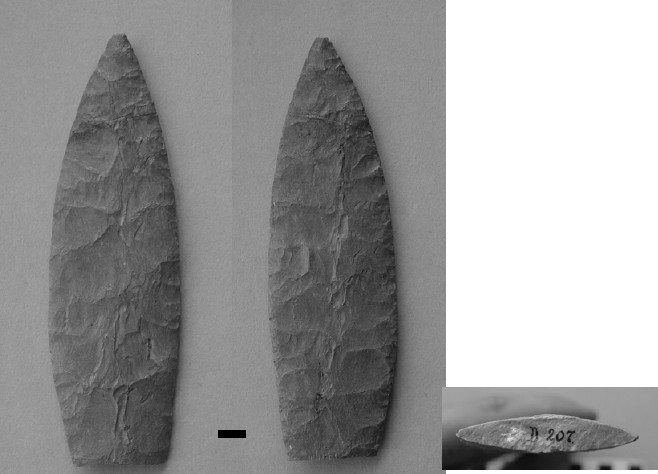
The 'python rock' artifacts don't even come close to exhibiting this level of craftsmanship.
The paper in Apollon also states that there are only a few archaeologists working on the African MSA... the flurry of recent publications and presentations at international meetings precisely about that period shows this is not the case at all.
I'll be curious to see how this stands up to critical scrutiny once details about these finds are published in scientific, peer-reviewed journals. In the meantime, you can also check out a very good post on the report on the Remote Central blog and some other comments on Mundo Neandertal (in Spanish) and on John Hawks' blog.
References
Minichillo, T.J. 2005. Middle Stone Age Lithic Study, South Africa: An Examination of Modern Human Origins. Unpublished PhD dissertation, Department of Anthropology, University of Washington.
Wednesday, November 22, 2006
Neanderthal childhood was as long as that of modern humans
Picked this one up on the website of the Montréal daily La Presse. The story (in French) reports on a study by Christopher Dean (University College London) and colleagues from French and Italian institutions which shows, through the use of high-resolution microcomputed tomography on two molars, that childhood was of comparable duration for Neanderthals and modern humans. Digging around the Nature web site, I found the paper in question, by Macchiarelli et al. (2006) in the papers available in advance of press. The authors conclude that
"Our data now allow us to predict M1 emergence time in Neanderthals with more certainty. If about 8mm of root were formed at an average of about 5.7 mmper day at gingival emergence, then this would have occurred at about 6.7 years of age, well within the human range (6.260.8 years (mean 6 s.d.)). This, together with the modern human-like position of the neonatal line, suggests both similar timing of tooth initiation relative to birth in Neanderthals and modern humans, and a predictable extended period between birth and M1 emergence, by which time about 90% of brain volume would have been attained."
While they also mention that that "a more complex enamel–dentine junction morphology and a late peak in root extension rate sets [Neanderthals] apart", their results are in contrast to those previously reported by Fernando Ramirez Rozzi and José Maria Bermudez de Castro (2004) who estimated that Neanderthals reached adulthood around fifteen years of age or so, that is to say, significantly earlier than modern humans. I should note that the Ramirez Rossi and Bermudez de Castro conclusions had already been challenged by Guatteli-Steinberg et al. (2005) who used dental perikymata counts to reocnstruct Neanderthal life history and show that it was similar to that of modern humans.
Macchiarelli et al.'s results provide another thread of evidence that demonstrates that modern humans and Neanderthals may not have been significantly different in terms of their biological development. This has a number of implications about the life history of Neanderthals, the structure of their population and the nature of their knowledge transmission strategies. This is especially interesting in light of a recent paper in the Journal of Human Evolution by Gurven et al. (2006) about the time needed to become a proficient hunter. Based on observations on the Tsimane foragers in the Bolivian Amazon, Gurven et al. suggest that physical maturity alone is not enough to ensure fully proficient hunting (an activity which requires much skill), and that full proficiency might only be attained about 10-20 years after reaching adulthood.
Gurven et al. (2006) therefore do away with the idea that physical maturity is, by itself, sufficient to be a fully proficient hunter. Bocherens et al. (2001, 2005) suggest that at least some Neanderthals were top carnivores, which implies they were able to develop fully competent hunting capacities comparable to those of modern humans (if not actually better ones). The idea that Neanderthals could achieve this level of skill simply by maturing more quickly is therefore seriously undermined by the Gurven et al. (2006) paper, and the new Macchiarelli et al. study suggests that, in fact, there is no need to invoke such improbable scenarios to explain effective hunting among Neanderthals. Now, how this all fits with the debate over Neanderthal longevity and life-history as a whole is another debate, one which I will not broach today...
I have to say that also really love the reconstruction of Neanderthal adult-infant interaction depicted in the La Presse feature, and I had not seen before...

I love how the Neanderthal kid looks kinda lost or detached in this one, but then again, I'd probably look like that myself if I was left alone with a guardian that looked as haggard as that adult Neanderthal!
References
Bocherens, H., M. Toussaint, D. Billiou, M. Patou-Mathis, D. Bonjean, M. Otte, and A. Mariotti. 2001. New isotopic evidence for dietary habits of Neandertals from Belgium. Journal of Human Evolution 40:497-505.
Bocherens, H., D. G. Drucker, D. Billiou, M. Patou-Mathis, and B. Vandermeersch. 2005. Isotopic evidence for diet and subsistence pattern of the Saint-Césaire I Neanderthal: review and use of a multi-source mixing model. Journal of Human Evolution 49:71-87.
Guatelli-Steinberg, D., D. J. Reid, T.A. Bishop, and C. S. Larsen. 2005. Anterior tooth growth periods in Neandertals were comparable to those of modern humans. PNAS 102:14197-14202
Gurven, M., H. Kaplan, and M.Gutierrez. 2006. How long does it take to become a proficient hunter? Implications for the evolution of extended development and long life span. Journal of Human Evolution 51:454-470.
Macchiarelli, R., L. Bondioli, A. Debénath, A. Mazurier, J.-F. Tournepiche, W. Birch, and C. Dean. 2006. How Neanderthal molar teeth grew. Nature: doi:10.1038/nature05314
Ramirez Rossi, F.V., and J. M. Bermudez de Castro. 2004. Surprisingly rapid growth in Neanderthals. Nature 428:936-939.
"Our data now allow us to predict M1 emergence time in Neanderthals with more certainty. If about 8mm of root were formed at an average of about 5.7 mmper day at gingival emergence, then this would have occurred at about 6.7 years of age, well within the human range (6.260.8 years (mean 6 s.d.)). This, together with the modern human-like position of the neonatal line, suggests both similar timing of tooth initiation relative to birth in Neanderthals and modern humans, and a predictable extended period between birth and M1 emergence, by which time about 90% of brain volume would have been attained."
While they also mention that that "a more complex enamel–dentine junction morphology and a late peak in root extension rate sets [Neanderthals] apart", their results are in contrast to those previously reported by Fernando Ramirez Rozzi and José Maria Bermudez de Castro (2004) who estimated that Neanderthals reached adulthood around fifteen years of age or so, that is to say, significantly earlier than modern humans. I should note that the Ramirez Rossi and Bermudez de Castro conclusions had already been challenged by Guatteli-Steinberg et al. (2005) who used dental perikymata counts to reocnstruct Neanderthal life history and show that it was similar to that of modern humans.
Macchiarelli et al.'s results provide another thread of evidence that demonstrates that modern humans and Neanderthals may not have been significantly different in terms of their biological development. This has a number of implications about the life history of Neanderthals, the structure of their population and the nature of their knowledge transmission strategies. This is especially interesting in light of a recent paper in the Journal of Human Evolution by Gurven et al. (2006) about the time needed to become a proficient hunter. Based on observations on the Tsimane foragers in the Bolivian Amazon, Gurven et al. suggest that physical maturity alone is not enough to ensure fully proficient hunting (an activity which requires much skill), and that full proficiency might only be attained about 10-20 years after reaching adulthood.
Gurven et al. (2006) therefore do away with the idea that physical maturity is, by itself, sufficient to be a fully proficient hunter. Bocherens et al. (2001, 2005) suggest that at least some Neanderthals were top carnivores, which implies they were able to develop fully competent hunting capacities comparable to those of modern humans (if not actually better ones). The idea that Neanderthals could achieve this level of skill simply by maturing more quickly is therefore seriously undermined by the Gurven et al. (2006) paper, and the new Macchiarelli et al. study suggests that, in fact, there is no need to invoke such improbable scenarios to explain effective hunting among Neanderthals. Now, how this all fits with the debate over Neanderthal longevity and life-history as a whole is another debate, one which I will not broach today...
I have to say that also really love the reconstruction of Neanderthal adult-infant interaction depicted in the La Presse feature, and I had not seen before...
I love how the Neanderthal kid looks kinda lost or detached in this one, but then again, I'd probably look like that myself if I was left alone with a guardian that looked as haggard as that adult Neanderthal!
References
Bocherens, H., M. Toussaint, D. Billiou, M. Patou-Mathis, D. Bonjean, M. Otte, and A. Mariotti. 2001. New isotopic evidence for dietary habits of Neandertals from Belgium. Journal of Human Evolution 40:497-505.
Bocherens, H., D. G. Drucker, D. Billiou, M. Patou-Mathis, and B. Vandermeersch. 2005. Isotopic evidence for diet and subsistence pattern of the Saint-Césaire I Neanderthal: review and use of a multi-source mixing model. Journal of Human Evolution 49:71-87.
Guatelli-Steinberg, D., D. J. Reid, T.A. Bishop, and C. S. Larsen. 2005. Anterior tooth growth periods in Neandertals were comparable to those of modern humans. PNAS 102:14197-14202
Gurven, M., H. Kaplan, and M.Gutierrez. 2006. How long does it take to become a proficient hunter? Implications for the evolution of extended development and long life span. Journal of Human Evolution 51:454-470.
Macchiarelli, R., L. Bondioli, A. Debénath, A. Mazurier, J.-F. Tournepiche, W. Birch, and C. Dean. 2006. How Neanderthal molar teeth grew. Nature: doi:10.1038/nature05314
Ramirez Rossi, F.V., and J. M. Bermudez de Castro. 2004. Surprisingly rapid growth in Neanderthals. Nature 428:936-939.
Tuesday, November 21, 2006
El Mirón Cave - Lawrence Straus ASU Lecture
It's a pretty paleo-heavy fall semester for colloquium speakers at ASU, and last Friday, we had the pleasure of having Prof. Lawrence Guy Straus (University of New Mexico) talking to a packed lecture hall about his ongoing project with M. R. Gonzales Morales (Universidad de Cantabria) at El Mirón Cave. This is one impressive site, folks, with a stratigraphy spanning uninterrupted the whole gamut from the Mousterian to the Bronze Age, and having yielded, among other things, the oldest reliably dated evidence for Neolithic lifeways in northern Atlantic Spain.
Of more direct Paleolithic import was Straus' discussion of some of the Magdalenian art found in the cave. This includes notably the following scapula bearing an incised deer

This is a motif that has been found on similar incised artifacts in other neighboring sites, and bears resemblance to parietal depictions of deer found in neighboring Magdalenian sites as well. This has enabled Straus and his colleague to hypothesize the existence of a relatively tightly bound cultural network defined, among other things, on the basis of shared iconography and stylistic conventions. 16,000 years ago. Very, very neat stuff.
In addition, a sondage at the bottom of the excavated area has revealed the presence of a (so far) undifferentiated Early Upper Paleolithic level dated to about 27 kya (uncalibrated) and Late Mousterian levels going back to 41 kya (uncalibrated). Unfortunately, these lower levels are not very well-known yet, having only been excavated over a very small area, but they're there, which is cool in and of itself. All in all, a fantastic site, one which really gives a good view of diachronic changes in site function, land-use patterns, and 'cultural' traditions. Presented with Straus' usual flair and engaging style (not to mention his intimate familiarity with the Paleolithic record of northern Spain), this was one very informative and very entertaining lecture.
Of more direct Paleolithic import was Straus' discussion of some of the Magdalenian art found in the cave. This includes notably the following scapula bearing an incised deer
This is a motif that has been found on similar incised artifacts in other neighboring sites, and bears resemblance to parietal depictions of deer found in neighboring Magdalenian sites as well. This has enabled Straus and his colleague to hypothesize the existence of a relatively tightly bound cultural network defined, among other things, on the basis of shared iconography and stylistic conventions. 16,000 years ago. Very, very neat stuff.
In addition, a sondage at the bottom of the excavated area has revealed the presence of a (so far) undifferentiated Early Upper Paleolithic level dated to about 27 kya (uncalibrated) and Late Mousterian levels going back to 41 kya (uncalibrated). Unfortunately, these lower levels are not very well-known yet, having only been excavated over a very small area, but they're there, which is cool in and of itself. All in all, a fantastic site, one which really gives a good view of diachronic changes in site function, land-use patterns, and 'cultural' traditions. Presented with Straus' usual flair and engaging style (not to mention his intimate familiarity with the Paleolithic record of northern Spain), this was one very informative and very entertaining lecture.
Tuesday, November 14, 2006
Missing Mousterians and Trails of Dead!
Not much time to write these days, but wanted to point out a very good post on Alex Steenhuyse's blog on the recent paper by Dibble and McPherron on the "Missing Mousterian" in Current Anthropology. Though Alex is not completely bias-free (n'est-ce pas?), he is very, very right in pointing out the importance of the approach taken by Dibble & McPherron (2006) to get a more thorough understanding of Neanderthal lifeways... good paper, I've read it, but haven't had a chance to blog about it given how hectic everything is these days...
In other news, So Divided, the latest record by rock juggernauts "... And You Will Know Us By The Trail of Dead" came out today... go buy it! It's fantastic, phenomenal even!! What's the relevance of this on a blog concerned with archaeology and anthropology, you may well ask... well, I have it on good authority that Trail of Dead's lead singer of the band used to be an anthropology major at UT Austin. So there you have it!
References
Dibble, H. L., and S. McPherron. 2006. The Missing Mousterian. Current Anthropology 47(5): 777-803.
In other news, So Divided, the latest record by rock juggernauts "... And You Will Know Us By The Trail of Dead" came out today... go buy it! It's fantastic, phenomenal even!! What's the relevance of this on a blog concerned with archaeology and anthropology, you may well ask... well, I have it on good authority that Trail of Dead's lead singer of the band used to be an anthropology major at UT Austin. So there you have it!
References
Dibble, H. L., and S. McPherron. 2006. The Missing Mousterian. Current Anthropology 47(5): 777-803.
Tuesday, November 07, 2006
Monday, October 30, 2006
Arthur Machen and the Paleolithic
Arthur Machen was a great writer who influenced many early 20th Century horror and fantastic fiction authors, such as, for instance, H. P. Lovecraft. His stories are still very entertaining reads today and, because most are set in Victorian England, they coincide temporally with the development of anthropology and archaeology as disciplines. This, and the fact that Machen often drew his protagonists from the small bourgeoisie leads to some really neat vignettes, such as this one, from The Red Hand, when two gentlemen taking an evening stroll come upon a murder site and alert the police.
"The three lanterns were flashing here and there, searching for more evidence, and in the gleam of one of them Dyson caught sight of an object in the road, to which he called the attention of the policeman nearest to him.
'Look, Phillipps,' he said, when the man had secured it and
held it up. 'Look, that should be something in your way!'
It was a dark flinty stone, gleaming like obsidian, and shaped to a broad edge something after the manner of an adze. One end was rough, and easily grasped in the hand, and the whole thing was hardly five inches long. The edge was thick with blood.
'What is it Phillipps?' said Dyson; and Phillipps looked hard at it.
'It's a primitive flint knife,' he said. 'It was made about ten thousand years ago. One exactly like this was found near Abury in Wiltshire, and all the authorities gave it that age.' "
A Paleolithic stone tool used as a murder weapon in 19th Century London! How cool is that as a hook?! And the rest of the story gets even better, with some hand prints on a wall, and more! Phenomenal reading!
References
Machen, A. 1906. The Red Hand. In The House of Souls. E. Grant Richards, London
"The three lanterns were flashing here and there, searching for more evidence, and in the gleam of one of them Dyson caught sight of an object in the road, to which he called the attention of the policeman nearest to him.
'Look, Phillipps,' he said, when the man had secured it and
held it up. 'Look, that should be something in your way!'
It was a dark flinty stone, gleaming like obsidian, and shaped to a broad edge something after the manner of an adze. One end was rough, and easily grasped in the hand, and the whole thing was hardly five inches long. The edge was thick with blood.
'What is it Phillipps?' said Dyson; and Phillipps looked hard at it.
'It's a primitive flint knife,' he said. 'It was made about ten thousand years ago. One exactly like this was found near Abury in Wiltshire, and all the authorities gave it that age.' "
A Paleolithic stone tool used as a murder weapon in 19th Century London! How cool is that as a hook?! And the rest of the story gets even better, with some hand prints on a wall, and more! Phenomenal reading!
References
Machen, A. 1906. The Red Hand. In The House of Souls. E. Grant Richards, London
New paper on Paglicci's EUP levels
The latest L'anthropologie is dedicated to the Upper Paleolithic and contains a paper by A. Palma di Cesnola (U of Siena) on the proto-Aurignacian and early Gravettian layers (24-22) of Grotta Paglicci, on the Gargano Promontory in Apulia, Italy. The site is important for a number of reasons, including the fact that it contains the earliest Aurignacian assemblage in southern Italy (ca. 34,000 BP, uncalibrated). This paper is a summary (in French, with an abstract and figure captions in English) of a the results of the excavations at Paglicci by the Prehistoric Ecology Section of the University of Siena in the 80's and 90's, recently published as a full-length monograph in Italian (Palma di Cesnola 2003a).
Palma di Cesnola (2006) provides a largely typological description of the lithic industries from levels 24-22 along with summary description of their chronological, sedimentary and zooarchaeological records. This is done using G. Laplace's analytical typology. There is unfortunately little information about the debitage or cores of those series, or about the raw materials exploited for their manufacture, although it seems fair to assume, on the basis of information provided in the monograph (i.e., Palma di Cesnola 2003b) that the only exploited lithotype comes from outcrops located about 30 km away from the site. Overall, the Aurignacian levels appear relatively poor in retouched tools compared to the abundant assemblages from the early Gravettian, although it bears emphasizing that those levels appear to have so far only been excavated over an area of about 7-8 square meters (Boscato 2003: Figure 4).
Of interest in the paper is the description of the Paglicci-type (or "PA 24 A1"-type) retouched bladelet that characterizes the backed bladelets of the top of the proto-Aurignacian sequence at Paglicci, while the base of the sequence is characterized by more classic Dufour types. This is interesting because Palma di Cesnola attributes the development of this new bladelet type to the result of proto-Aurignacian (or more precisely what he terms the "marginally backed bladelet Aurignacian") groups who originally made Dufour bladelets settling in "peculiar" contexts in meridional Italy where "under conditions of relative isolation, they would have created specialized and completely new tools" (2006: 366). He sees the Castelcivita sequence (Gambassini 1997) corroborating such an interpretation since at that site too, a Dufour level is overlain by a proto-Aurignacian level characterized by a distinct bladelet type, in that case the "Castelcivita bladelet," which has also been identified at the comparatively recent open-air Aurignacian site of Serino (Accorsi et al. 1979).
Palma di Cesnola also describes Paglicci's rich early Gravettian industries that date back to about 28,000 BP (uncalibrated) and he subsequently presents an overview of the earliest Gravettian in Italy, mentioning that unpublished dates now show the Gravettian to have been present in the Veneto about 30-31,000 BP uncalibrated (Palma di Cesnola 2006: 368). These data suggest that the issue of the origins and diffusion of the Gravettian in Italy will be an interesting topic to keep track of , and that some previous ideas about these processes might well have to be rethought in the coming years.
Overall, the paper's a good summary of those important assemblages, though it's a pity that information on the debitage and cores is missing. For anyone wanting to get an in-depth perspective on those assemblages, I highly recommend consulting the edited site report which comprises detailed analyses of pretty much all aspects of the archaeological record of layers 24-22 (Palma di Cesnola 2003a).
References
Accorsi, C., E. Aiello, C. Bartolini, L. Casteletti, G. Rodolfi, and A. Ronchitelli. 1979. Il Giacimento di Serino (Avellino): Stratigrafia, Ambienti, e Paletnologia. Atti della Società Toscana di Scienze Naturali A 86:435-487.
Boscato, P. 2003. I macromammiferi dell'Aurignaziano e del Gravettiano antico di Grotta Paglicci. In Paglicci. LÂ’Aurignaziano e il Gravettiano antico (A. Palma di Cesnola, ed.), pp. 49-62. Claudio Grenzi Editore, Foggia, Italy.
Gambassini, P. (editor). 1997. Il Paleolitico di Castelcivita, culture e ambiente. Materiae no.5. Electa, Naples.
Palma di Cesnola, A. (editor). 2003a. Paglicci. L'Aurignaziano e il Gravettiano antico. Claudio Grenzi Editore, Foggia, Italy.
Palma di Cesnola, A. 2003b. Il sito. In Paglicci. LÂ’Aurignaziano e il Gravettiano antico (A. Palma di Cesnola, ed.), pp. 13-14. Claudio Grenzi Editore, Foggia, Italy.
Palma di Cesnola, A. 2003c. LÂ’Aurignaziano dello strato 24. In Paglicci. LÂ’Aurignaziano e il Gravettiano antico (A. Palma di Cesnola, ed.), pp. 111-138. Claudio Grenzi Editore, Foggia, Italy.
Palma di Cesnola, A. 2006. LÂ’Aurignacien et le Gravettien ancien
de la grotte Paglicci au Mont Gargano. L’anthropologie 110: 355–370.
Palma di Cesnola (2006) provides a largely typological description of the lithic industries from levels 24-22 along with summary description of their chronological, sedimentary and zooarchaeological records. This is done using G. Laplace's analytical typology. There is unfortunately little information about the debitage or cores of those series, or about the raw materials exploited for their manufacture, although it seems fair to assume, on the basis of information provided in the monograph (i.e., Palma di Cesnola 2003b) that the only exploited lithotype comes from outcrops located about 30 km away from the site. Overall, the Aurignacian levels appear relatively poor in retouched tools compared to the abundant assemblages from the early Gravettian, although it bears emphasizing that those levels appear to have so far only been excavated over an area of about 7-8 square meters (Boscato 2003: Figure 4).
Of interest in the paper is the description of the Paglicci-type (or "PA 24 A1"-type) retouched bladelet that characterizes the backed bladelets of the top of the proto-Aurignacian sequence at Paglicci, while the base of the sequence is characterized by more classic Dufour types. This is interesting because Palma di Cesnola attributes the development of this new bladelet type to the result of proto-Aurignacian (or more precisely what he terms the "marginally backed bladelet Aurignacian") groups who originally made Dufour bladelets settling in "peculiar" contexts in meridional Italy where "under conditions of relative isolation, they would have created specialized and completely new tools" (2006: 366). He sees the Castelcivita sequence (Gambassini 1997) corroborating such an interpretation since at that site too, a Dufour level is overlain by a proto-Aurignacian level characterized by a distinct bladelet type, in that case the "Castelcivita bladelet," which has also been identified at the comparatively recent open-air Aurignacian site of Serino (Accorsi et al. 1979).
Palma di Cesnola also describes Paglicci's rich early Gravettian industries that date back to about 28,000 BP (uncalibrated) and he subsequently presents an overview of the earliest Gravettian in Italy, mentioning that unpublished dates now show the Gravettian to have been present in the Veneto about 30-31,000 BP uncalibrated (Palma di Cesnola 2006: 368). These data suggest that the issue of the origins and diffusion of the Gravettian in Italy will be an interesting topic to keep track of , and that some previous ideas about these processes might well have to be rethought in the coming years.
Overall, the paper's a good summary of those important assemblages, though it's a pity that information on the debitage and cores is missing. For anyone wanting to get an in-depth perspective on those assemblages, I highly recommend consulting the edited site report which comprises detailed analyses of pretty much all aspects of the archaeological record of layers 24-22 (Palma di Cesnola 2003a).
References
Accorsi, C., E. Aiello, C. Bartolini, L. Casteletti, G. Rodolfi, and A. Ronchitelli. 1979. Il Giacimento di Serino (Avellino): Stratigrafia, Ambienti, e Paletnologia. Atti della Società Toscana di Scienze Naturali A 86:435-487.
Boscato, P. 2003. I macromammiferi dell'Aurignaziano e del Gravettiano antico di Grotta Paglicci. In Paglicci. LÂ’Aurignaziano e il Gravettiano antico (A. Palma di Cesnola, ed.), pp. 49-62. Claudio Grenzi Editore, Foggia, Italy.
Gambassini, P. (editor). 1997. Il Paleolitico di Castelcivita, culture e ambiente. Materiae no.5. Electa, Naples.
Palma di Cesnola, A. (editor). 2003a. Paglicci. L'Aurignaziano e il Gravettiano antico. Claudio Grenzi Editore, Foggia, Italy.
Palma di Cesnola, A. 2003b. Il sito. In Paglicci. LÂ’Aurignaziano e il Gravettiano antico (A. Palma di Cesnola, ed.), pp. 13-14. Claudio Grenzi Editore, Foggia, Italy.
Palma di Cesnola, A. 2003c. LÂ’Aurignaziano dello strato 24. In Paglicci. LÂ’Aurignaziano e il Gravettiano antico (A. Palma di Cesnola, ed.), pp. 111-138. Claudio Grenzi Editore, Foggia, Italy.
Palma di Cesnola, A. 2006. LÂ’Aurignacien et le Gravettien ancien
de la grotte Paglicci au Mont Gargano. L’anthropologie 110: 355–370.
Spike in traffic... and blog rationale
There's been a spike in traffic on this blog lately, thanks in no small part to its being mentioned on the Palanth Forum and the Palanthsci group (thanks to the guilty parties, you know who you are!). Thank you guys for judging my opinions worthy of consideration! So, if you get here from such fine spots along the information superhighway, let me wish you a warm welcome!
I guess this is as good an occasion as any to re-make explicit my goals and intentions about this blog. First and foremost, somewhat selfishly, it serves as a repository for my inchoate thoughts and first reactions to topics that interest me from a scholarly standpoint and have to do with my research, from close or from far. As such, I reserve the right to revisit, revise and disavow them at any point in time. This is also the reason why I opt to post them in blog format rather than post them directly on listervs or discussion groups, where they might appear to be fully crystallized ideas. I don't really have a problem with people linking from discussion boards to the contents of this blog, as long as this important caveat is fully understood.
I tend to be blunt when I speak and write, though I never mean to be insulting or derogatory - I'm a strong believer that there's really no point for those attitudes in science as in life. If you, as a reader, feel the tone of a post is excessive, please let me know. The last thing I need as I post here is to make enemies and generate rancor; as I said, it's not my goal and, frankly, I'm not in a position where I can really afford either. The posts here are simply my burgeoning thoughts and first reactions to stuff I read, or presentations I get to see, or things that come to my attention that I feel are somehow relevant to my research (okay, except for the World Cup stuff, that was just sheer exultation!). As such, they shouldn't be considered definitive or set in stone at all. In fact, they're very likely to change, as they have time to sit around my cerebrum and macerate and come in contact with one another. But, given what I felt was a paucity of blogs discussing Paleolithic and hunter-gatherer archaeology, I felt that it might serve to stimulate discussion if I were to post them as a blog. Also, because I'm writing my thesis, I can't guarantee posts on a regular basis, but I try to post a couple of times a week or so.
I like the blog format for scientific discussion for a number of reasons, a main one being that it democratizes discussion of issues. I'm a PhD candidate in the School of Human Evolution and Social Change (formerly the Department of Anthropology) at Arizona State University, and my research currently focuses on the Uluzzian industry of southern Italy and the Middle-Upper Paleolithic Transition as a whole, topics I approach from the perspective of lithic analysis, ecological theory and hunter-gatherer studies. While this doesn't make me an authority in any real sense, I do feel that I have at least some competency to discuss issues pertaining to these research topics. If you disagree with me, then by all means post a comment.
What I try to do in this blog is post on issues that otherwise might not get broached in discussions of recent discoveries or papers. This is especially true for short papers in journals like Nature, Science or the PNAS, that usually don't give commentators a chance to go into much detail about their concerns with papers published therein. So, in this blog, when I address issues or concerns I have with papers, I usually focus on details rather than the "big picture." This isn't because I don't think that the big picture is important, but rather because I believe that in order to get an accurate big picture, you need to make sure the individual pixels of that picture, so to speak, are accurate. And I think that it's unscientific to disregard peer-reviewed research that flatly disagrees with a given argument, so I try to bring up such literature when I feel it's been ignored.
However, more than anything, I tend to post comments on papers or topics that I've liked or that have otherwise somehow piqued my curiosity at any given point in time. I'm also a consummate fan of pointing out when pop culture and/or literature intersect with paleoanthropology, so when I stumble on interesting examples of this, I like to post about them as well.
So this, in a nutshell, is the spirit of "A Very Remote Period Indeed." Welcome, enjoy, and feel free to discuss!
PS: I'm aware there are some glitches with my personal site, and I hope to correct them in the coming weeks... however, this all has to wait 'til the dissertation is done!
I guess this is as good an occasion as any to re-make explicit my goals and intentions about this blog. First and foremost, somewhat selfishly, it serves as a repository for my inchoate thoughts and first reactions to topics that interest me from a scholarly standpoint and have to do with my research, from close or from far. As such, I reserve the right to revisit, revise and disavow them at any point in time. This is also the reason why I opt to post them in blog format rather than post them directly on listervs or discussion groups, where they might appear to be fully crystallized ideas. I don't really have a problem with people linking from discussion boards to the contents of this blog, as long as this important caveat is fully understood.
I tend to be blunt when I speak and write, though I never mean to be insulting or derogatory - I'm a strong believer that there's really no point for those attitudes in science as in life. If you, as a reader, feel the tone of a post is excessive, please let me know. The last thing I need as I post here is to make enemies and generate rancor; as I said, it's not my goal and, frankly, I'm not in a position where I can really afford either. The posts here are simply my burgeoning thoughts and first reactions to stuff I read, or presentations I get to see, or things that come to my attention that I feel are somehow relevant to my research (okay, except for the World Cup stuff, that was just sheer exultation!). As such, they shouldn't be considered definitive or set in stone at all. In fact, they're very likely to change, as they have time to sit around my cerebrum and macerate and come in contact with one another. But, given what I felt was a paucity of blogs discussing Paleolithic and hunter-gatherer archaeology, I felt that it might serve to stimulate discussion if I were to post them as a blog. Also, because I'm writing my thesis, I can't guarantee posts on a regular basis, but I try to post a couple of times a week or so.
I like the blog format for scientific discussion for a number of reasons, a main one being that it democratizes discussion of issues. I'm a PhD candidate in the School of Human Evolution and Social Change (formerly the Department of Anthropology) at Arizona State University, and my research currently focuses on the Uluzzian industry of southern Italy and the Middle-Upper Paleolithic Transition as a whole, topics I approach from the perspective of lithic analysis, ecological theory and hunter-gatherer studies. While this doesn't make me an authority in any real sense, I do feel that I have at least some competency to discuss issues pertaining to these research topics. If you disagree with me, then by all means post a comment.
What I try to do in this blog is post on issues that otherwise might not get broached in discussions of recent discoveries or papers. This is especially true for short papers in journals like Nature, Science or the PNAS, that usually don't give commentators a chance to go into much detail about their concerns with papers published therein. So, in this blog, when I address issues or concerns I have with papers, I usually focus on details rather than the "big picture." This isn't because I don't think that the big picture is important, but rather because I believe that in order to get an accurate big picture, you need to make sure the individual pixels of that picture, so to speak, are accurate. And I think that it's unscientific to disregard peer-reviewed research that flatly disagrees with a given argument, so I try to bring up such literature when I feel it's been ignored.
However, more than anything, I tend to post comments on papers or topics that I've liked or that have otherwise somehow piqued my curiosity at any given point in time. I'm also a consummate fan of pointing out when pop culture and/or literature intersect with paleoanthropology, so when I stumble on interesting examples of this, I like to post about them as well.
So this, in a nutshell, is the spirit of "A Very Remote Period Indeed." Welcome, enjoy, and feel free to discuss!
PS: I'm aware there are some glitches with my personal site, and I hope to correct them in the coming weeks... however, this all has to wait 'til the dissertation is done!
Thursday, October 26, 2006
Hovers on Neanderthal-modern human interactions in the Levant
Just read a dynamite paper by Erella Hovers, a chapter in Conard's When Neanderthals and Modern Humans Met (2006), about the nature of interactions between the two hominin groups in the Levant. She focuses mainly on the Middle Paleolithic record of the region. After reviewing the available empirical evidence and discussing relevant ecological theory, she concludes that:
"Some archaeologists have favored [the competitive model] as the most ecologically parsimonious scenario (Shea 2003b), given the principle of competitive exclusion. However, the Levant in the late Middle and early Upper Pleistocene was a region of unpredictable, short-duration environmental fluctuations on millennial and centennial scales, and of spatially fragmented habitats. Because the coexistence of similar species does not depend on environmental stochasticity (Wang et al. 2000), and since Neanderthals and modern humans were congruent competitors in this region, a scenario of their coexistence in dynamic equilibrium on a regional scale is tenable from an ecological point of view. And while full synchrony of Moderns and Neanderthals throughout the Middle Paleolithic (or at least its later part) is not a fact of the archaeological record, a scenario of coexistence is as, or more, consistent with the available data than a model of competition-driven extinctions of the two taxa. The suggestion that Neanderthal appearance and the disappearance of Moderns are linked by a cause-and-effect relationship is not well supported by either the archaeological data or ecological theory. It stems from confounding temporal association of postulated events with causation for long-term demographic and evolutionary processes. Indications (and putative ones at that) for local extinctions of Moderns (or Neanderthals) during the Middle Paleolithic cannot be simplistically be interpreted as evidence for the extinction of a whole lineage in the region" (Hovers 2006:76)
This is a pretty radical departure from commonly proposed scenarios of Neanderthal-modern human interactions in the Levant. What I especially like about this paper is that Hovers actually reviews the ecological literature in this piece rather than simply invoking it as a mysterious black box buzzing with the sounds of arcane evolutionary forces to support her ideas. By doing this, she's able to generate coherent sets of theoretically-grounded expectations that she then tests against the archaeological record, as opposed to the other way around which is how at least some archaeologists tend to proceed. The kind of approach adopted by Hovers here is the way to go, in my humble opinion, if we are to move the debate over the evolutionary fate of Neanderthals forward.
References
Conard, N. J. (ed.). 2006. When Neanderthals and Modern Humans Met. Tübingen Publications in Prehistory. Kerns Verlag, Tübingen.
Hovers, E. 2006. Neanderthals and modern humans in the Middle Paleolithic of the Levant: what kind of interactions. In When Neanderthals and Modern Humans Met (N.J. Conard, ed.), pp. 65-85. Tübingen Publications in Prehistory. Kerns Verlag, Tübingen.
"Some archaeologists have favored [the competitive model] as the most ecologically parsimonious scenario (Shea 2003b), given the principle of competitive exclusion. However, the Levant in the late Middle and early Upper Pleistocene was a region of unpredictable, short-duration environmental fluctuations on millennial and centennial scales, and of spatially fragmented habitats. Because the coexistence of similar species does not depend on environmental stochasticity (Wang et al. 2000), and since Neanderthals and modern humans were congruent competitors in this region, a scenario of their coexistence in dynamic equilibrium on a regional scale is tenable from an ecological point of view. And while full synchrony of Moderns and Neanderthals throughout the Middle Paleolithic (or at least its later part) is not a fact of the archaeological record, a scenario of coexistence is as, or more, consistent with the available data than a model of competition-driven extinctions of the two taxa. The suggestion that Neanderthal appearance and the disappearance of Moderns are linked by a cause-and-effect relationship is not well supported by either the archaeological data or ecological theory. It stems from confounding temporal association of postulated events with causation for long-term demographic and evolutionary processes. Indications (and putative ones at that) for local extinctions of Moderns (or Neanderthals) during the Middle Paleolithic cannot be simplistically be interpreted as evidence for the extinction of a whole lineage in the region" (Hovers 2006:76)
This is a pretty radical departure from commonly proposed scenarios of Neanderthal-modern human interactions in the Levant. What I especially like about this paper is that Hovers actually reviews the ecological literature in this piece rather than simply invoking it as a mysterious black box buzzing with the sounds of arcane evolutionary forces to support her ideas. By doing this, she's able to generate coherent sets of theoretically-grounded expectations that she then tests against the archaeological record, as opposed to the other way around which is how at least some archaeologists tend to proceed. The kind of approach adopted by Hovers here is the way to go, in my humble opinion, if we are to move the debate over the evolutionary fate of Neanderthals forward.
References
Conard, N. J. (ed.). 2006. When Neanderthals and Modern Humans Met. Tübingen Publications in Prehistory. Kerns Verlag, Tübingen.
Hovers, E. 2006. Neanderthals and modern humans in the Middle Paleolithic of the Levant: what kind of interactions. In When Neanderthals and Modern Humans Met (N.J. Conard, ed.), pp. 65-85. Tübingen Publications in Prehistory. Kerns Verlag, Tübingen.
Cosquer Revisited - ASU lecture
On Tuesday night, Jean Clottes presented a talk entitled "Cosquer Revisited" at Arizona State University. The event was organized by Elisabeth Culley and Peter Welsh of the Deer Valley Rock Art Center, and sponsored by the newly formed School of Human Evolution and Social Change, which is my academic unit at ASU. It was a great, very enjoyable talk. Clottes is a lively and engaging speaker, he is intimately familiar with all the recent discoveries, and the topic of Paleolithic cave art always makes for intereting and visually gripping presentations.
In addition to detailing ongoing work at Cosquer, Clottes discussed findings at Cussac (which contains a slew of human burials of Gravettian age) and Chauvet, as well as another, unnamed and recently discovered Gravettian-age painted cave. All this will be published in time, but it sure was very nice to get a glimpse of ongoing research and recent discoveries. Beyond detailing the kinds of paintings and engraving found at the site, he also argued that men, women and children all can be shown to have contributed to the creation of the wonderful art preserved at the site, thanks to an anlysis of Cosquer's hand stencils and prints.
Perhaps the most controversial and stimulating aspect of the Cosquer talk was that in which Clottes discussed the intentional scraping off of sections of the cave wall and intentional breaking of stalagmites. Similar behaviors have allegedly been documented in some North American caves where prehistoric people intentionally collected calcium carbonate that was subsequently ground into powder for human consumption for its medicinal properties. I'd never heard about this, and am not familiar at all with this literature. But, if it can be shown that the Cosquer artists did the same thing, that would constitue, to the best of my knowledge, the earliest documented instance of the collection of pharmacopeia in the archaeological record. Clottes clearly mentioned that this was just a tentalizing working hypothesis at the moment, but since none of the wall scrapings or broken stalagmite sections were recovered in the cave, it does appear that this material was intentionally taken away from the site. Fascinating stuff.
In addition to detailing ongoing work at Cosquer, Clottes discussed findings at Cussac (which contains a slew of human burials of Gravettian age) and Chauvet, as well as another, unnamed and recently discovered Gravettian-age painted cave. All this will be published in time, but it sure was very nice to get a glimpse of ongoing research and recent discoveries. Beyond detailing the kinds of paintings and engraving found at the site, he also argued that men, women and children all can be shown to have contributed to the creation of the wonderful art preserved at the site, thanks to an anlysis of Cosquer's hand stencils and prints.
Perhaps the most controversial and stimulating aspect of the Cosquer talk was that in which Clottes discussed the intentional scraping off of sections of the cave wall and intentional breaking of stalagmites. Similar behaviors have allegedly been documented in some North American caves where prehistoric people intentionally collected calcium carbonate that was subsequently ground into powder for human consumption for its medicinal properties. I'd never heard about this, and am not familiar at all with this literature. But, if it can be shown that the Cosquer artists did the same thing, that would constitue, to the best of my knowledge, the earliest documented instance of the collection of pharmacopeia in the archaeological record. Clottes clearly mentioned that this was just a tentalizing working hypothesis at the moment, but since none of the wall scrapings or broken stalagmite sections were recovered in the cave, it does appear that this material was intentionally taken away from the site. Fascinating stuff.
Tuesday, October 24, 2006
New Evolutionary Anthropology
The latest issue of Evolutionary Athropology came out online today. I bring it up because it contains two papers, one by P. Mellars, the other by J. Zilhão, that deal directly with issues that I'm currently writing about in my dissertation, albeit from a very different perspective. The papers represent good and timely summaries of where the "replacement" and "indigenist" scenarios of modern human origins in Europe stand in late 2006.
I had read the Mellars paper as a preprint, and there isn't much new to report about the conclusions reached in his paper. I'll post on it later in detail, but should mention now that I think that his relabeling of the proto-Aurignacian is wrong-headed, especially since it leads to no particular nuancing of his position as a result.
As for the Zilhão paper, I've just had a chance to glance at it, but in it he perpetuates the factually wrong idea that the lithic assemblage from Level V at Klioura I in Greece is Uluzzian (see Koumouzelis et al. 2001a, b). This perspective is unsupported by even a very casual evaluation of the record (Riel-Salvatore 2006a, 2006b), so its unfortunate to see it given such wide thrift in press. This is especially true since Klisoura is then taken to "date" the earliest Uluzzian. This is the result of using a narrow typological perspective and a culture-historical research agenda, where the goal of archaeology becomes the tracking of cultures over time and space rather than understanding past behavior.
In other news, I got a copy of the Bar-Yosef and Zilhão Towards a Definition of the Aurignacian volume (2006) in the mail yesterday, and I must temper my preliminary assessement of the volume posted a few weeks ago... the volume actually contins a wealth of stimulating papers, most of which directly grapple with the issue of defining the Aurignacian. The only thing that I was surprised not to see in the volume was a concluding chapter by the editors discussing what the agreement was following that meeting and perusal of lithic assemblages from throughout Eurasia. Oh well.
References
Bar-yosef, O., and J. Zilhão (eds.). 2006. Towards a definition of the Aurignacian. Proceedings of the Symposium held
in Lisbon, Portugal, June 25-30, 2002. Trabalhos de Arqueologia 45. Instituto Português de Arqueologia, Lisbon (Protugal).
Koumouzelis, M., J.K. Kozlowski, C. Escutenaire, V. Sitlivy, K. Sobczyk, H. Valladas, N. Tisnerat-Laborde, P. Wojtal, and B. Ginter. 2001a. La fin du Paléolithique moyen et le début du Paléolithique supérieur en Grèce: la séquence de la Grotte 1 de Klissoura. L'Anthropologie 105:469-504.
Koumouzelis, M., B. Ginter, J. K. Kozlowski, M. Pawlikowski, O. Bar-Yosef, R. M. Albert, M. Litynska-Zajac, E. Stworzewicz, P. Wojtal, and G. Lipecki. 2001b. The early Upper Palaeolithic in Greece : The excavations in Klisoura Cave. Journal of Archaeological Sciences 28:515-539.
Mellars, P. 2006. Archeology and the dispersal of modern humans in Europe: Deconstructing the "Aurignacian." Evolutionary Anthropology 15:167-182.
Riel-Salvatore, J. 2006a. The place of the Uluzzian in the Middle-Upper Paleolithic Transition in Italy. Paper presented at the 71st annual meeting of the Society for American Archaeology, San Juan, Puerto Rico.
Riel-Salvatore, J. 2006b. The Uluzzian as a manifestation of the Middle-Upper Paleolithic Transition in Italy? Paper presented at the 15th meeting of the Union Internationale de Sciences Pre- et Protohistoriques, Lisbon, Portugal.
Zilhão, J. 2006. Neandertals and moderns mixed, and it matters. Evolutionary Anthropology 15:183-195.
I had read the Mellars paper as a preprint, and there isn't much new to report about the conclusions reached in his paper. I'll post on it later in detail, but should mention now that I think that his relabeling of the proto-Aurignacian is wrong-headed, especially since it leads to no particular nuancing of his position as a result.
As for the Zilhão paper, I've just had a chance to glance at it, but in it he perpetuates the factually wrong idea that the lithic assemblage from Level V at Klioura I in Greece is Uluzzian (see Koumouzelis et al. 2001a, b). This perspective is unsupported by even a very casual evaluation of the record (Riel-Salvatore 2006a, 2006b), so its unfortunate to see it given such wide thrift in press. This is especially true since Klisoura is then taken to "date" the earliest Uluzzian. This is the result of using a narrow typological perspective and a culture-historical research agenda, where the goal of archaeology becomes the tracking of cultures over time and space rather than understanding past behavior.
In other news, I got a copy of the Bar-Yosef and Zilhão Towards a Definition of the Aurignacian volume (2006) in the mail yesterday, and I must temper my preliminary assessement of the volume posted a few weeks ago... the volume actually contins a wealth of stimulating papers, most of which directly grapple with the issue of defining the Aurignacian. The only thing that I was surprised not to see in the volume was a concluding chapter by the editors discussing what the agreement was following that meeting and perusal of lithic assemblages from throughout Eurasia. Oh well.
References
Bar-yosef, O., and J. Zilhão (eds.). 2006. Towards a definition of the Aurignacian. Proceedings of the Symposium held
in Lisbon, Portugal, June 25-30, 2002. Trabalhos de Arqueologia 45. Instituto Português de Arqueologia, Lisbon (Protugal).
Koumouzelis, M., J.K. Kozlowski, C. Escutenaire, V. Sitlivy, K. Sobczyk, H. Valladas, N. Tisnerat-Laborde, P. Wojtal, and B. Ginter. 2001a. La fin du Paléolithique moyen et le début du Paléolithique supérieur en Grèce: la séquence de la Grotte 1 de Klissoura. L'Anthropologie 105:469-504.
Koumouzelis, M., B. Ginter, J. K. Kozlowski, M. Pawlikowski, O. Bar-Yosef, R. M. Albert, M. Litynska-Zajac, E. Stworzewicz, P. Wojtal, and G. Lipecki. 2001b. The early Upper Palaeolithic in Greece : The excavations in Klisoura Cave. Journal of Archaeological Sciences 28:515-539.
Mellars, P. 2006. Archeology and the dispersal of modern humans in Europe: Deconstructing the "Aurignacian." Evolutionary Anthropology 15:167-182.
Riel-Salvatore, J. 2006a. The place of the Uluzzian in the Middle-Upper Paleolithic Transition in Italy. Paper presented at the 71st annual meeting of the Society for American Archaeology, San Juan, Puerto Rico.
Riel-Salvatore, J. 2006b. The Uluzzian as a manifestation of the Middle-Upper Paleolithic Transition in Italy? Paper presented at the 15th meeting of the Union Internationale de Sciences Pre- et Protohistoriques, Lisbon, Portugal.
Zilhão, J. 2006. Neandertals and moderns mixed, and it matters. Evolutionary Anthropology 15:183-195.
Monday, October 23, 2006
Chris Mooney blog
Another week, another dissertation chapter, and another post...
Surfing around, I came upon Chris Mooney's blog, which is unfortunately on temporary hiatus for the next month or so. In case you don't know it, Mooney is the author of the excellent, excellent book The Republican War on Science, of which I finished reading the updated paperback edition just last week (yes, I read it in my "spare time"). While there is a temporary halt in updates, the site is nonetheless a very interesting to read it through and contains a number of posts on the politicization of science in the US as well as popular scientific divulgation. Good stuff.
Surfing around, I came upon Chris Mooney's blog, which is unfortunately on temporary hiatus for the next month or so. In case you don't know it, Mooney is the author of the excellent, excellent book The Republican War on Science, of which I finished reading the updated paperback edition just last week (yes, I read it in my "spare time"). While there is a temporary halt in updates, the site is nonetheless a very interesting to read it through and contains a number of posts on the politicization of science in the US as well as popular scientific divulgation. Good stuff.
Thursday, October 19, 2006
More online thesis goodness!!
Oh yeah! Stumbled on this great site today, and I'm quite happy about this. It's an online repository that contains at least some recent PhD theses from the Université de Bordeaux 1 downloadable as pdf files! Included in the bunch are a number of archaeologically-themed theses. More theses online, that's what I'm talking about, people! Shazam!
Wednesday, October 18, 2006
The ongoing Divje babé I flute controversy
Hi all. Sorry for the momentary lack of posts... things are pretty hectice in Arizona. A recent browse through the journals brought a number of new papers to my attention, including the following two, which struck me because they were published at the same time (more or less) and argue exactly opposite interpretation of a single artifact, namely the alleged bone flute from the Mousterian site of Divje babé I, in Slovenia.
Check out Wikipediafor some pics of the thing. Wiki incidentally has a remarkably detailed treatment of this artifact! I present two views of the "flute" taken from that Wiki entry:


In any case, back to the new pubs. The first paper, in the Oxford Journal of Archaeology by Iain Morley, argues against the "flute" interpretation of the artifact. Here's the abstract:
"The reputed Neanderthal ‘flute’ from the Slovenian site of Divje
babe I has stimulated much interest and detailed research since the original
publication of its discovery in 1997. In spite of nearly ten years’ worth of
analysis and discussion its status as an artefact has remained ambiguous;
nevertheless it is still frequently cited as a ‘flute’. This paper examines the
literature and research regarding this object, and finds that much of the
ambiguity regarding the object’s status derives from the literature itself. It
concludes that there is no need to invoke hominin agency in explaining the
features of the bone."
Now, contrast this to the following paper by Turk et al. (2006) "in press" in L'Anthropologie. Their abstract states that:
"The suspected flute, which dates to Moershoofd-Glinde or Orel Interstadial, and is definitely older than 46 ka, was analysed with the aid of multi-slice computed tomography (MSCT) and reinterpreted in the light of two hypotheses, one of which envisages an artificial origin of the holes and the other a natural one. It was found that there were four holes on the diaphysis; that at least two were made prior to the damage to the proximal and distal ends of the diaphysis; and that carnivores could not have made all the holes, but one at the most. The holes are very probably artificial, made by the combined use of stone and simple bone tools found at the Divje babé I site. The majority, and probably all the damage made by carnivores on the suspected flute, are of secondary origin. Conclusions about the origin of the holes cannot therefore be reached only on the basis of the damage, and the hypothesis of an artificial origin cannot be rejected."
Hmmmmmmm. The debate hardly seems closed, does it? Without having had a chance to go through both papers in much depth (I am writing a dissertation, folks!), my natural tendency is to give thorough analyses (i.e., Turk et al. 2006) greater currency than literature reviews (i.e., Morley 2006). Of course, it all depends on the reliability of the tomographic analysis, so I'll defintiely be posting a follow-up to this in the coming days.
References:
Morley, I. 2006. Mousterian musicianship? The case of the Divje Babe I bone. Oxford Journal of Archaeology 25:317–333
Turk, I., B.A.B. Blackwell, J. Turk, and M. Pflaum. 2006. Résultats de l'analyse tomographique informatisée de la plus ancienne flûte découverte à Divje babé I (Slovénie) et sa position chronologique dans le contexte des changements paléoclimatiques et paléoenvironnementaux au cours du dernier glaciaire. L'Anthropologie 110: in press. DOI: 10.1016/j.anthro.2006.06.002.
Check out Wikipediafor some pics of the thing. Wiki incidentally has a remarkably detailed treatment of this artifact! I present two views of the "flute" taken from that Wiki entry:
In any case, back to the new pubs. The first paper, in the Oxford Journal of Archaeology by Iain Morley, argues against the "flute" interpretation of the artifact. Here's the abstract:
"The reputed Neanderthal ‘flute’ from the Slovenian site of Divje
babe I has stimulated much interest and detailed research since the original
publication of its discovery in 1997. In spite of nearly ten years’ worth of
analysis and discussion its status as an artefact has remained ambiguous;
nevertheless it is still frequently cited as a ‘flute’. This paper examines the
literature and research regarding this object, and finds that much of the
ambiguity regarding the object’s status derives from the literature itself. It
concludes that there is no need to invoke hominin agency in explaining the
features of the bone."
Now, contrast this to the following paper by Turk et al. (2006) "in press" in L'Anthropologie. Their abstract states that:
"The suspected flute, which dates to Moershoofd-Glinde or Orel Interstadial, and is definitely older than 46 ka, was analysed with the aid of multi-slice computed tomography (MSCT) and reinterpreted in the light of two hypotheses, one of which envisages an artificial origin of the holes and the other a natural one. It was found that there were four holes on the diaphysis; that at least two were made prior to the damage to the proximal and distal ends of the diaphysis; and that carnivores could not have made all the holes, but one at the most. The holes are very probably artificial, made by the combined use of stone and simple bone tools found at the Divje babé I site. The majority, and probably all the damage made by carnivores on the suspected flute, are of secondary origin. Conclusions about the origin of the holes cannot therefore be reached only on the basis of the damage, and the hypothesis of an artificial origin cannot be rejected."
Hmmmmmmm. The debate hardly seems closed, does it? Without having had a chance to go through both papers in much depth (I am writing a dissertation, folks!), my natural tendency is to give thorough analyses (i.e., Turk et al. 2006) greater currency than literature reviews (i.e., Morley 2006). Of course, it all depends on the reliability of the tomographic analysis, so I'll defintiely be posting a follow-up to this in the coming days.
References:
Morley, I. 2006. Mousterian musicianship? The case of the Divje Babe I bone. Oxford Journal of Archaeology 25:317–333
Turk, I., B.A.B. Blackwell, J. Turk, and M. Pflaum. 2006. Résultats de l'analyse tomographique informatisée de la plus ancienne flûte découverte à Divje babé I (Slovénie) et sa position chronologique dans le contexte des changements paléoclimatiques et paléoenvironnementaux au cours du dernier glaciaire. L'Anthropologie 110: in press. DOI: 10.1016/j.anthro.2006.06.002.
Subscribe to:
Posts (Atom)