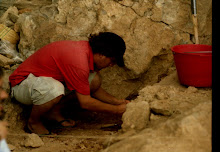
I'm in Italy conducting a bit of fieldwork for a short while. While here, I'll be giving a public conference at the Museo Archeologico del Finale in Finale Ligure next Saturday, May 29, 2010.
"30mila anni fa a Finale Ligure: Nuove acquisizioni sul Paleolitico della Caverna delle Arene Candide // 30,000 Years Ago in Finale Ligure: New insights on the Paleolithic of the Caverna delle Arene Candide."
Saturday May 29 2010, 15.30
Museo Archeologico del Finale
Chiostri di Santa Caterina in Finalborgo (Finale Ligure - SV)
So, if you're in southern France or northern Italy that day, definitely come by! Can't make it? You can read a bit about what we've been up to on UC Denver's Network site.
Showing posts with label fieldwork. Show all posts
Showing posts with label fieldwork. Show all posts
Saturday, May 22, 2010


Monday, September 21, 2009
I know what you did last summer
Over the weekend, I came across yet another ill-informed op-ed by some talking head about what to do to 'fix' the university system - in this case, the proposed 'solution' to the high costs of post-secondary education is simply to have professors teach more so their work weeks are similar to those of 'normal' people! Riiiight. Most of it is pretty generic repetition of the remarkably ignorant claim that a professor's work week is adequately measured by how many hours he or she teaches in a given week. To me, that's kind of like saying that the work week of police officers only amounts to the time they actually spend arresting criminals - you know, the rest of the time, they're just drivin' around and talking with people in the neighborhood, not actually putting in any time towards what we're really paying them to do.
Now, I'm obviously somewhat biased, but does it really surprise anyone that an hour of class time requires several hours of preparation beforehand, on top of writing exams, meeting with students and grading tests and assignment? None of the professors I know (and I know many) just show up and pontificate about the day's topic without doing any research on it or providing reasonably structured critical analysis of it, which seems to be the warped perception some pundits have of university lecturing (which may be more indicative of how they do things than how we do them, but I digress...).
What annoys me the most in most of these discussions, though, is when people criticizing professors' work whip out the old "and on top of it all, you have 3-4 months of summer vacation a year!" canard as a final and self-evident nail in the coffin of the defenders of higher education. As an archaeologist with an active field project, this aggravates me to no end. 3-4 months of vacation a year, really? Let me tell you a bit about what I did last summer, then: I turned in my grades on April 30, and on May 5, I was on my way to my field site, which means the May 1-4 period was spent frantically wrapping up lose ends and making sure all my material was ready for the field, where I stayed for two months (until July 6), training and supervising the work of seven students and several volunteers. We had pretty long days this summer: we set off for the site around 6:45AM and were back home around 6:00PM, after getting supplies for the next day - that's 11:15 work hours, 5 days a week. Tack on another two hours of work a day for me to review my field notes for the day, prepare the goals of the next day, and try to keep up with academic responsibilities like reviewing papers and administration that, shockingly, don't mysteriously get put on hold once a term is over. You can also add about another six hours each week for field trips I would organize for the students to get familiarized with the archaeology of the region. Right there, we're already talking about a ca. 72:15 hour work week, and that's not counting discussions/meetings with colleagues in the evening and weekends. All that during my extensive 'vacation' time... no wonder I felt so rested when I started at UCD at the beginning of August!
Mind you, I'm not writing this to complain or to toot my own horn, since I had a dynamite crew this summer and since all archaeologists I know that have an active field project have similar, if not more grueling schedules when they're doing fieldwork. The point, however, is precisely this: most of our research gets done in the summer. Few if any of us spend that time (or can afford to spend it!) sipping exotic cocktails in no less exotic resorts. That research, in turn, provides material and data for us to analyze during the rest of the year and for us to use to provide concrete, empirically informed examples of concepts we cover in our classes, in addition to providing potential research opportunities for interested students (which we then supervise using time that often doesn't get counted as part of our weekly teaching hours). Basically, for archaeologists as for the vast majority of academics, summer is a time to get some research done. And without that research, the quality of classroom education can decrease, which underscores the logic behind the organization of the academic year at the university, and the need for academics to do research. If any pundit out there doubts the veracity of any of this, you're hereby invited to join me in the field next summer... I have plenty of screening and sorting that needs getting done, and after a couple of months of that, I'll be more than happy to hear about your impressions of how academic archaeologists spend their summers.
Now, I'm obviously somewhat biased, but does it really surprise anyone that an hour of class time requires several hours of preparation beforehand, on top of writing exams, meeting with students and grading tests and assignment? None of the professors I know (and I know many) just show up and pontificate about the day's topic without doing any research on it or providing reasonably structured critical analysis of it, which seems to be the warped perception some pundits have of university lecturing (which may be more indicative of how they do things than how we do them, but I digress...).
What annoys me the most in most of these discussions, though, is when people criticizing professors' work whip out the old "and on top of it all, you have 3-4 months of summer vacation a year!" canard as a final and self-evident nail in the coffin of the defenders of higher education. As an archaeologist with an active field project, this aggravates me to no end. 3-4 months of vacation a year, really? Let me tell you a bit about what I did last summer, then: I turned in my grades on April 30, and on May 5, I was on my way to my field site, which means the May 1-4 period was spent frantically wrapping up lose ends and making sure all my material was ready for the field, where I stayed for two months (until July 6), training and supervising the work of seven students and several volunteers. We had pretty long days this summer: we set off for the site around 6:45AM and were back home around 6:00PM, after getting supplies for the next day - that's 11:15 work hours, 5 days a week. Tack on another two hours of work a day for me to review my field notes for the day, prepare the goals of the next day, and try to keep up with academic responsibilities like reviewing papers and administration that, shockingly, don't mysteriously get put on hold once a term is over. You can also add about another six hours each week for field trips I would organize for the students to get familiarized with the archaeology of the region. Right there, we're already talking about a ca. 72:15 hour work week, and that's not counting discussions/meetings with colleagues in the evening and weekends. All that during my extensive 'vacation' time... no wonder I felt so rested when I started at UCD at the beginning of August!
Mind you, I'm not writing this to complain or to toot my own horn, since I had a dynamite crew this summer and since all archaeologists I know that have an active field project have similar, if not more grueling schedules when they're doing fieldwork. The point, however, is precisely this: most of our research gets done in the summer. Few if any of us spend that time (or can afford to spend it!) sipping exotic cocktails in no less exotic resorts. That research, in turn, provides material and data for us to analyze during the rest of the year and for us to use to provide concrete, empirically informed examples of concepts we cover in our classes, in addition to providing potential research opportunities for interested students (which we then supervise using time that often doesn't get counted as part of our weekly teaching hours). Basically, for archaeologists as for the vast majority of academics, summer is a time to get some research done. And without that research, the quality of classroom education can decrease, which underscores the logic behind the organization of the academic year at the university, and the need for academics to do research. If any pundit out there doubts the veracity of any of this, you're hereby invited to join me in the field next summer... I have plenty of screening and sorting that needs getting done, and after a couple of months of that, I'll be more than happy to hear about your impressions of how academic archaeologists spend their summers.
Monday, January 14, 2008
Reporting archaeology in Harper's
Kris Hirst discusses a long essay by Gregory Jaynes in the latest issue of Harper's which focuses in part on the politics of an archaeological project, and she argues that the worst curse an archaeologist might have to endure is the presence of a journalist on site. While some might expect field archaeology to be similar to what's described in some dispatches from The Onion Hirst points that out that
"...most principal investigators (PI is what they call us) are frustrated, angry, worried people all the time during an excavation.I haven't read Jaynes' piece yet, though I'm now planning to stop by the newsstand on my way home and picking it up to see for myself. I'm of mixed mind after having read Hirst's post, though... While I agree with her that journalists will seize on the most dramatic aspects of archaeology to write about (in this case, field frustration), one has to wonder about whether it is ever a good idea to have a journalist on site for more than the time of a site tour and interview, and why? I assume that most archaeologists obviously want their project and research to gain as much public exposure as possible, and that often requires having journalists come visit a field site. However, it seems intuitive to me that having someone doing 'participant observation' on your project for a prolonged period of time will result in all aspects of your project getting more attention than they would have otherwise. On the other hand, many people say that any publicity is good publicity... mixed blessings, I guess.
But for the rest of the people on the crew, and any tourists or journalists who happen by, archaeology is incredibly dull. The work is painfully slow, the climate and dirt inescapable, the people tired and cranky. Any real exciting finds these days are very rare indeed and can take place under a microscope months or even years after the excavation is done.
It's clear what happened to Jaynes. He came into an important excavation and hung around, bored out of his skull. He eavesdropped on the only exciting thing going on: the frustration of a PI being expressed to his superior."
Subscribe to:
Posts (Atom)