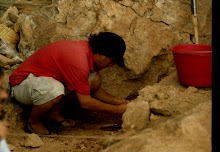
Arthur Machen was a great writer who influenced many early 20th Century horror and fantastic fiction authors, such as, for instance, H. P. Lovecraft. His stories are still very entertaining reads today and, because most are set in Victorian England, they coincide temporally with the development of anthropology and archaeology as disciplines. This, and the fact that Machen often drew his protagonists from the small bourgeoisie leads to some really neat vignettes, such as this one, from The Red Hand, when two gentlemen taking an evening stroll come upon a murder site and alert the police.
"The three lanterns were flashing here and there, searching for more evidence, and in the gleam of one of them Dyson caught sight of an object in the road, to which he called the attention of the policeman nearest to him.
'Look, Phillipps,' he said, when the man had secured it and
held it up. 'Look, that should be something in your way!'
It was a dark flinty stone, gleaming like obsidian, and shaped to a broad edge something after the manner of an adze. One end was rough, and easily grasped in the hand, and the whole thing was hardly five inches long. The edge was thick with blood.
'What is it Phillipps?' said Dyson; and Phillipps looked hard at it.
'It's a primitive flint knife,' he said. 'It was made about ten thousand years ago. One exactly like this was found near Abury in Wiltshire, and all the authorities gave it that age.' "
A Paleolithic stone tool used as a murder weapon in 19th Century London! How cool is that as a hook?! And the rest of the story gets even better, with some hand prints on a wall, and more! Phenomenal reading!
References
Machen, A. 1906. The Red Hand. In The House of Souls. E. Grant Richards, London
Monday, October 30, 2006


New paper on Paglicci's EUP levels
The latest L'anthropologie is dedicated to the Upper Paleolithic and contains a paper by A. Palma di Cesnola (U of Siena) on the proto-Aurignacian and early Gravettian layers (24-22) of Grotta Paglicci, on the Gargano Promontory in Apulia, Italy. The site is important for a number of reasons, including the fact that it contains the earliest Aurignacian assemblage in southern Italy (ca. 34,000 BP, uncalibrated). This paper is a summary (in French, with an abstract and figure captions in English) of a the results of the excavations at Paglicci by the Prehistoric Ecology Section of the University of Siena in the 80's and 90's, recently published as a full-length monograph in Italian (Palma di Cesnola 2003a).
Palma di Cesnola (2006) provides a largely typological description of the lithic industries from levels 24-22 along with summary description of their chronological, sedimentary and zooarchaeological records. This is done using G. Laplace's analytical typology. There is unfortunately little information about the debitage or cores of those series, or about the raw materials exploited for their manufacture, although it seems fair to assume, on the basis of information provided in the monograph (i.e., Palma di Cesnola 2003b) that the only exploited lithotype comes from outcrops located about 30 km away from the site. Overall, the Aurignacian levels appear relatively poor in retouched tools compared to the abundant assemblages from the early Gravettian, although it bears emphasizing that those levels appear to have so far only been excavated over an area of about 7-8 square meters (Boscato 2003: Figure 4).
Of interest in the paper is the description of the Paglicci-type (or "PA 24 A1"-type) retouched bladelet that characterizes the backed bladelets of the top of the proto-Aurignacian sequence at Paglicci, while the base of the sequence is characterized by more classic Dufour types. This is interesting because Palma di Cesnola attributes the development of this new bladelet type to the result of proto-Aurignacian (or more precisely what he terms the "marginally backed bladelet Aurignacian") groups who originally made Dufour bladelets settling in "peculiar" contexts in meridional Italy where "under conditions of relative isolation, they would have created specialized and completely new tools" (2006: 366). He sees the Castelcivita sequence (Gambassini 1997) corroborating such an interpretation since at that site too, a Dufour level is overlain by a proto-Aurignacian level characterized by a distinct bladelet type, in that case the "Castelcivita bladelet," which has also been identified at the comparatively recent open-air Aurignacian site of Serino (Accorsi et al. 1979).
Palma di Cesnola also describes Paglicci's rich early Gravettian industries that date back to about 28,000 BP (uncalibrated) and he subsequently presents an overview of the earliest Gravettian in Italy, mentioning that unpublished dates now show the Gravettian to have been present in the Veneto about 30-31,000 BP uncalibrated (Palma di Cesnola 2006: 368). These data suggest that the issue of the origins and diffusion of the Gravettian in Italy will be an interesting topic to keep track of , and that some previous ideas about these processes might well have to be rethought in the coming years.
Overall, the paper's a good summary of those important assemblages, though it's a pity that information on the debitage and cores is missing. For anyone wanting to get an in-depth perspective on those assemblages, I highly recommend consulting the edited site report which comprises detailed analyses of pretty much all aspects of the archaeological record of layers 24-22 (Palma di Cesnola 2003a).
References
Accorsi, C., E. Aiello, C. Bartolini, L. Casteletti, G. Rodolfi, and A. Ronchitelli. 1979. Il Giacimento di Serino (Avellino): Stratigrafia, Ambienti, e Paletnologia. Atti della Società Toscana di Scienze Naturali A 86:435-487.
Boscato, P. 2003. I macromammiferi dell'Aurignaziano e del Gravettiano antico di Grotta Paglicci. In Paglicci. LÂ’Aurignaziano e il Gravettiano antico (A. Palma di Cesnola, ed.), pp. 49-62. Claudio Grenzi Editore, Foggia, Italy.
Gambassini, P. (editor). 1997. Il Paleolitico di Castelcivita, culture e ambiente. Materiae no.5. Electa, Naples.
Palma di Cesnola, A. (editor). 2003a. Paglicci. L'Aurignaziano e il Gravettiano antico. Claudio Grenzi Editore, Foggia, Italy.
Palma di Cesnola, A. 2003b. Il sito. In Paglicci. LÂ’Aurignaziano e il Gravettiano antico (A. Palma di Cesnola, ed.), pp. 13-14. Claudio Grenzi Editore, Foggia, Italy.
Palma di Cesnola, A. 2003c. LÂ’Aurignaziano dello strato 24. In Paglicci. LÂ’Aurignaziano e il Gravettiano antico (A. Palma di Cesnola, ed.), pp. 111-138. Claudio Grenzi Editore, Foggia, Italy.
Palma di Cesnola, A. 2006. LÂ’Aurignacien et le Gravettien ancien
de la grotte Paglicci au Mont Gargano. L’anthropologie 110: 355–370.
Spike in traffic... and blog rationale
There's been a spike in traffic on this blog lately, thanks in no small part to its being mentioned on the Palanth Forum and the Palanthsci group (thanks to the guilty parties, you know who you are!). Thank you guys for judging my opinions worthy of consideration! So, if you get here from such fine spots along the information superhighway, let me wish you a warm welcome!
I guess this is as good an occasion as any to re-make explicit my goals and intentions about this blog. First and foremost, somewhat selfishly, it serves as a repository for my inchoate thoughts and first reactions to topics that interest me from a scholarly standpoint and have to do with my research, from close or from far. As such, I reserve the right to revisit, revise and disavow them at any point in time. This is also the reason why I opt to post them in blog format rather than post them directly on listervs or discussion groups, where they might appear to be fully crystallized ideas. I don't really have a problem with people linking from discussion boards to the contents of this blog, as long as this important caveat is fully understood.
I tend to be blunt when I speak and write, though I never mean to be insulting or derogatory - I'm a strong believer that there's really no point for those attitudes in science as in life. If you, as a reader, feel the tone of a post is excessive, please let me know. The last thing I need as I post here is to make enemies and generate rancor; as I said, it's not my goal and, frankly, I'm not in a position where I can really afford either. The posts here are simply my burgeoning thoughts and first reactions to stuff I read, or presentations I get to see, or things that come to my attention that I feel are somehow relevant to my research (okay, except for the World Cup stuff, that was just sheer exultation!). As such, they shouldn't be considered definitive or set in stone at all. In fact, they're very likely to change, as they have time to sit around my cerebrum and macerate and come in contact with one another. But, given what I felt was a paucity of blogs discussing Paleolithic and hunter-gatherer archaeology, I felt that it might serve to stimulate discussion if I were to post them as a blog. Also, because I'm writing my thesis, I can't guarantee posts on a regular basis, but I try to post a couple of times a week or so.
I like the blog format for scientific discussion for a number of reasons, a main one being that it democratizes discussion of issues. I'm a PhD candidate in the School of Human Evolution and Social Change (formerly the Department of Anthropology) at Arizona State University, and my research currently focuses on the Uluzzian industry of southern Italy and the Middle-Upper Paleolithic Transition as a whole, topics I approach from the perspective of lithic analysis, ecological theory and hunter-gatherer studies. While this doesn't make me an authority in any real sense, I do feel that I have at least some competency to discuss issues pertaining to these research topics. If you disagree with me, then by all means post a comment.
What I try to do in this blog is post on issues that otherwise might not get broached in discussions of recent discoveries or papers. This is especially true for short papers in journals like Nature, Science or the PNAS, that usually don't give commentators a chance to go into much detail about their concerns with papers published therein. So, in this blog, when I address issues or concerns I have with papers, I usually focus on details rather than the "big picture." This isn't because I don't think that the big picture is important, but rather because I believe that in order to get an accurate big picture, you need to make sure the individual pixels of that picture, so to speak, are accurate. And I think that it's unscientific to disregard peer-reviewed research that flatly disagrees with a given argument, so I try to bring up such literature when I feel it's been ignored.
However, more than anything, I tend to post comments on papers or topics that I've liked or that have otherwise somehow piqued my curiosity at any given point in time. I'm also a consummate fan of pointing out when pop culture and/or literature intersect with paleoanthropology, so when I stumble on interesting examples of this, I like to post about them as well.
So this, in a nutshell, is the spirit of "A Very Remote Period Indeed." Welcome, enjoy, and feel free to discuss!
PS: I'm aware there are some glitches with my personal site, and I hope to correct them in the coming weeks... however, this all has to wait 'til the dissertation is done!
Thursday, October 26, 2006
Hovers on Neanderthal-modern human interactions in the Levant
Just read a dynamite paper by Erella Hovers, a chapter in Conard's When Neanderthals and Modern Humans Met (2006), about the nature of interactions between the two hominin groups in the Levant. She focuses mainly on the Middle Paleolithic record of the region. After reviewing the available empirical evidence and discussing relevant ecological theory, she concludes that:
"Some archaeologists have favored [the competitive model] as the most ecologically parsimonious scenario (Shea 2003b), given the principle of competitive exclusion. However, the Levant in the late Middle and early Upper Pleistocene was a region of unpredictable, short-duration environmental fluctuations on millennial and centennial scales, and of spatially fragmented habitats. Because the coexistence of similar species does not depend on environmental stochasticity (Wang et al. 2000), and since Neanderthals and modern humans were congruent competitors in this region, a scenario of their coexistence in dynamic equilibrium on a regional scale is tenable from an ecological point of view. And while full synchrony of Moderns and Neanderthals throughout the Middle Paleolithic (or at least its later part) is not a fact of the archaeological record, a scenario of coexistence is as, or more, consistent with the available data than a model of competition-driven extinctions of the two taxa. The suggestion that Neanderthal appearance and the disappearance of Moderns are linked by a cause-and-effect relationship is not well supported by either the archaeological data or ecological theory. It stems from confounding temporal association of postulated events with causation for long-term demographic and evolutionary processes. Indications (and putative ones at that) for local extinctions of Moderns (or Neanderthals) during the Middle Paleolithic cannot be simplistically be interpreted as evidence for the extinction of a whole lineage in the region" (Hovers 2006:76)
This is a pretty radical departure from commonly proposed scenarios of Neanderthal-modern human interactions in the Levant. What I especially like about this paper is that Hovers actually reviews the ecological literature in this piece rather than simply invoking it as a mysterious black box buzzing with the sounds of arcane evolutionary forces to support her ideas. By doing this, she's able to generate coherent sets of theoretically-grounded expectations that she then tests against the archaeological record, as opposed to the other way around which is how at least some archaeologists tend to proceed. The kind of approach adopted by Hovers here is the way to go, in my humble opinion, if we are to move the debate over the evolutionary fate of Neanderthals forward.
References
Conard, N. J. (ed.). 2006. When Neanderthals and Modern Humans Met. Tübingen Publications in Prehistory. Kerns Verlag, Tübingen.
Hovers, E. 2006. Neanderthals and modern humans in the Middle Paleolithic of the Levant: what kind of interactions. In When Neanderthals and Modern Humans Met (N.J. Conard, ed.), pp. 65-85. Tübingen Publications in Prehistory. Kerns Verlag, Tübingen.
Cosquer Revisited - ASU lecture
On Tuesday night, Jean Clottes presented a talk entitled "Cosquer Revisited" at Arizona State University. The event was organized by Elisabeth Culley and Peter Welsh of the Deer Valley Rock Art Center, and sponsored by the newly formed School of Human Evolution and Social Change, which is my academic unit at ASU. It was a great, very enjoyable talk. Clottes is a lively and engaging speaker, he is intimately familiar with all the recent discoveries, and the topic of Paleolithic cave art always makes for intereting and visually gripping presentations.
In addition to detailing ongoing work at Cosquer, Clottes discussed findings at Cussac (which contains a slew of human burials of Gravettian age) and Chauvet, as well as another, unnamed and recently discovered Gravettian-age painted cave. All this will be published in time, but it sure was very nice to get a glimpse of ongoing research and recent discoveries. Beyond detailing the kinds of paintings and engraving found at the site, he also argued that men, women and children all can be shown to have contributed to the creation of the wonderful art preserved at the site, thanks to an anlysis of Cosquer's hand stencils and prints.
Perhaps the most controversial and stimulating aspect of the Cosquer talk was that in which Clottes discussed the intentional scraping off of sections of the cave wall and intentional breaking of stalagmites. Similar behaviors have allegedly been documented in some North American caves where prehistoric people intentionally collected calcium carbonate that was subsequently ground into powder for human consumption for its medicinal properties. I'd never heard about this, and am not familiar at all with this literature. But, if it can be shown that the Cosquer artists did the same thing, that would constitue, to the best of my knowledge, the earliest documented instance of the collection of pharmacopeia in the archaeological record. Clottes clearly mentioned that this was just a tentalizing working hypothesis at the moment, but since none of the wall scrapings or broken stalagmite sections were recovered in the cave, it does appear that this material was intentionally taken away from the site. Fascinating stuff.
Tuesday, October 24, 2006
New Evolutionary Anthropology
The latest issue of Evolutionary Athropology came out online today. I bring it up because it contains two papers, one by P. Mellars, the other by J. Zilhão, that deal directly with issues that I'm currently writing about in my dissertation, albeit from a very different perspective. The papers represent good and timely summaries of where the "replacement" and "indigenist" scenarios of modern human origins in Europe stand in late 2006.
I had read the Mellars paper as a preprint, and there isn't much new to report about the conclusions reached in his paper. I'll post on it later in detail, but should mention now that I think that his relabeling of the proto-Aurignacian is wrong-headed, especially since it leads to no particular nuancing of his position as a result.
As for the Zilhão paper, I've just had a chance to glance at it, but in it he perpetuates the factually wrong idea that the lithic assemblage from Level V at Klioura I in Greece is Uluzzian (see Koumouzelis et al. 2001a, b). This perspective is unsupported by even a very casual evaluation of the record (Riel-Salvatore 2006a, 2006b), so its unfortunate to see it given such wide thrift in press. This is especially true since Klisoura is then taken to "date" the earliest Uluzzian. This is the result of using a narrow typological perspective and a culture-historical research agenda, where the goal of archaeology becomes the tracking of cultures over time and space rather than understanding past behavior.
In other news, I got a copy of the Bar-Yosef and Zilhão Towards a Definition of the Aurignacian volume (2006) in the mail yesterday, and I must temper my preliminary assessement of the volume posted a few weeks ago... the volume actually contins a wealth of stimulating papers, most of which directly grapple with the issue of defining the Aurignacian. The only thing that I was surprised not to see in the volume was a concluding chapter by the editors discussing what the agreement was following that meeting and perusal of lithic assemblages from throughout Eurasia. Oh well.
References
Bar-yosef, O., and J. Zilhão (eds.). 2006. Towards a definition of the Aurignacian. Proceedings of the Symposium held
in Lisbon, Portugal, June 25-30, 2002. Trabalhos de Arqueologia 45. Instituto Português de Arqueologia, Lisbon (Protugal).
Koumouzelis, M., J.K. Kozlowski, C. Escutenaire, V. Sitlivy, K. Sobczyk, H. Valladas, N. Tisnerat-Laborde, P. Wojtal, and B. Ginter. 2001a. La fin du Paléolithique moyen et le début du Paléolithique supérieur en Grèce: la séquence de la Grotte 1 de Klissoura. L'Anthropologie 105:469-504.
Koumouzelis, M., B. Ginter, J. K. Kozlowski, M. Pawlikowski, O. Bar-Yosef, R. M. Albert, M. Litynska-Zajac, E. Stworzewicz, P. Wojtal, and G. Lipecki. 2001b. The early Upper Palaeolithic in Greece : The excavations in Klisoura Cave. Journal of Archaeological Sciences 28:515-539.
Mellars, P. 2006. Archeology and the dispersal of modern humans in Europe: Deconstructing the "Aurignacian." Evolutionary Anthropology 15:167-182.
Riel-Salvatore, J. 2006a. The place of the Uluzzian in the Middle-Upper Paleolithic Transition in Italy. Paper presented at the 71st annual meeting of the Society for American Archaeology, San Juan, Puerto Rico.
Riel-Salvatore, J. 2006b. The Uluzzian as a manifestation of the Middle-Upper Paleolithic Transition in Italy? Paper presented at the 15th meeting of the Union Internationale de Sciences Pre- et Protohistoriques, Lisbon, Portugal.
Zilhão, J. 2006. Neandertals and moderns mixed, and it matters. Evolutionary Anthropology 15:183-195.
Monday, October 23, 2006
Chris Mooney blog
Another week, another dissertation chapter, and another post...
Surfing around, I came upon Chris Mooney's blog, which is unfortunately on temporary hiatus for the next month or so. In case you don't know it, Mooney is the author of the excellent, excellent book The Republican War on Science, of which I finished reading the updated paperback edition just last week (yes, I read it in my "spare time"). While there is a temporary halt in updates, the site is nonetheless a very interesting to read it through and contains a number of posts on the politicization of science in the US as well as popular scientific divulgation. Good stuff.
Surfing around, I came upon Chris Mooney's blog, which is unfortunately on temporary hiatus for the next month or so. In case you don't know it, Mooney is the author of the excellent, excellent book The Republican War on Science, of which I finished reading the updated paperback edition just last week (yes, I read it in my "spare time"). While there is a temporary halt in updates, the site is nonetheless a very interesting to read it through and contains a number of posts on the politicization of science in the US as well as popular scientific divulgation. Good stuff.
Thursday, October 19, 2006
More online thesis goodness!!
Oh yeah! Stumbled on this great site today, and I'm quite happy about this. It's an online repository that contains at least some recent PhD theses from the Université de Bordeaux 1 downloadable as pdf files! Included in the bunch are a number of archaeologically-themed theses. More theses online, that's what I'm talking about, people! Shazam!
Wednesday, October 18, 2006
The ongoing Divje babé I flute controversy
Hi all. Sorry for the momentary lack of posts... things are pretty hectice in Arizona. A recent browse through the journals brought a number of new papers to my attention, including the following two, which struck me because they were published at the same time (more or less) and argue exactly opposite interpretation of a single artifact, namely the alleged bone flute from the Mousterian site of Divje babé I, in Slovenia.
Check out Wikipediafor some pics of the thing. Wiki incidentally has a remarkably detailed treatment of this artifact! I present two views of the "flute" taken from that Wiki entry:


In any case, back to the new pubs. The first paper, in the Oxford Journal of Archaeology by Iain Morley, argues against the "flute" interpretation of the artifact. Here's the abstract:
"The reputed Neanderthal ‘flute’ from the Slovenian site of Divje
babe I has stimulated much interest and detailed research since the original
publication of its discovery in 1997. In spite of nearly ten years’ worth of
analysis and discussion its status as an artefact has remained ambiguous;
nevertheless it is still frequently cited as a ‘flute’. This paper examines the
literature and research regarding this object, and finds that much of the
ambiguity regarding the object’s status derives from the literature itself. It
concludes that there is no need to invoke hominin agency in explaining the
features of the bone."
Now, contrast this to the following paper by Turk et al. (2006) "in press" in L'Anthropologie. Their abstract states that:
"The suspected flute, which dates to Moershoofd-Glinde or Orel Interstadial, and is definitely older than 46 ka, was analysed with the aid of multi-slice computed tomography (MSCT) and reinterpreted in the light of two hypotheses, one of which envisages an artificial origin of the holes and the other a natural one. It was found that there were four holes on the diaphysis; that at least two were made prior to the damage to the proximal and distal ends of the diaphysis; and that carnivores could not have made all the holes, but one at the most. The holes are very probably artificial, made by the combined use of stone and simple bone tools found at the Divje babé I site. The majority, and probably all the damage made by carnivores on the suspected flute, are of secondary origin. Conclusions about the origin of the holes cannot therefore be reached only on the basis of the damage, and the hypothesis of an artificial origin cannot be rejected."
Hmmmmmmm. The debate hardly seems closed, does it? Without having had a chance to go through both papers in much depth (I am writing a dissertation, folks!), my natural tendency is to give thorough analyses (i.e., Turk et al. 2006) greater currency than literature reviews (i.e., Morley 2006). Of course, it all depends on the reliability of the tomographic analysis, so I'll defintiely be posting a follow-up to this in the coming days.
References:
Morley, I. 2006. Mousterian musicianship? The case of the Divje Babe I bone. Oxford Journal of Archaeology 25:317–333
Turk, I., B.A.B. Blackwell, J. Turk, and M. Pflaum. 2006. Résultats de l'analyse tomographique informatisée de la plus ancienne flûte découverte à Divje babé I (Slovénie) et sa position chronologique dans le contexte des changements paléoclimatiques et paléoenvironnementaux au cours du dernier glaciaire. L'Anthropologie 110: in press. DOI: 10.1016/j.anthro.2006.06.002.
Thursday, September 28, 2006
Warm-adapted Neanderthals in northern France
In posts published today, Alex Steenhuyse and John Hawks both link to this short article in The Independent about a new Mousterian site at Caours, France, near the shore of the Channel.
The interesting features of this specific site are its age, its geographical location and its contents. As concerns its age, it is reported to be about 125,000 years old, which puts it at the warmest moment of the last glacial cycle. As concerns its geography, it is located relatively far north, implying that Neanderthals were able to exploit northerly regions at least during those times when climate was favorable (also a conclusion of various paper in Van Andel and Davies [2003]). As concerns its contents, the site contains the bones of elephant, rhino, aurochs, wild boar, and various kinds of deer, and those apparently "show signs of having been sawn through, crushed or stripped of their meat by flint tools." This suggests that Neanderthals successfully acquired and processed these animals very early on.
The key word here is "acquired." To the "Neanderthal good" camp, this will be taken as evidence of hunting, which in turn - given the size of some of those beasties - strongly implies cooperative hunting and considerable planning depth. To the "Neanderthal bad" camp, this evidence (especially since it comes from a riverine context) will be taken as merely one more instance of Neanderthal opportunistic scavenging, with dead animals being washed down the river after dying of natural, non-human causes and the more-or-less putrefied corpses being butchered by grunting cavemen. I suspect that when the actual report for this site comes out, it will contain a detailed zooarchaeological analysis of the remains that will be used to support one or the other scenario. In the meantime, I just want to point out that the Independent article mentions specifically that the remains "include a small fragment of elephant bone, several rhinoceros teeth, and many remnants of aurochs, wild boar and several kinds of deer" (my emphasis). Maybe this will turn out to be primarily a hunting camp, with some scavenging of the largest animals? Then again, since it's unlikely folks (Neanderthal or modern) would drag a whole elephant carcass back to camp, maybe not... This is another example of people with different perspectives taking the same evidence to make it agree with what they believe. However, in this case as in any other, the empirical burden usually does agree better with some perspectives.
Another interesting feature of this article: the way it portrays Neanderthals. Contra popular tendencies, Neanderthals are not described as "evolutionary dead-ends". On the contrary, they're described as "our tough and resourceful, near-human, European predecessors" who were "known to be squat, powerful people, who had language and fire and buried their dead." That's a relatively far-cry from the descriptions of Neanderthals in the popular press over the past several years... hey, maybe reporters are finally starting to get it?
References:
Van Andel, T. H., and W. Davies (eds.). 2003. Neanderthals and modern humans in the European landscape during the last glaciation: archaeological results of the Stage 3 Project. McDonald Institute for Archaeological Research, Cambridge (UK).
Monday, September 25, 2006
La bataille aurignacienne continue... encore et toujours!
The Palanth Forum has a post that presents the contents of the 45th volume of the Trabalhos de Arqueologia monograph series of the Instituto Português de Arqueologia. The reason I bring this up in this blog is that the title of the volume (edited by O. Bar-Yosef [Harvard] and J. Zilhão [Bristol]) is Towards a Definition of the Aurignacian. It's based on a small conference that was held in Lisbon in 2002, organized by the editors of the volume, one assumes to clarify what is meant by the term "Aurignacian," a cultural label/period/technocomplex/what-have-you. This is an important issue because the Aurignacian has, perhaps aptly, been described as the "promiscuous handmaiden of Paleolithic archaeology" by one prominent researcher, because of the tendency of many people to make the Aurignacian be whatever the hell they want to support their view of the Middle-Upper Paleolithic transition.
I've read some of the papers in this volume, and most are quite interesting. However, one can well wonder whether this book will, in the end, really end the bataille aurignacienne that started in the early years of the 20th Century with the work of the Abbé Breuil, among others. One of the reasons behind this question is that most of the authors who contribute chapters to the effort already have well-known stances on what the Aurignacian is, how and where it originated, and what its relation to previous European industries was. Then, there's also those researchers who seem to consider that the Aurignacian is unproblematic to identify anyway and who just talk about it without even addressing the issue that is central to the volume. I think that it's emblematic that some of the most thought-provoking papers in the lot that I've had the chance to read so far come from the youngest researchers. There's also a heavy emphasis on continental European perspectives, with only two papers coming from researchers espousing an explicitly anthropological archaeological perspective. That's not necessarily a bad thing, to be sure, but given that many of the interpretive divergences concerning the Aurignacian appear to get somehow amplified over the Atlantic, a more even balance of viewpoints might have yielded different insights into the question.
In the end, I think that this volume will be very useful in highlighting what, in 2006, different people think the Aurignacian is, but perhaps not so much in terms of coming up with a widely shared definition of that phenomenon. Regardless, it should be very useful reading for anyone interested in the topic of the Middle-Upper Paleolithic transition and/or the emergence of behavioral modernity outside Africa.
Incidentally, the Palanth Forum is an interesting discussion board where a lot of interesting material gets posted or publicized. Well worth checking out, although the action there has unfortunately been kind of slow lately.
Wednesday, September 20, 2006
New online thesis database
I just downloaded a full-length thesis as a pdf from the "thèses-en-ligne" website, which is maintained by the French CNRS as a host for doctoral theses based on multidisciplinary research. There are over 5,000 theses available, including a number having to do with, among other things, prehistory and paleoenvironments.
I think this is a brilliant initiative that should serve as a model for other countries. First, it gives doctoral research a wider diffusion than it might otherwise get, especially given the difficulties of procuring theses from overseas for the Interlibrary Loan services of many North American universities. Second, it actually gives publicly-funded research entities an actual, concrete output which citizens can freely access. Lastly, it also forces some transparency in research results (i.e., people can finally check and see whether a PhD thesis really contains a meaningful discussion of certain issues), and it responsabilizes up-and-coming researchers by ensuring that they give back to the funding agencies that financed their work.
I think that, in the US, the NSF should start something like this, and that any public funding for doctoral research should be awarded only if the researcher agrees to provide NSF with a copy of the finished thesis. The same should also be true for the Canadian SSHRC and NSERC.
In any case, the CNRS initiative joins those of a number of other groups that wish to provide access to theses having to do with specific kinds of research. The Paleoanthropology Society's Dissertation Distribution Service is a good example. It is to be hoped that more research societies begin similar efforts
The oldest child...
The National Geographic web site has a story about a 3.3 million-year-old infant skeleton found in the Dikika region of Ethiopia by a team of researchers led by Zeresenay Alemseged of the Max Planck Institute of Evolutionary Anthropology's Department of Human Evolution, in Germany. The site features some video and additional photographs, as well as a link to a much more detailed report about the find, and its implications for understanding development at that period of our past. Here's a shot of the skeleton which, unlike Lucy, has an almost complete cranium!
 (Copyright: National Geographic Society;
source: http://www9.nationalgeographic.com/ngm/dikikababy/gallery7.html.)
This story has been a long time coming, since the first remains were originally found about five years ago, so it's nice to finally have a relatively detailed and well-illustrated report on the finds!
Added 20/09/2006, 15:03: The remains are also the subject of two new papers in Nature. Both can be accessed from this webpage which provides additional information.
More on Finlayson et al. (2006)
Just a brief note to point out that Alex Steenhuyse also has posted some interesting comments on his blog about the Finlayson et al. (2006) paper on late Neanderthal dates at Gorham's Cave. He draws some interesting parallels between this paper and the Gravina et al. (2005) paper on new dates for the site of Grotte des Fées de Châtelperron that was published last year. BTW, you might also want to check out Alex's website (Anthrosite), which contains info on his research on the Middle-Upper Paleolithic Transition in France, and some of his publications and ongoing research. Good stuff, good stuff.
It's also interesting to note that all of the in-depth comments on the Finlayson et al. (2006) paper that I've seen on the blogosphere (yikes, I just used that word!) so far have been rather skeptical...
References:
Finlayson, C., et al. 2006. Late survival of Neanderthals at the southernmost extreme of Europe. Nature: in press. doi : 10.1038/nature05195
Gravina, B., P. Mellars, and C. B. Ramsey. 2005. Radiocarbon dating of interstratified Neanderthal and early modern human occupations at the Chatelperronian type-site. Nature 438:51-56.
Tuesday, September 19, 2006
Bonn Conference Pre-Prints
2006 marks the 150th anniversary of the original Neanderthal type-specimen discovery at Feldhofer Cave, in the Neander Valley, in Germany. To commemorate the discovery that set the stage for much of today's paleoanthropological research, a major international conference was held in Bonn, Germany earlier this year, where some of the most prominent researchers in the field of "Neanderthal studies" presented reviews and new discoveries.
The full program, complete with extensive abstracts (each several pages long), have been made available as a pdf file on the Istituto Italiano di Preistoria e Protostoria's web site. It's a pretty big file, but well worth the hassle to get an idea of the currently dominant stances and perspectives about Neanderthals today.
The full program, complete with extensive abstracts (each several pages long), have been made available as a pdf file on the Istituto Italiano di Preistoria e Protostoria's web site. It's a pretty big file, but well worth the hassle to get an idea of the currently dominant stances and perspectives about Neanderthals today.
The scientific method...

Courtesy of PhD Comics by Jorge Cham (which I warmly recommend reading).
Should I be concerned that I found this comic so damn funny...?

Thursday, September 14, 2006
Tragedy in Montreal
The tragic shooting spree that happened yesterday in Montreal took place at my sister's school. She was outside the building when it happened, and escaped uninjured although she is badly shaken. I'm so relieved she's safe, you have no idea. This is a tragedy, nothing less, and I feel overwhelmed right now. My thoughts go out to the injured and the families of the deceased student and the nineteen other people that were injured, some critically. It's a dark day.
The latest of the last?
Through the magic of the information superhighway, I managed to get a copy of Finlayson et al.'s (2006) paper that I mentioned in my last post. It's pretty short, and I've had time to go through it in depth.
At its most basic, this is a schematic site report focused on chronology as derived from AMS 14C dates, of which the authors present fully 30. There's unfortunately little to no discussion of the lithic or faunal assemblages (presumably because that information will be included in the project's final report/publication), so there is almost no information about the patterns of mollusk and sea mammal exploitation in the Mousterian levels of Gorham's Cave, which I was originally so excited about, based on comments by Finlayson on the Nature news report.
The main of the paper is an argument for an age of ca. 28,000 radiocarbon years (that is, uncalibrated) for the Late Mousterian at Gorham's, and that there is no evidence for infiltration from the overlying Upper Paleolithic (Solutrean and Magdalenian) level III into Mousterian level IV. That these two form discrete and well separated depositional units is well demonstrated by a combination of two measurements of “geochemical detrital ratios”, in this case K/Al and Mg/Al, which indicate radically different depositional contexts for levels III and IV (Finlayson et al. 2006: Figure 1c). So, the late MP and UP levels are clearly distinct, no argument there, and this is further suggested by a photograph (Figure 1d) of a section at the site which leaves little doubt as to the dramatically distinct sediment color in each.
As for the dates themselves, the 22 that concern the Late MP level (samples 9-30) are a bit hard to make sense of at first glance, especially since the authors present doubled, rather than single error ranges. Now there's absolutely nothing wrong with doing this; in fact, given their large corpus of dates, it's probably better to do so, since it means that all the radiocarbon determinations thus presented are ca. 95% likely to correspond to the range within which an individual sample's actual age falls. However, it does lead to a bit of confusion since dates are usually presented with single error ranges.
Regardless, even at second glance, the chronological data are very messy, and as a whole they display no obvious logical stratigraphic coherence, although they all fall somewhere between ca. 24-32,500 uncal. BP, distibuted over about 50 cm of sediment. Finlayson et al. explain this general lack of coherence as resulting from
“repeated use [of the site] confirmed by the stratigraphic distribution of the dates within level IV that indicate localized alterations due to use and reuse (for example trampling and cleaning) in the area around the position of the hearths but dates in stratigraphic sequence within the location of the hearths themselves. Thus, three samples (16, 17 and 20; Fig. 1) came from Mousterian superimposed hearths. These three dates provide a stratigraphic sequence from 24,0106320 to 30,5606720 yr BP. Taken together, all the dates show that Neanderthals occupied the site until 28 kyr BP and possibly as recently as 24 kyr BP.” (2006:p.1).
In other words, they explain away 19 of their dates that are not in coherent stratigraphic order by focusing on only three of them that are coehrent and suggest a very young age for the Mousterian deposits. Their argument for this (i.e., focus at the center of the heart which remained in a fixed position throughout the Mousterian at the site), while certainly valid is also somewhat problematic. For one thing, the majority of the bottommost dates (i.e., samples 24-27 and 30) display a coherent age of roughly 31-32.5 kya uncal for the base of the deposit, and this even well away (i.e., roughly 4 meters) from the hearth which is supposed to be the epicenter of disturbance. Embedded between them are samples 28-29, which date to (ironically) 28 and 29 kya. If anything, given that these two samples come from immediately next to each other (as best as can be gauged from Figure 1c), their unexpected recent ages are perhaps best explained by some unspecified localized form of contamination. So, overall, the very base of the hearth would seem to date to somewhere between 31-32.5 kya, thus providing a terminus post quem (or ante quem, depenging on your take) for the age of overlying samples. The four stratigraphically highest samples (9-12) give ages ranging from 26-30 kya (with an average of around 28.5 kya), which is coherent with the minimum age of the Late MP deposits just outlined. I think that this is basically where the data presented leaves us at this point, however. And what is known so far should, in the absence of evidence to the contrary encourage us to lean towards an older age for the top of the Mousterian (i.e., closer to 30 kya than 26 kya).
I think that the argument that the dates should all be considered valid but in secondary context because people continued using the site for prolonged periods and moved stuff around is not very good for two main reasons: First, this is likely to have been the norm at many cave/rockshelter sites whose physical characteristics (e.g., the presence of a high vault, or ceiling openings to enable smoke to clear out) would have constrained the positioning of certain features such as hearths. This is certainly something I've observed in my own field work, where Mousterian and Aurignacian hearths were located at the same spot in the rockshelter. Should we suppose that Italian Pleistocene hominins were more mindful about kicking stuff around and/or digging around than those from Gibraltar? Or that they operated with more of a concern for future archaeologists? I don't think so. This being the case, the argument that people lived in sites and must have disturbed sediments and the position of dating samples is unconvincing and basically a post hoc argument that has little inherent merit. There are ways to demonstrate the integrity (or lack thereof) of given layers within archaeological sites (e.g., micromorphology) and in their absence, it is simply impossible to accept the argument for anthropogenic (or any other source) sedimentary disturbance at face value. Maybe this information will be provided in the final report, but at the moment, it's lacking.
The second line of evidence against the explanation for mixing has to do with the intensity of occupation at the site. The authors report a total of 103 lithics for level IV, which was excavated over an area of 29 square meters. The site stratigraphy presented in the paper indicates a thickness of about 1m for level IV, which means that we're dealing with a density of about 3.55 lithic artifacts per cubic meter of excavated sediment! Even if we take only the top half of the deposits (ca. 50 cm thick), that still only gives about 7 lithics per cubic meter. Practically, that means that, digging a 1x1m unit in 10 cm spits, one would encounter one lithic per spit, 7 times out 10! In my view at least, this is hardly the kind of evidence of very intensive use and reuse of an area, especially around a hearth, where lithic concentrations tend to be relatively dense in general. So the argument for heavy human action on the sediment is, as a result, severely weakened. A caveat to this argument, however, is that it is unclear from this paper what is considered an artifact. Are we only talking about retouched tools here? Or are we (as I assume) including debitage as well? What's the frequency of retouched pieces relative to the total? This is information that could significantly clarify the discussion about site occupation intensity. Again, I suppose we'll have to wait for the final report to be sure.
So, in the end, is this site really 28 ky or even 24 ky old? As is usually the case in paleoanthropology, it's not impossible. However, in light of the reasoning just outlined, I think that the possibility of sample contamination should be dealt with in a more thorough fashion before being discarded out of hand. At the moment, I'm not unwilling to consider that the top of the sequence may be as old as 28.5 ky old, but my money's still on a slightly older age, probably along the lines of 30 kya. What would have considerably clarified the issue here would have been the presentation of the results of complementary dating methods (e.g., TL, OSL, ESR). This would have enabled an objective discussion of whether or not the sediments were really disturbed or if the charcoal samples might have been contaminated by younger material at some point.
Check out also John Hawks' blog for some additional comments on the paper.
References:
Finlaysn, C. L., et al. 2006. Late survival of Neanderthals at the southernmost extreme of Europe. Nature: in press. doi:10.1038/nature05195
Wednesday, September 13, 2006
The end of the Neanderthal world... geographically!!
It's all over the web!
There's an article in the New York Times
about a soon-to-be-published report by Clive Finlayson's team on new radiocarbon dates from Gorham's Cave, Gibraltar, that seem to indicate that some Mousterian tools at the site date to 28,000 BP. The NYT piece is based on a paper that should come out soon in Nature, but so far, all that's available is this news report by David Brill, titled "Neanderthal's last stand." The NYT piece also refers to a commentary by Eric Delson and Katarina Harvati to be published along with the Nature paper, in which they stress caution, but nonetheless suggest that the date seems convincing.
The news report doesn't have much more detail, except a mention that the assemblage (or is it the retouched tools?) is composed of 103 artifacts, and that the site has yielded evidence for extensive exploitation of sea resources (shellfish and mammals!). There's a comment in the news report by Paul Mellars, who rightly mentions (yes, yes... I just wrote "rightly"!) that we must be somewhat wary of the dates because minute amounts of contamination might have affected the resulting dates. However, there's no way to tell before reading the piece whether this is an issue (I suspect it's not... they probably have multiple AMS dates can be done on extremely small samples).
A few comments:
1) These are only tools that are dated; there's no associated fossils, although only Neanderthals are known t have manufactured Mousterian industries in Europe.
2) The evidence for sea mammal harvesting (in the form of scavenging) is some of the first of its kind for a Mousterian site; that, to me, is perhaps the neatest aspect of this news so far!
3) Purely coincidentally, I finished reading Finlayson's Neanderthals and Modern Humans (2004) volume today. Overall, I liked it quite a bit, especially because it takes such a refreshingly different perspective from most research on Neanderthals and modern humans (he actually formulates test hypotheses and contrasts them to the known record, as oppose to just describing the record!). It's a bit environmental deterministic, but it's very well done... too bad people don't seem to have picked up on it too much yet... hopefully this new paper will change that!
More thoughts after I've found the paper itself!
Tuesday, September 12, 2006
New posts soon!
Apologies for the recent lack of updates, and expect some new posts in the extremely near future. Got back from te UISPP meetings in Lisbon where a grand time was had. I'll be writing more about that (and other topics) very soon, so check back in a few!
Subscribe to:
Posts (Atom)