Tuesday, November 13, 2007

McGill Journal of Education Helps Fight Creationism

I saw a few mentions of this online over the past two weeks, but only had time to check it out in detail today: The current issue (Vol. 42, no. 2) of the McGill Journal of Education is dedicated to the "Teaching and Learning of Evolution". It comprises an editorial, six research papers, two opinion pieces and a book review, all revolving around that central theme and all provided with English and French abstracts. Also, they are all available in pdf format free of charge, though you have the option of contributing a few dollars to keep the journal open access. There's some really thought-provoking and useful content in there if you have any link to the teaching of evolutionary biology, geology or any related discipline.

I'm especially glad that this is being published by a journal linked directly to McGill University, where I currently work, and to its Evolution Education Research Center, led by Brian Alters., who was one of the witnesses during the Dover trial. In related news, since I don't get PBS around these parts, I simply can't wait to check out PBS' "Judgment Day" available online in its entirety starting Nov. 16, 2007. 'Liveblogging' of the show from a number of trustworthy sources suggests it is quite a good program.

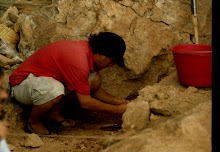
Mammoth hunters of the Russian Far East

They found one of their camps, apparently.

The site, found during a 2007 archaeological expedition to Lake Evoron, is the largest of four Stone Age sites, discovered near the Amur River so far, and was most likely established by mammoth hunters.

"We came to this conclusion after studying flint pikes, arrowheads and a stone scraper," Malyavin said, adding that a comprehensive archaeological excavation could take a couple of years.

Wait, what? Where the hell are the mammoth bones?! There better be some serious use-wear/blood residue analysis being undertaken if they want to make the case that people were hunting mammoths based on stone tools alone.

The modern Stone Age family

The Boston Globe has a feature entitled 'Stone Age Feminism?' (I have to wonder if they had a contest with CNN for the lamest spin on Stone Age news) which talks about how recent discoveries about Neanderthals (FOXP2, 'red hair', extension of their range to Siberia, etc.) may articulate with the argument put forth last year by Kuhn & Stiner (2006) that sexual division of labor was largely absent among Neanderthals. Some people have blogged about this (here and here), just as other have offered more thoughts about the 'spin' or 'framing' put on some of the recent genetic papers (here for FOXP2, here for MC1R). I'm not an anthropological geneticist, so I won't talk about those studies any more than I already have.

In contrast, although the Kuhn & Stiner paper has been discussed at length on some other blogs (including by John Hawks who was fairly critical of their argument), this renewed interest in it a year after its original publication prompted me to finally pitch in my two cents.

I suspect that there's two main ways in which the main conclusion of the paper was greeted by researchers. On one side, people who still think of the Middle-Upper Paleolithic transition in terms of a list of features that distinguish the UP from the MP (and by extension, modern humans from Neanderthals) probably clapped their hands excitedly before chiseling "sexual division of labor" into the stone tablet that bears the other commandments of modern human behavior. Nothing new under the sun here. On the other side, you have people who largely dismissed Kuhn and Stiner's argument by saying that it just doesn't jive with the paleoanthropological record, ethnographic analogy and/or common sense. Again, nothing too earth-shattering.

My own view doesn't really fall on a simple continuum between those two extremes. If someone held a pistol to my head and asked me to pick sides right there and then, I suppose I'd probably say I lean more towards this second pole (though if this situation really were to happen, I'd probably just say whatever the hell they wanted to hear!). However, if the same paleoanthropologically-inclined gun-toting individual was armed with, say, a musket (or any other weapon that would give yours truly a bit more time to talk), I would promptly qualify this statement by adding that, while it may not be congruent with all of the data we now have available, Kuhn and Stiner's paper is nonetheless quite an important contribution to studies of the Middle-Upper Paleolithic transition for two main reasons:

1) It bring together a wide range of archaeological data whose joint patterns previous synthetic treatments have been unable to account for convincingly. Admittedly, this is done at the expense of some of the finer details of the archaeological record (I think there's evidence Neanderthals exploited small game and plants, and that there's little evidences that modern humans engaged in substantially less close-range hunting), although this is perhaps unavoidable in any synthetic treatment of the evidence. However, it does propose a novel idea to account for some general patterns, although as John Hawks has pointed it is difficult to test empirically. The important thing here is to look at this as a new avenue of research, and not a paleoanthropological received truth to be accepted and repeated uncritically, a point unfortunately lost on the popular media.

2) Most importantly (and I think that's what Kuhn and Stiner were really going for), it forces researchers to come to grips with the idea that the Late Pleistocene archaeological record is now sufficiently well-known that we can and should be focusing on other questions than simply what techniques of tool manufacture hominins used, what their chronology was, what the oldest evidence for "behavior X" is, how hominins moved around and managed their resources, and what critters hominins were eating. These are all obviously critical questions (some that I tackle in my own work), but is there more to Paleolithic archaeology than this? According to that paper, yes. That Kuhn & Stiner tried to roll this specifically into the modern human origins debate, to which they have spent their whole career contributing, is perhaps best seen as secondary. On the other hand, it likely accounts for why the news outfits all latched on the "Stone Age feminism" angle - it's just too easy and speaks to contemporary issues almost more than it does about prehistoric life.

I was (and remain) a little surprised by the gusto with which some people reacted to this paper stressing that we might want to consider addressing social issues from a paleoanthropological standpoint (although I can understand that such reactions were mainly driven by empirical concerns). That idea is not exactly new, having been frequently presented and repackaged by researchers like Gamble (esp. Gamble 1999), sometimes on empirical bases much weaker than those invoked by Kuhn and Stiner (2006). Obviously, we must be careful not to get carried away in that direction and make sure that we can strongly link inference to hard data derived from archaeological research. However, given that we're dealing not only with prehistoric lifeways but with prehistoric people, I think there is a case to be made for looking at a new set of issues in contemporary paleoanthropology, although it is critically important that this work be as solidly anchored in the empirical record as possible. That peculiar vein of research may not be everyone's cup of tea, but it can be worth investigating, especially if we are to make Paleolithic research relevant to the broader world of hunter-gatherer anthropology.

References:

Gamble, C. 1999. The Palaeolithic Societies of Europe. Cambridge University Press, New York.

Kuhn, S. L., and M. C. Stiner. 2006. What's a Mother to Do? The Division of Labor among Neandertals and Modern Humans in Eurasia. Current Anthropology 47:953-980.

Wednesday, November 07, 2007

Four Stone Hearth #27

It's that time again... gather one, gather all around the latest installment of Four Stone Hearth, the blog carnival. This time around it's being hosted by Sam over at Sorting Out Science. It's really a pleasure to read and reflect about, so make sure you do yourself the favor of visiting that corner of the information superhighway.

Monday, November 05, 2007

The caveman in the mirror?

Meredith Small presents a humorous essay on "the scariest thing about Neanderthals."

The gist of her argument is that, despite their rough facades,

...these ancient fellow Europeans were also culturally sophisticated. They buried their dead, built shelters, made tools, used fire and hunted. The may have had language (DNA sequencing has also revealed they carried the FOXP2 gene which is linked to language ability). And they had brains 100 cubic centimeters larger than people today.

And so why have these interesting people been relegated to second-class citizen status?

Because they threaten us.

Neanderthals are chronologically the closest, and the most familiar, example that we have of our kind disappearing off the face of the Earth, and that means we can go too.

Of course, not everybody thinks of Neanderthals as second-class citizens. But, given that many people do, Small's essay is an interesting spin on the long-standing idea that Neanderthals can be argued to embody the us-vs-them perspective in paleoanthropology.

More on the "Red Lady"

Hot on the heels of the news that the Red Lady is older than previously thought, Greg Laden offers some additional thoughts on why he also thinks it might be tricky to infer that burial originated in Western Europe based on a new date from this burial.

Tuesday, October 30, 2007

Asking a "lady" her age

The 'Red Lady of Paviland' is a Gravettian burial originally found in 1823 Goat's Hole Cave at Paviland (UK), and which was recently returned to the National Museum of Wales from Oxford University where it had been kept since its discovery. The body is actually that of a young male and was found covered in red ochre as well as "with a number of artefacts including ivory wands, bracelets and periwinkle shells."

It was originally thought to date to about 18 kya, before more recent assays established it was 25-26 kya. Well, it turns out that Tom Higham and his team have determined it is, in fact, some 4000 years older, or "just over 29 kya".

Beyond the general 'older is better' paleoanthropological cachet of this new report, there are some interesting implications drawn from this new age:

"It would mean The Red Lady lived in an age when the climate was much warmer than it would have been 4,000 years later.

Dr Higham added: "The data that we have got now is making a lot more sense."

He said it was important for "our understanding of the presence and behaviour of humans in this part of the world at this time".

He also said it "might" suggest that the custom of burying people with artefacts originated in western Europe rather than eastern Europe as had previously been thought.

"This raises new questions about the way in which these people spread and lived on the continent," he added."


I don't know what else they're basing the claim for a Western European origin of burials, but a single burial is not much to go on for such an interpretation. I'm sure there'll be more about this in the write-up of the analysis, which should be published in the Journal of Human Evolution early in 2008 (the corrected proof wasn't available when I checked today).

An artist's rendition of the burial ceremony in the Gravettian
( http://museums.ncl.ac.uk/flint/archrit.html).

Monday, October 29, 2007

The size of one's package...

I’ve been struggling to find time to string together my first set of thoughts about the Marean et al. (2007) paper that came out about 10 days ago, and this since even before CNN was harping on about “Stone Age clambakes” (such a lame spin). So I figured I'd better do it now, while they were still fresh-ish…

A few things, as a preamble. First, if you want a “public” rendering of the study, you’re much better off checking out the official ASU press release than any of the media coverage that was heaped on the piece. Second, for a tongue-in-cheek spin on what the findings reported by Marean et al. (2007) might mean, check out this post on Hot Cup of Joe. Third, in the interest of full disclosure, Marean was one of my PhD committee members and I consider a number of the paper’s coauthors pretty good friends.

Moving on to the paper itself, the chrono-stratigraphy of the study seems beyond reproach to me. In other words, there’s no question we’re dealing here with an MSA coastal occupation beginning at least ca. 167 kya. Also, the GIS modeling of the paleo-shoreline (available as a [very large – 64 megs!] supplementary video) is very enlightening and the authors put it to very good use in inferring the most likely time of occupation of the site during the LC-MSA. As far as I know, it’s the first time this kind of video information is presented alongside a paleoanthropology piece in Nature, and I hope this is a trend that will stick for archaeological contributions, insofar as they are useful, of course.

By and large, what most strikes me about the paper is the discussion of a “behavioral package” that comprises coastal living, shellfish exploitation, ochre use and bladelet production. These elements are unquestionably all there at PP13B, but their varying representation across the LC-MSA stratigraphy strongly suggests that they were far from indissociable in evolutionary time, and this even at a single locale. Interestingly, this very fact emphasizes how dynamic the MSA appears to have been as a form of behavioral adaptation, even in its comparatively early phases. This contrasts with some views of the MSA as a single ‘thing’ across space and time. That said, it also raises the issue of whether we are, in fact dealing with a discrete “package” and of what elements are its essential features, for lack of a better term. I think that we still have some way to go in highlighting what the advantages provided by each of these different behaviors was, especially in different situational contexts, but it is very intriguing to first find them in association when the coast first appears to become more or less permanently occupied.

This discussion about a modern “behavioral package” (which is what they’re getting at, really), I feel, is the cornerstone of this piece. It also strikes at the beating heart of a long-standing and still unresolved question in paleoanthropology, namely what makes modern humans, well, “modern” in behavioral terms and what of these elements are the fundamental ones. The data put forth by Marean et al. suggest that the expansion of the diet breadth might be key, although it's clearly not sufficient on its own (hence the "package"). Regardless, this paper is important in fleshing out our understanding of the MSA in an otherwise poorly-known segment of its chronology and in reiterating how internally variable this industry can be.

As I implied at the beginning of this post, I mainly to get out what thoughts I’ve had time to formulate about this paper before it had been too long. I just might return with some more a little while later.

Reference:

Marean, C. W., M. Bar-Matthews, J. Bernatchez, E. Fisher, P. Goldberg, A. I. R. Herries, Z. Jacobs, A. Jerardino, P. Karkanas, T.Minichillo, P. J. Nilssen, E. Thompson, I. Watts, and H. M. Williams. 2007. Early human use of marine resources and pigment in South Africa during the Middle Pleistocene. Nature 449:905-908.

Wednesday, October 24, 2007

Ugg 4 Prez!

Finally, a clear paleoanthropological voice among the front-runners for the Republican presidential nomination, courtesy of This Modern World:


Hat tip to Tom Minichillo.

Four Stone Hearth #26

The 26th installment of the Four Stone Hearth anthropology blog carnival is up at the Primate Diaries. There are, among other things, a thought-provoking essay on the origins of melody by Victor Grauer and a great discussion by Chris O'Brien of how ID - not satisfied in misrepresenting biological evolution - also misrepresents archaeology. Lots of good stuff there, so check it out, people.
.

Sunday, October 21, 2007

Against Creationism in Canada

Scott Rowed writes a very good op-ed piece in the Calgary Herald criticizing the growth of creationism in Canada, and the age-old attempts of creationists to portray evolution as "just another theory". He also justly criticizes politicians like John Tory (Conservative Party Leader of Ontario) who are trying to derive political capital by pushing creationism in Canadian public schools.

I can only agree with Rowed when he argues that:

"Science and technology are the engines of our economy. If we indoctrinate our children with pseudo-science like creationism or intelligent design, or dumb down the curriculum to avoid "offending religious sensibilities," we are robbing them of exciting careers and harming Canada's future scientific and economic power.

The science curriculum need to be strengthened, not gutted. It needs to inspire young children with the wonders of distant galaxies and nebulas, with the vastness of geological time, and with the incredible diversity of life on Earth and how evolution shaped it."


Thanks to Greg Laden for making me aware of this one.

Thursday, October 18, 2007

McGill Lecture

For you readers in the greater Montreal area, it might interest you to know that I'll be giving a public lecture entitled "New Insights on the Middle-Upper Paleolithic Transition in Italy" in the Department of Anthropology at McGill University this coming Monday (Oct. 22). I'll be presenting a summary of my latest research on the archaeology of the last Neanderthals and the first modern humans in Italy, as well as outline some new research projects I've undertaken of late. The event will take place in the Stephen Leacock Building, Room 738, from 12:30-2:00PM. It's open to everyone, so come one, come all!

Newsflash: Neanderthals had modern FOXP2

So, as revealed in a study by Krause et al. (2007) currently in press in Current Biology, it turns out that:

"...Neandertals carried a FOXP2 protein that was identical to that
of present-day humans in the only two positions that differ
between human and chimpanzee. Leaving out the
unlikely scenario of gene flow, this establishes that
these changes were present in the common ancestor
of modern humans and Neandertals." (Krause et al. 2007: 4).


You can also read a press release here. In other words, despite some recent claims that 'modern' FOXP2 proteins would be shown to distinguish modern humans from Neanderthals (e.g., Klein 2003, Mellars 2006), it turns out that this is not the case after all. Since FOXP2 has been considered by those and other researchers as the basis for the capacity for modern language, should we now stop arguing about whether Neanderthals had the capacity (and therefore likely used) fully modern speech? Not to toot my own horn or anything, but this is exactly the issue that had been discussed in my post on Neanderthal tooth-picking and its implications for their linguistic abilities (check out the comments, especially). Obviously, FOXP2 is not the only gene involved in language, so the question isn't truly resolved, but it's the one that's most often and most vociferously brought up in debates about Neanderthal linguistic ability, so this is pretty big news indeed for paleoanthropologists.

In any case, here's the abstract of the Krause et al. piece:

"Although many animals communicate vocally, no extant
creature rivals modern humans in language ability.
Therefore, knowing when and under what evolutionary
pressures our capacity for language evolved is of great
interest. Here, we find that our closest extinct relatives,
the Neandertals, share with modern humans two
evolutionary changes in FOXP2, a gene that has been
implicated in the development of speech and language.
We furthermore find that in Neandertals, these changes
lie on the common modern human haplotype, which
previously was shown to have been subject to a selective
sweep. These results suggest that these genetic
changes and the selective sweep predate the common
ancestor (which existed about 300,000–400,000 years
ago) of modern human and Neandertal populations.
This is in contrast to more recent age estimates of the
selective sweep based on extant human diversity data.
Thus, these results illustrate the usefulness of retrieving
direct genetic information from ancient remains for
understanding recent human evolution."


And note that last bit about the age estimates - in the long run, I think this may turn out to be one of the more important implications of this study, as it emphasizes the need to look at what the paleoanthropological record itself tells us about these issues, as opposed to genetic studies on modern populations alone.

References:

Klein, R. 2003. Whither the Neanderthals? Science 299:1525-1527.

Krause, J., C. Lalueza-Fox, L. Orlando, W. Enard, R. E. Green, . H. A. Burbano, J.-J. Hublin, C. Hänni, J. Fortea, M. de la Rasilla, J. Bertranpetit, A. Rosas, and S. Pääbo. 2007. The Derived FOXP2 Variant of Modern Humans Was Shared with Neandertals. Current Biology: DOI: 10.1016/j.cub.2007.10.008.

Mellars, P. 2006. Why did modern human populations disperse from Africa ca. 60,000 years ago? A new model. Proceedings of the National Academy of Sciences 103:9381-9386.

Wednesday, October 17, 2007

Pirate Arrrrrr...chaeology Update

It appears they want to bring up one of the canons from the ship that might be Blackbeard's Queen Anne's Revenge. I had talked about this project a bit earlier this year. Keep posted for more on this.

Newsflash: Neanderthals could build stuff

The Mousterian site of La Folie, which is located just north of Poitiers (France), is the subject of an extremely well-done website (in French, unfortunately with no English translation). The site is dated by TL to about 57.7 +/- 2.4 kya and had thus far been the subject of a few preliminary reports that emphasized its contextual integrity and the identification of activity areas within it (Bourguignon et al. 2002, 2006). One of the key aspects of the site is that a number of approaches were combined to confidently establish the existence of regularly spaced postholes around its periphery (indicating the existence of a relatively large man-made structure) and discrete activity areas within the area circumscribed by this structure (slightly under 250 squared meters, over a thickness of about 10 cm). The absence of evidence for a central or transversal posts that would have been needed to support a roof suggests that the structure was a large (i.e., ca. 10m in diameter) windbreak rather than a tent or hut. The postholes were surrounded by limestone blocks used to anchor the wooden posts used in the structure, traces of which have clearly been identified through micromorphological analysis in at least one of the holes. Likewise, micromorphology identified a large area along one side of the structure that was devoid of archaeological remains, save for decomposed plant materials, which suggest that it represents a bedding area.

Use-wear and technological analyses show that the lithic industry used at the site is characteristic of the Mousterian of Acheulean Tradition, and that it included a Levallois production strategy aimed at producing sharp flakes used to work a variety of materials (e.g., wood, skin, soft plant material). A few of these blanks were retouched to produce, among other things, retouched backed knives, but most of the lithics appear to have been produced and used relatively expediently. The investigators argue that the site served as a task site likely used in food procurement, although there are only scant details about this interpretation provided on the website.

All in all, this is a very eloquent presentation of the results of this excavation and it demonstrates how relatively dry archaeological data can be presented in an engaging way to the public at large. On a more technical level, as had already been documented at the Middle Paleolithic site of Tor Faraj in Jordan (Henry et al. 2004), this confirms that Neanderthals were able to partition and clearly organize their living space, in contrast to claims that "well organized sites" only appear in the Upper Paleolithic.

References:

Bourguignon, L., Sellami, F., Deloze, V., Sellier-Segard, N., Beyries, S., Emery-Barbier, E. 2002. L’habitat moustérien de « La Folie » (Poitiers, Vienne) : synthèse des premiers résultats. Paléo 14:29-48.

Bourguignon, L., Vieillevigne, E., Guibert, P., Bechtel, F., Beyries, S., Émery-Bariber, A., Deloze, V., Delahaye, C., Sellami, F., Sellier-Segard, N. 2006. Compléments d’informations chronologiques sur le campement moustérien de tradition acheuléenne du gisement de la Folie (Poitiers, Vienne). Paléo 18:37-44.

Henry, D. O., H. J. Hietala, A. M. Rosen, Y. E. Demidenko, V. I. Usik and T. L. Armagan. 2004. Human Behavioral Organization in the Middle Paleolithic: Were Neanderthals Different? American Anthropologist 106:17-31.

Kudos

My friend and former ASU postdoc Chris Fisher - a geoarchaeologist at Colorado State University who works mainly in the Lake Pátzcuaro Basin (Michoacán, Mexico) - was recently awarded the 2007 Gordon R. Willey Prize by the Archaeology Division of the AAA. This was for a paper based on his doctoral research research published in American Anthropologist in 2005 in which he looked at human-environment interactions in his study area. Fisher argues that contact led to a precipitous decline in indigenous population meaning that the land management system they had developed could not be maintained, thus leading to widespread landscape degradation. It's a very good paper, and you can read it as a pdf here. Congrats Chris!

Tuesday, October 16, 2007

New insights on raw material use

At the moment, I'm wrapping my head around two papers about patterns of raw material procurement and use in archaeological assemblages.

In the first, Jelmer Eerkens et al. (2007 - available as a pdf on Eerkens' web page) use obsidian characterization to demonstrate how different components of a lithic assemblage (i.e., small flakes vs. large flakes vs. formal tools) can yield different and complementary patterns of raw material use and how focusing on small flakes can inform us of broader behavioral patterns of the people responsible for depositing the assemblage, even if larger pieces are missing, either through curation or looting. I'll have a bit more to post on this paper soon, but it's a very demonstration of why archaeologists need to pay attention to all the pieces in their assemblage if they wish to accurately depict prehistoric life.

The second paper, by Lucy Wilson, I've just started reading, so I'll have to post more about it later, but its starting point is quite thought-provoking and, in spite of its conceptual simplicity, has not previously been used before in lithic analysis, to the best of my knowledge. Wilson uses 'gravity modeling' (similar to that used in economics and other social sciences) to predict how attractive given sources of raw material would have been to foragers in their vicinity and to extrapolate from this a baseline of how prevalent they should theoretically be in lithic assemblages found at a given point on the landscape. This, in turn, allows us to tease apart the influence of the natural abundance and flaking properties of given materials from that of 'other' factors leading to raw material source selection, thus potentially paving the way for a discussion of 'social' factors linked to the use of various lithotypes. This one sounds quite good, so check again soon for a more detailed post on this one.

References:

Eerkens, Jelmer W., J.R. Ferguson, M.D. Glascock, C.E. Skinner, and S.A. Waechter. 2007. Reduction strategies and geochemical characterization of lithic assemblages: a comparison of three case studies from western North America. American Antiquity 72:585-597.

Wilson, L. 2007 (in press). Understanding Prehistoric Lithic Raw Material Selection: Application of a Gravity Model. Journal of Archaeological Method and Theory 14. DOI: 10.1007/s10816-007-9042-4.

Fuel and mining magnate backed UK challenge to An Inconvenient Truth

Wish I could say I was surprised, but by now I've grown too cynical or jaded (or both) by the frequency at which such revelations percolate in the media following the release of allegedly "neutral" challenges to scientific consensus.

Check out the full story here.

Thursday, October 04, 2007

Wine!

Not much time to post this week since my "free time" has been coopted by the family unit to help in crushing crates and crates of grapes in preparation of this year's supply of Castello Salvatore... I just got home now, and I'm exhausted; we crushed about 40 cases of grapes tonight: Cabernet Sauvignon (yeah!), Pinot Noir (hm), Zinfandel (not my call). Should make for a good range this year, though.


Now, to make this relevant to archaeology, I should mention that the fantastic (and very well-written) book Ancient Wine by Patrick McGovern was brought up in conversation a number of times this evening. The first instance, between me and my father, concluded thusly:

Me: "... as McGovern claims in that book Ancient Wine that I gave you a copy of last Christmas."

Him: "Oh yeah, yeah..."

Me: "So you'll remember winemaking is first documented in the Neolithic, at the site of Hajji Furz Tepe, in Iran..."

Him: "..."

Me: "You never read the book, did you?"

Him: "Well... no... but it was a very thoughtful gift!"

Anyway, all of that to say that, here at A Very Remote Period Indeed, we're all about actualistic studies, be they in flintknapping or winemaking. I like to think of it as a form of ethnoarchaeology (yeah, that's the ticket!). The really fun part of all this, of course, is when we finally taste the end product to test the rather lengthy list of hypotheses I have about just how people might have used this stuff in the past... salute!

Friday, September 21, 2007

How modern are the hobbits' tools?

There is one passage in the Tocheri et al. (2007) paper that hasn't gotten all that much attention in the media frenzy about the fact that this study 'proves' the hobbits were a different species:

"Our analyses support hypotheses that LB1
is descended from a hominin ancestor that
migrated out of Africa before the evolution of
the shared, derived wrist morphology that is
characteristic of modern humans, Neandertals,
and their last common ancestor. The association
of LB1 with direct evidence of stone
flaking technology comparable to that found at
Oldowan or other Lower Paleolithic sites
throughout the Old World provides
additional support for the hypothesis that the
earliest hominins to use and make stone tools
retained primitive hominin wrist morphology.
The structurally modified
wrist of modern humans and Neandertals
probably evolved sometime between 1.8 and
0.8 Ma. These structural modifications
form a morphological complex that may
represent an adaptation for better distribution
of forces radio-ulnarly across the wrist to
facilitate the full commitment to tool-related
manipulative behaviors that arose in the
hominin lineage leading to modern humans
and Neandertals." (Tocheri et al. 2007: 1745; references excised).


In my view, this passage is of capital importance because it narrows the range of interpretation of the stone tool assemblage associated with the H. floresiensis remains. Here's what they look like in the original Morwood et al. (2004) pub:


(From Pharyngula)

To recap, there are those who think that these tools are basically "Upper Paleolithic", which has been taken to mean either that 1) small-brained hominids can manufacture such things (Morwood et al. 2004) or 2) that such tools can only be manufactured by modern humans, which means that LB1 is most likely a microcephalic H. sapiens that lived about 18 kya (Martin et al. 2006). Some scholars (e.g., Brumm et al. 2006) have argued that there are strong continuities between Lower Paleolithic industries found elsewhere on Flores, and recently the 'modern' features of the lithic assemblage associated with LB1 have been downplayed significantly, suggesting it is relatively simple and part of a technological sequence that involved the production of both 'core tools' and flakes (Moore and Brumm 2007).

Personally, I have never been especially convinced by the claims for systematic blade technology associated with LB1. The two 'macroblades' (a, b) and two 'microblades' (e, f) illustrated by Morwood et al. (2004: Fig. 5) aren't very regular (the central dorsal ridges are not straight in any of them) and none of their platforms (from what can be seen) are truly 'lipped', unlike the platforms usually generated by soft-hammer production (which is largely employed in true blade production). Furthermore, the illustrated "burin core" really looks to me like a flake core from which a series of small flakes with subparallel edges were knocked off, not a bladelet core. None of this really conforms to the "narrow blades removed sequentially from blade cores" alluded to by some detractors (in Culotta 2007:741) who considers they can only be produced by H. sapiens (a misleading assertion anyway [Bar-Yosef and Kuhn 1999]). Rather, M. Moore and T. Sutkina , who have studied the tools, argue that they represent fairly "simple stone artifacts" (in Culotta 2007:741), which happen to include a few flakes that are twice as long as they are wide - the traditional, if slightly outdated, definition of a blade.

Also keep in mind this "trade secret" of archaeologists: the pieces selected for illustration in published papers are usually the "best looking" ones. In other words, if people want to show they have blades in their assemblage, they tend to illustrate the best examples, even if they don't necessarily accurately reflect the range of products they're actually dealing with. If they had regular, textbook blades in their assemblage, I'd be very surprised that Morwood et al. (2004) had chosen not to illustrate them instead of the ones presented in Fig. 5.

In any case, this is where the Tocheri et al. (2007) paper comes in: Blade technology and prepared core technology, which Neanderthals and modern humans are known to have been able to produce, requires a substantial degree of skill and manual dexterity. The tools at Liang Bua do not reflect this kind of manual dexterity and indeed appear to be very close to Lower Paleolithic freehand flake production strategies. This is the kind of technology which could be expected to be associated with pre-modern wrist morphology, which Tocheri et al. (2007) make a strong case for. For me, this is an instance of two sets of paleoanthropological evidence potentially coming together rather nicely and coherently to support one another, and it would lend credence to the hypothesis that the wrist morphology of LB1 was typical of the hominins who produced the stone tools found at the site. While this study obviously doesn't resolve the issue of whether LB1 represents a distinct species and while it is possible for modern humans to produce more rudimentary lithics, the various evidential threads do seem to be starting to come together as an integrated whole.

This discussion and the new paper nonetheless raise a few more issues for me: looking at the scans of various kinds of wrist bones presented in the paper, it looks like the LB1 bones are most similar to those of chimps, not those of early Homo or Australopithecus. What gives? Granted, there aren't very many bones of fossil hominins that we can compare the LB1 wrist to, but what might be the implications of this for the taxonomic designation of LB1 and, especially, for the necessary morphological and neurological preconditions for systematic, purposeful tool production?

References:

Bar-Yosef, O., and S. L. Kuhn. 1999. The big deal about blades: laminar technologies and human evolution. American Anthropologist 101:322-338

Brumm, A., F. Aziz, G. D. van den Bergh, M. J. Morwood, M. W. Moore,I. Kurniawan, D. R. Hobbs, and R. Fullagar. 2006. Early stone technology on Flores and its implications for Homo floresiensis. Nature 441:624-628.

Culotta, E. 2007. The Fellowship of the Hobbit. Science 317:740-742.

Martin, R. D., A. M. MacLarnon, J. L. Philips, and W. B. Dobyn. 2006. Flores Hominid: New Species or Microcephalic Dwarf? The Anatomical Record A 288A:1123-1145.

Moore, M., and A. Brumm. 2007. Stone artifacts and hominins in island Southeast Asia: New insights from Flores, eastern Indonesia. Journal of Human Evolution 52:85-102

Morwood, M. J., et al. 2004. Archaeology and age of a new hominin from Flores in eastern Indonesia. Nature 431:1087-1091.

Tocheri, M. W., C. M. Orr, S. G. Larson, T. Sutikna, Jatmiko, E. W. Saptomo, R. Awe Due, T.Djubiantono, M. J. Morwood, W. L. Jungers. 2007. The Primitive Wrist of Homo floresiensis and Its Implications for Hominin Evolution. Science 317:1743-1745.