There's a
lengthy report describing some preliminary findings of Middle and perhaps even Lower Paleolithic artifacts on the Greek island of Crete that
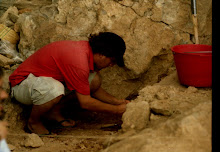
Thomas Strasser presented earlier this week. The report stresses especially that "ancient Homo species — perhaps Homo erectus — had used rafts or other seagoing vessels to cross from northern Africa to Europe via at least some of the larger islands in between."
If they're correct, Strasser's interpretations agree exactly with the results of work reported by Mortensen (2008) and which I already
discussed a couple of years ago. Specifically, Mortensen argued that the implements he discovered "suggest that the first humans reached the island across the sea from Libya. That an early contact between northern Africa and southern Europe existed already during the Palaeolithic periods is a hypothesis now supported by most scholars."
Archaeoblog is skeptical about the findings, especially since no illustrations are provided that would help assess how 'Paleolithic' the implements look, while
Hawks is also skeptical but suggests that fleeting human occupation may have occurred on Crete in the Middle Pleistocene as it may have on other large Mediterranean islands.
I'm of two minds about this. On the one hand, apparently large numbers of artifacts appear to have been found, on at least four distinct terraces as well as some rockshelters. Given that the team comprises a
bona fide Paleoltihic archaeologist (C. Runnels), I see no reason to challenge the human-made nature of these implements. And, by referring to the Mortensen report, the current report certainly suggests that there was some sizeable human population on Crete at least during the Late Pleistocene (i.e., after ca. 130kya). That said, based on the description in the report, the stone tools in question appear to be handaxe-like things made on quartz (
I recently discussed handaxes here). Quartz can be an impractical material to work, mainly because of its coarse crystalline structure, though in some cases, it can be fine-grained enought to yield decent knapped products. In other words, the structure of quartz often limits the range of formas that can be made from it, usually restricting them to relatively 'coarse' ones similar to some Lower Paleolithic types, which may account for some of the similarities mentioned in the text. Without some good illustration and photographs of these artifacts and of the quality of the quartz used to manufacture them, it's hard to make any kind of definitive statement.
Moving to the issue of the colonization of Crete, the whole 'they came straight from Africa' model is unconvincing to me. For one thing, the Greek mainland is much closer to the island than North Africa, and lower sea levels during cold periods of the Pleistocene would have made Crete more visible and accessible from there than from, say, Lybia. For another, the amount of finds and their time-transgressive nature (that is, they were found on four terraces spanning at least 90,000 years) suggest that people permanently settled the island for long stretches of the Middle Paleolithic. Both of these observations argue for hominins arriving to the island purely by chance. The question is whether or not they reached through seafaring. If they came from Europe, complex seafaring is unlikely to have been critical, whereas if they came directly from Africa, it would have been essential.
In a
recent post, I detailed how seafaring - as inferred from the colonization of islands - has been argued by some to represent evidence of 'modern human behavior' (Norton and Jin 2009). However, in that case, colonization through seafaring was demonstrated by the presence of foreign lithic raw materials at specific site. If I understand the report about the finds by Strasser's team, however, the raw material of the Cretan finds appears to be exclusively local. The report states that
... hand axes found on Crete were made from local quartz but display a style typical of ancient African artifacts.
“Hominids adapted to whatever material was available on the island for tool making,” Strasser proposes. “There could be tools made from different types of stone in other parts of Crete.”
Strasser has conducted excavations on Crete for the past 20 years. He had been searching for relatively small implements that would have been made from chunks of chert no more than 11,000 years ago. But a current team member, archaeologist Curtis Runnels of Boston University, pointed out that Stone Age folk would likely have favored quartz for their larger implements. “Once we started looking for quartz tools, everything changed,” Strasser says.
This local provisioning of raw material, in my view, argues against colonization by seafaring to a degree. Reference to the stylistic similarities of the Cretan handaxes and those from Africa is, again in my view, a non-argument, since handaxes are very similar in morphology and technology pretty much throughout the Old World (McPherron 2000).
ReferencesMcPherron, S.P. 2000. Handaxes as a Measure of the Mental Capabilities of Early Hominids.
Journal of Archaeological Science 27:655-663.
Mortensen, P. 2008. Lower to Middle Palaeolithic artefacts from Loutró on the south coast of Crete.
Antiquity 82(317): http://www.antiquity.ac.uk/ProjGall/mortensen/index.html.
Norton, C.J., and J.J.H. Jin. 2009. The evolution of modern human behavior in East Asia: current perspectives.
Evolutionary Anthropology 18:247-260.