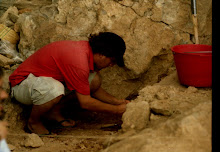
There’s been a lot of buzz about the new paper by Zilhão et al. (2010) on the use of pierced shells and pigments by Neanderthals at the sites of Cueva de los Aviones and Cueva Antón, in southern Spain some 50,000 years ago, so I thought I’d give a few comments about it here.
This is a very significant study in that it strengthens the conclusions of previous research that suggests that Neanderthals habitually used pigments (e.g., Soressi and d’Errico 2007, which I discussed here). Importantly, it also broadens the range of color of these pigments to include, beyond black, yellows, reds, and orange. This matters because of the contention by some (e.g., Watts 2002) that the red color of ochre has important symbolic connotations that black pigments couldn’t have (e.g., blood, life, menstruation, etc.), and that this is an important distinction between Neanderthal and ‘fully modern’ use of coloring. Credibly establishing the presence of a range of colorful pigments derived from external sources at both these sites (their mineral sources are at least 3-5km distant from either cave) is therefore a major contribution to our knowledge of Neanderthal behavior and some of its symbolic underpinnings.
It of major interest in this paper is the description of a fragmented horse metatarsal with a pointed tip that bears traces of orange pigment at Cueva de los Aviones. The authors argue that “this naturally pointed bone may have been used as a stiletto for the preparation or application of mineral dyes or as pin or awl to perforate soft materials (e.g., hides) that were themselves colored with such dyes.” The relevance of this observation is highlighted by the manganese ‘crayons’ that were found at the Mousterian site of Pech de l’Aze, France (Soressi and d’Errico 2007), since it establishes that Neanderthals were not only using pigments in a range of color, but also that they had a range of manners of applying it to surfaces. This strongly hints at Neanderthal pigment use being a flexible behavior that varied from context to context, in contrast to their oft-repeated characterization of people who knew how to do only a limited range of things but do them quite well (which was one of the recurrent sound bites in the Human Spark documentary recently shown on PBS and which I will discuss on this blog in coming days).
Of course, in this ornament-obsessed period of paleoanthropological research, much of the buzz the paper has been getting derives from the fact that pierced shells were also recovered from both sites, many of which bore pigments. Early shell ornaments and associated pigments, of course, have recently been in the news (and discussed on this blog) and the focus of much attention in helping identify behavioral modernity (e.g., d’Errico et al. 2009). The authors make a strong case for the pierced shells having been purposefully selected by humans as ornaments (even if it’s a bit hard to get a clear idea of the trends in other periods based on the graph in the supplementary info), even if some of the perforations appear natural, artfully pointing out the interpretive double-standard that is sometimes applied to evidence associated with Neanderthals as opposed to that associated with modern humans.
The discussion of Cueva Antón’s Pecten maximus upper shell valve as most likely representing an ornament is also very good. By describing that it was the external surface of this comparatively flat valve that was colored, and by stressing that Antón is currently 60km distant from the shore, the authors make a strong case for this interpretation. Even the most ardent critic is going to have to explain why and how this large and comparatively fragile colored marine shell reached this site, and the patterning of its coloration. From a parsimony standpoint, viewing it as an ornament is imminently reasonable.
Overall, I think the authors are fully justified in concluding
"that these innovations were fulfilling a need—aiding in thepersonalor social identification of people—that did not exist in the preceding two million years of human evolution. Our findings therefore support models of the emergence of behavioral modernity as caused by technological progress, demographic increase, and social complexification and show that there is no biunivocal correlation between “modern” anatomy and “modern” behavior" (Zilhão et al. 2010:5).
They also argue that the null hypothesis about the authorship of ornaments found with ‘transitional industries’ can now reasonably argued to be Neanderthals. The argument about population pressures driving social innovation is a convincing one in this context, since the northern Mediterranean shore appears to have served repeatedly as a Neanderthal refugium during their evolutionary history and the range of food resources available in these more mesic regions likely could have sustained larger populations than elsewhere across their range.
As is usual in studies of early ornaments, however, the sample size remains low, and we must remain careful about inferring too much from them. At present, what these new discovery establish is that Neanderthals used pigments in different parts of their range and applied them in different ways. As well, it establishes that Neanderthals in southern Spain used pierced shells as ornaments at least for a moment of their evolutionary history. This raises the thorny question of why such evidence has not been found in other Neanderthal sites. Is it because archaeologists were not looking for it? Or is it because this was a short-lived phenomenon that emerged in response to localized demographic conditions? And given that there are no transitional industries documented in Spain, is it warranted to link the ornaments from Los Aviones and Antón to those found in France, Italy and East-Central Europe during the transition interval? Whatever the case may be, it now is clear that archaeologists need to pay extra attention when dealing with Mousterian sites yielding shells, as we have convincing evidence that Neanderthals did, in some cases, use shell ornaments well before the transition.
References
d'Errico, F., M. Vanhaeren, N. Barton, A. Bouzouggar, H. Mienis, D. Richter, J.-J. Hublin, S. P. McPherron, and P. Lozouet. 2009. Additional evidence on the use of personal ornaments in the Middle Paleolithic of North Africa. PNAS 106:16051-16056.
Soressi, M., and F. d’Errico. 2007. Pigments, gravures, parures: Les comportements symboliques controversées des Néandertaliens. In Les Néandertaliens. Biologie et cultures (B. Vandermeersch and B. Maureille, eds.), pp. 297-309. Editions du CTHS, Paris.
Watts, I. 2002. Ochre in the Middle Stone Age of Southern Africa: Ritualised Display or Hide Preservative? South African Archaeological Bulletin 57:1-14.
Zilhao, J., Angelucci, D., Badal-Garcia, E., d'Errico, F., Daniel, F., Dayet, L., Douka, K., Higham, T., Martinez-Sanchez, M., Montes-Bernardez, R., Murcia-Mascaros, S., Perez-Sirvent, C., Roldan-Garcia, C., Vanhaeren, M., Villaverde, V., Wood, R., & Zapata, J. (2010). Symbolic use of marine shells and mineral pigments by Iberian Neandertals Proceedings of the National Academy of Sciences DOI: 10.1073/pnas.0914088107