Showing posts with label academia. Show all posts

Wednesday, October 25, 2017

A 'Canadian connection' in North American faculty jobs in Archaeology?


In a paper in press in American Antiquity, Speakman and colleagues (2017) present some data about which archaeology programs in the US and Canada have been most successful at placing their graduates over the past 40 years or so. They conclude that “success in obtaining a faculty position upon graduation is predicated in large part on where one attends graduate school” and that “success in landing a faculty position begins the moment one applies for graduate school” because “being accepted into a top program, as well as the reputation of scholars in that program… really does make a difference.” To me (and for them), these overall conclusions are unsurprising, though it is nice to see impressions and rules of thumb being backed up with some hard numbers. In a nutshell, if you’re interested in being an archaeology prof in North America, you better graduate from Michigan, Arizona, Berkeley, UPenn, ASU, Harvard, TAMU, UCSB, Chicago or UNM, in that order, since these are the ten North American programs in their “tier I”. The second tier also does pretty well in placing grads, and it comprises UCLA, Florida, Pitt, UT Austin, Wisconsin, Tennessee, OSU, UNC Chapel Hill and Virginia.

The authors indicate some readers might be uncomfortable with their approach which divided the 110 North American universities in their sample into six tiers (I, II, III, IV, V, and 0), based on the number of their grads who have secured a faculty position. I’m personally not too bothered by it, as I think this is a rather apt reading of the data they present, rather than a direct judgement of the quality of the faculty in these different programs.

What did strike me, from my position as an archaeology professor at a Canadian university, is how these trends don’t quite seem to jive with the reality of the Canadian market. Based on the data presented, Canadian program are not particuarly great at placing their graduates into faculty positions. The Canadian institutions they list are, in decreasing order of success, McMaster (Tier III – 8 grads placed in 20 years), Calgary (Tier III – 6 grads), followed by Alberta, McGill and Toronto (all three in Tier IV, tied with four grads each), Simon Fraser University (Tier V, 2 grads), and finally UBC, Manitoba and Montréal in Tier 0, meaning programs that haven’t placed a single grad between 1994 and 2014.

Looking at this from a Canadian perspective, I was struck that this list excluded two Canadian universities with dedicated Archaeology programs leading to the PhD, namely Memorial University and Université Laval, though this is likely a result of the bias the authors themselves bring up about the completeness of the AAA AnthroGuide from which they gathered most of their data. Also excluded is the new PhD program at the University of Victoria, which didn’t exist for the period the authors consider.

Additionally, my admittedly subjective impression is that there are a proportionally a lot more archaeology faculty trained at Canadian institutions hired into Canadian program. In the database provided as part of the article’s supplementary material, only 59 of the 1084 (or 5.4%) archaeology faculty listed obtained their PhDs from Canadian programs; this drops to 4.6% (or 28/608) if you consider only those PhDs awarded between 1994 and 2014. This is much lower than my gut feeling of the proportion of Canadian-trained archaeologists is in actuality in most Canadian programs. For instance, at UdeM, out of our seven archaeology and bioarchaeology faculty, two (so 28.4%) received their PhD from Canadian institutions (actually, Québec, in this case); these figures will have to be adjusted next year, following the hire of a public archaeologist we're currently advertising for. Looking more broadly, at SFU, out of 16 tenured/tenure-track faculty listed on their website, fully 8 (50%) come from Canadian institutions, while neighboring UBC has 2/6 (33%) graduates from Canadian programs. At the other end of the country, at MUN’s archaeology department 7/11 (63.6%) tenured/tenure-track faculty listed received their doctorate from a Canadian program. The disparity between these numbers and the overall representation of Canadian PhDs in archaeology programs in North America as a whole is pretty staggering.

There are a couple of ways to think about this trend. On the one hand, it is probably not terribly surprising, considering that, by law, priority is given to Canadian citizens for positions in Canada; insofar as having a Canadian PhD is loosely correlated with being a Canadian citizen, this probably reflects that fact up to a degree. Likewise, scholars working on topics in Canadian archaeology are more likely to be trained in Canada and, in turn, to be appealing to Canadian programs wanting specialists in these issues. The flipside of both these considerations, of course, is that correspondingly fewer Canadian-trained archaeologists must serve as faculty in US archaeology programs, which would have the effect of depressing the already low representation of Canadian programs south of the border. Whether it also has the effect of creating a distinctive Canadian archaeological tradition is an open question; I would surmise that it doesn’t, considering the level of methodological and theoretical integration that currently characterizes the field, but this is just an impression. That said, these (admittedly partial) data suggest one thing rather clearly: if you want to teach archaeology in Canada, receiving a PhD in archaeology from a Canadian program would appear to give your chances a serious boost.

References

Speakman, R.J., C.S. Hadden, M.H. Colvin, J. Cramb, K.C. Jones, T.W. Jones, C.L. Kling, I. Lulewicz, K.G. Napora, K.L. Reinberger, B.T. Ritchison, M.J. Rivera-Araya, A.K. Smith and V.D. Thompson. 2017. Choosing a path to the ancient world in a modern market: The reality of faculty jobs in archaeology. American Antiquity: https://doi.org/10.1017/aaq.2017.36.

Monday, September 26, 2011

Write, and write right!

This piece from a couple of years ago and entitled "Righting your writing" has been making the rounds in my FB network. It provides a pretty good series of tip/strategies for scientists to write more clearly. One that stood out to me was the one about developing daily writing habits

Write daily for 15 to 30 minutes
During your daily writing sessions, don’t think about your final manuscript. Just write journal entries, says Tara Gray, director of the teaching academy that provides training and support to New Mexico State University professors. “People think there’s two phases of a research project—doing the research and writing it up,” she says. Rather than setting aside large chunks of time for each activity, combine them to improve your writing and your research. The first time Gray encouraged a group of faculty members at New Mexico State to adhere to this schedule for three months, they wrote about twice as much as their normal output.
I can't emphasize how important this is. For one thing it builds discipline about getting something on the page everyday. For another, it does wonders to declaw the idea that writing has to be perfect on the first go-around. What I mean by this, it that it makes writing a lot less daunting if you do it habitually, and train yourself to expect that for every 10 words you write, you may end up keeping only one or two in the end. Even if you keep just that fraction, it adds up over time into lines, paragraphs, pages, sections, chapters and even dissertations. In a way, it's really just the academic equivalent of Stephen King setting daily writing goals of 1,000 or 2,000 words (King 2000), except that here you're writing to get in the habit of writing about your work, not fiction, and to fit that habit in the rest of your day.

This is incidentally the key piece of advice from J. Bolker's Writing Your Dissertation in Fifteen Minutes A Day (Bolker 1998). I rarely recommend books as must-reads for graduate students, since everyone's trajectory and style is so different. Bolker's book is one of the few exceptions to this general rule: it really does a wonderful job of showing the importance and, frankly, the healthiness of making writing a routine exercise as opposed to something that is better saved for intense bursts. Now - spoiler alert - the book doesn't actually show you how to write your dissertation (or thesis, or paper, or whatever) in 15 minutes a day. But it does provide a really clear framework for how to think about and structure your writing, and especially developing healthy writing habits. And the key thing about this is also what T. Gray mentions in the quote above: in my experience, approaching writing in this way does allow you to write more and write better overall. It also provides you with a much better use of your time for those 15-30 minutes 'dead periods' between classes or meetings than just surfing the net!

That said, I don't know about the 'journal entry' approach advocated by Gray, but to each is own. Frankly, the important thing is really just to write something, anything daily. It may sound silly, but for a great many people, it works and it helps make the whole process of academic writing that much easier and, dare I say it, appealing.

References

Bolker, J. 1998.Writing Your Dissertation in Fifteen Minutes a Day: A Guide to Starting, Revising, and Finishing Your Doctoral Thesis.Owl Books, NY.

King, S. 2000. On Writing: A Memoir of the Craft. Scribner, NY.

Thursday, January 14, 2010

Yikes!!

Over the past few weeks, many friends and colleagues have sent me a link to this article by Thomas H. Benton who makes a good case about why most students planning to do so should in reality not go to grad school. If you're an undergraduate or returning student thinking about going for a PhD, especially in an overcrowded field like anthropology, you should definitely read it, as well as its companion piece on the need for current PhD students to think about unconventional ways of succeeding with a doctorate.

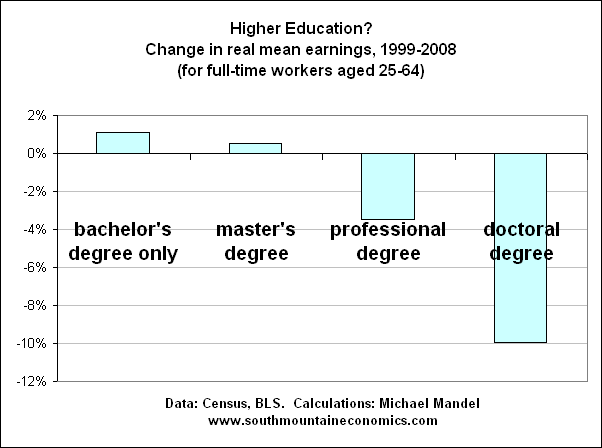
If you need additional information on why getting a PhD might not be such a great idea unless you're willing to sacrifice a good chunk of time for little reward, consider this figure published last week in a piece by Mike Mandel:


Out of all people with post-secondary degrees, the mean earnings of those holding a doctorate have fallen the most dramatically (ca. 10%) from 1999 to 2008! Now, maybe those with a PhD make more money to than a BA-educated worker to begin with (although whether that's the case in academia could certainly be debated), so that they still make a more comfortable living. Nonetheless, that's a pretty significant drop in the standard of living of PhD-holders, one that certainly should make one wonder about whether or not the return on your time and money investment in going for that PhD will be worth it in the end.

On an aside, I wonder whether or not this includes adjuncts or lecturers that are not the tenure-track but nonetheless qualify as full time workers based on the number of courses they teach. If so, this could certainly help explain part of the trend. Nonetheless, that this trend in post-PhD employment is having such an impact on the figures as a whole should serve as an additional bucket of ice water to be doused on students eager to pursue a PhD!

Monday, September 21, 2009

I know what you did last summer

Over the weekend, I came across yet another ill-informed op-ed by some talking head about what to do to 'fix' the university system - in this case, the proposed 'solution' to the high costs of post-secondary education is simply to have professors teach more so their work weeks are similar to those of 'normal' people! Riiiight. Most of it is pretty generic repetition of the remarkably ignorant claim that a professor's work week is adequately measured by how many hours he or she teaches in a given week. To me, that's kind of like saying that the work week of police officers only amounts to the time they actually spend arresting criminals - you know, the rest of the time, they're just drivin' around and talking with people in the neighborhood, not actually putting in any time towards what we're really paying them to do.

Now, I'm obviously somewhat biased, but does it really surprise anyone that an hour of class time requires several hours of preparation beforehand, on top of writing exams, meeting with students and grading tests and assignment? None of the professors I know (and I know many) just show up and pontificate about the day's topic without doing any research on it or providing reasonably structured critical analysis of it, which seems to be the warped perception some pundits have of university lecturing (which may be more indicative of how they do things than how we do them, but I digress...).

What annoys me the most in most of these discussions, though, is when people criticizing professors' work whip out the old "and on top of it all, you have 3-4 months of summer vacation a year!" canard as a final and self-evident nail in the coffin of the defenders of higher education. As an archaeologist with an active field project, this aggravates me to no end. 3-4 months of vacation a year, really? Let me tell you a bit about what I did last summer, then: I turned in my grades on April 30, and on May 5, I was on my way to my field site, which means the May 1-4 period was spent frantically wrapping up lose ends and making sure all my material was ready for the field, where I stayed for two months (until July 6), training and supervising the work of seven students and several volunteers. We had pretty long days this summer: we set off for the site around 6:45AM and were back home around 6:00PM, after getting supplies for the next day - that's 11:15 work hours, 5 days a week. Tack on another two hours of work a day for me to review my field notes for the day, prepare the goals of the next day, and try to keep up with academic responsibilities like reviewing papers and administration that, shockingly, don't mysteriously get put on hold once a term is over. You can also add about another six hours each week for field trips I would organize for the students to get familiarized with the archaeology of the region. Right there, we're already talking about a ca. 72:15 hour work week, and that's not counting discussions/meetings with colleagues in the evening and weekends. All that during my extensive 'vacation' time... no wonder I felt so rested when I started at UCD at the beginning of August!

Mind you, I'm not writing this to complain or to toot my own horn, since I had a dynamite crew this summer and since all archaeologists I know that have an active field project have similar, if not more grueling schedules when they're doing fieldwork. The point, however, is precisely this: most of our research gets done in the summer. Few if any of us spend that time (or can afford to spend it!) sipping exotic cocktails in no less exotic resorts. That research, in turn, provides material and data for us to analyze during the rest of the year and for us to use to provide concrete, empirically informed examples of concepts we cover in our classes, in addition to providing potential research opportunities for interested students (which we then supervise using time that often doesn't get counted as part of our weekly teaching hours). Basically, for archaeologists as for the vast majority of academics, summer is a time to get some research done. And without that research, the quality of classroom education can decrease, which underscores the logic behind the organization of the academic year at the university, and the need for academics to do research. If any pundit out there doubts the veracity of any of this, you're hereby invited to join me in the field next summer... I have plenty of screening and sorting that needs getting done, and after a couple of months of that, I'll be more than happy to hear about your impressions of how academic archaeologists spend their summers.

Tuesday, September 16, 2008

Well, look at that...

Most of the feedback I've gotten about this blog over the past couple of years has been generally positive, thought most of it is usually qualified with formulas to the effect of "I don't know where you find the time" and "What concrete purpose does it serve?"

Well, over the summer, a commentary of mine came out in the journal Medical Hypotheses. It's entitled "Mad Neanderthal disease? Some comments on "A potential role for Transmissible Spongiform Encephalopathies in Neanderthal extinction" (Riel-Salvatore 2008). Regular AVRPI readers might find that title sounds familiar, and they would be right. "Mad Neanderthal Disease?" was also the title of a post I wrote last winter in reaction to the publication of a paper by. S. Underdown (2008) and the considerable media buzz it generated.

After I wrote that post, a reader - who happened to agree with me - asked me what the point of posting this (and other things) only to the web was, since, in practice, my comments left no durable trace in 'The Literature' (y'know, the stuff that leaves a tangible papertrail). I've always said that I think of blogging first and foremost as a way of forcing myself to articulate first reactions to articles and newsreports that I read, and to engage a wider audience in debates over archaeology, anthropology, and other topics. This post was a case in point. I received several comments on it, including one that pointed me to a reference to Homo sapiens cannibalism/handling of the dead that I'd overlooked in my original post, and - very recently - another one that brought to my attention an old paper on a very similar model (Wolbarsht 1975) (in fact an extremely similar model, down to the virus, ethnographic comparisons, and mode of transmission).

So, having taken the time to write the post anyway, all I had to do was pull up the file that contains its text (I save all of my posts as individual text files, should Blogger ever decide to cancel this fair blog), add the missing ref, format it for length and style, write a short cover letter to the editor, log on the Medical Hypotheses online submission service, and voila!, a submitted paper. In all, it took maybe an extra hour of work. Funny thing is, had I not blogged about this, I don't think that I would have bothered to write a comment on the Underdown paper in the first place, probably reserving my thoughts for 'over beer' discussions with colleagues.

Arguably, this is not exactly a full-blown peer-reviewed publication. However, it goes to show two things: first, blogging is useful as a catalyst to write, engender debate and refine one's ideas. In my case, this is further demonstrated by another paper of mine (this one currently in press in a bona fide peer-reviewed archaeology journal) that incorporates edited passages of an earlier post; in this case too, the time that elapsed between my writing that post and my writing that academic paper (along with the discussion that post generated) was crucial in helping me develop ideas I originally put together over two years ago now. This ties into the second thing I want to say about blogging: it can have a very real, tangible academic output. Between converting/adapting/incoporating blog posts into 'proper' (or rather, standard) academic papers and helping one to develop thoughts without actually setting out to write in the formal, somewhat more rigid style and structure of an academic paper, blogging can certainly be a stimulus for one's academic output. And this, of course, is in addition to the benefits of making academic literature accessible to a larger public, providing a critical assessment of discoveries that are 'published' only through press releases (*cough*cultofthepython*cough*), and other benefits discussed by Hawks in a thoughtful post about two months ago (John, if you read this, congrats on the tenure, btw!).

Now, I'm not saying this will be true for everyone, and I'm definitely not saying that all my posts are 'papers in becoming' or inherently worthy of publication in peer-reviewed venues (far from it). However, I would argue that it is certainly not a waste of time that might have been devoted to other pursuits, which I think the rest of my academic and personal record demonstrate (this is in addition to the fact that it actually doesn't consume as much time as many people seem to think). Obviously, this approach means that I'm occasionally blogging about 'work in progress' and one might rightfully argue that this exposes me to a form of intellectual 'sniping.' But, beyond the fact that I don't think too many people would want to do that in the first place (especially with my position on some debates!), the beautiful thing about blogs is that everything is neatly chronicled online, with dates and all - if one adds to that the occasional mention of my posts by other bloggers, what this all amounts to is what I think is a fairly secure barrier against sniping, should I ever need one. Plus, most of these ideas I've already presented at meetings anyway, so it's not like they've been exactly secret!

References:

Riel-Salvatore, J. 2008. Mad Neanderthal disease? Some comments on "A potential role for Transmissible Spongiform Encephalopathies in Neanderthal extinction." Medical Hypotheses 71:473-474.

Underdown, S. 2008. A potential role for Transmissible Spongiform Encephalopathies in Neanderthal extinction. Medical Hypotheses 71:4-7.

Wolbarsht, M. L. 1975. The Demese ef the Ne'enderthels: Wes Lengege E Fecter? Science 187:600-601.