Showing posts with label Turkey. Show all posts

Wednesday, April 07, 2010

Another brick in the wall: A Paleolithic stone structure from Theopetra, Greece

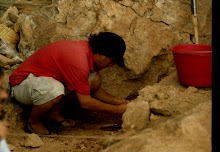
There's a brief report at Discovery News that provides some detail about an artificial stone structure that appears to have been built at the entrance of Theopetra Cave (Greece) ResearchBlogging.orgto protect its inhabitants from the elements (see also comments here). That, in and of itself is not news; what is news is the age of the thing: 23,000 years BP, obtained by optically stimulate luminescence (OSL).

The structure is a stone wall that blocked two-thirds of the entrance to the Theopetra cave near Kalambaka on the north edge of the Thessalian plain. It was constructed 23,000 years ago, probably as a barrier to cold winds.

“An optical dating test, known as Optically Stimulated Luminescence, was applied on quartz grains nested within the stones. We dated four different samples from the sediment and soil materials, and all provided identical dates,” Nikolaos Zacharias, director of the laboratory of archaeometry at the University of Peloponnese, told Discovery News.


This is definitely cool, as there are not very many such structures known from the Paleolithic. One possible, though somewhat shaky, comparable example is that of "two low, roughly linear wall-like piles of cobbles, each about 50m long [that] border a portion of the scatter" of the scatter of mostly Upper Paleolithic stone tools recovered at site MAC064, Iran (Rosenberg 1984:83).

I was surprised, though, that the report refers to the Theopetra structure as the oldest 'man-made' (sic) structure. This is because I can think of at least one other stone structure, at Ucagizli Cave in Turkey (Kuhn et al 2003: 114-116 - available as a free pdf here), that dates to slightly older than ca. 30,000 BP. Here's what it looks like:


And though it appears at first glance to be perhaps less impressive than the Theopetra wall (though the picture in the DN report is a bit unclear as to what the exact boundaries of the wall are), Kuhn et al. (2003: 114) describe the Ucagizli wall as a feature consisting "of a single arched course of limestone blocks, each 20-40cm in length. The blocks form a 'wall' running roughly parallel to the back wall of the cave at a distance of 1.5 to 2m from it. The alignment is clearly artifical: it corresponds with neither the cave's dripline nor any obvious fault or crack in the roof , and there were no blocks of comparable size in the surrounding sediments. Moreover, several of the blocks were set on edge rather than resting on their broad face." By analogy to ethnographic observations, they interpret it as most likely demarcating the edges of "a bedding area in the back of the cave."

So yes, the Theopetra wall is old, but not necessarily the oldest evidence of an artificial stone structure that we have for the Upper Paleolithic. In any case, it'll be very interesting to see what other material is associated with this wall at Theopetra, to see whether or not its interpretation as a windbreak is borne out. As I've discussed before with the case of La Folie, the correlation between features and other aspects of the archaeological record is critical in inferring their ultimate function.

References

Kuhn, S. L., Stiner, M. C., Kerry, K. W., and Güleç, E. 2003. The early Upper Paleolithic at Üçağızlı Cave (Hatay, Turkey): preliminary results. In Goring-Morris, N., and Belfer-Cohen, A. (eds.) More Than Meets the Eye: Studies on Upper Palaeolithic Diversity in the Near East, Oxbow Books, Oxford, pp. 106-117.

Rosenberg, Michael (1990). Stone "Walls" and Paleolithic Tools: The MAC064 Site Iran, 28, 83-88


Wednesday, November 21, 2007

Paleolithic papers in Near Eastern Archaeology

The June 2006 issue of Near Eastern Archeology contains four papers, all of which deal with the Paleolithic. Included in this fine lot is a paper by the team of Mike Bisson, one of my colleagues at McGill, about their recent work in Jordan. I'm providing the abstracts of all these papers here:
The Pleistocene Peopling of Anatolia: Evidence from Kaletepe Deresi
By Ludovic Slimak, Damase Mouralis, Nur Balkan-Atli, Didier Binder, and Steven L. Kuhn
Anatolia has been called the crossroads of Eurasia, forming as it does a land-bridge between Europe, the Levant, and central Asia. Historical documents and the region's rich archaeological record provide ample testimony to frequent movements of people, ideas, and goods across Anatolia over the last few millennia. A range of evidence, both circumstantial and direct, suggests that humans and human ancestors repeatedly traversed the region in even more remote times.


Late Acheulian Variability in the Southern Levant: A Contrast of the Western and Eastern Margins of the Levantine Corridor

by Gary O. Rollefson, Leslie A. Quintero, and Philip J. Wilke

One of the fascinating aspects of the archaeology of very ancient times is that it offers glimpses of extinct lifeways. We find this particularly true for the cultural behavior of hominids during the Lower Palaeolithic. Interestingly, relatively little is known about the daily habits of people during the fairly well-studied period of the Acheulian in the Levant, in spite of numerous site discoveries of considerable note. Much of this deficiency results from a lack of preserved perishable goods; these seldom survive time depths in the hundreds of thousands to well over a million years. But also lacking is clear understanding of the behavioral significance of those objects that do survive the wear and tear of time, specifically the numerous stone artifacts. This article presents new research that assists our quest for understanding of these ancient lives.


Human Evolutions at the Crossroads: An Archaeological Survey in Northwest Jordan
by Michael S. Bisson, April Nowell, Carlos Cardova, Regina Kalchgruber, and Maysoon al-Nahar
Human evolution can be traced back 7,000,000 years. Modern humans evolved in Africa 160,000 years ago and as recently as 26,000 years ago we shared parts of the world with at least one other species - the Neanderthals. Since the discover of the first Neanderthal in 1856 in Germany, this species has generated controversy; specifically, there are questions concerning their genetic relationship to modern humans, their capacity for language and artistic expression, or the reasons for their extinction. Resolving thse debates in the long term depends on an accumulation of evidence for how Neanderthals adapted to the physical and cultural environments around them. In other words, in order to understand why they died, we need to first understand how they lived.

Shelter or Hunting Camp? Accounting for the Presenceof a Deeply Sratified Cave Site in the Syrian Steppe
By Bruce Schroeder

No abstract available.

The latest issue also contains a paper on the Lower Paleolithic of Iran:
The Lower Paleolithic Occupation of Iran
By Fereidoun Bigalri and Sonia Shidrang

Iran is a natural bridge connecting Western Asia to South and Central Asia and therefore, we might expect it to have been a main route for hominin expansion eastwards. Despite its strategic location, however, it has so far produced little evidence for early hominin occupation. The authors present here the results of new investigations in the region that affirm the archaeological potential of this region for understanding Lower Paleolithic hominin adaptaton to their environment.

This should all help shed greater light on the Pleistocene record of the Near/Middle East, which is always good, especially in light of some of my current projects. I'm especially excited about the Schroeder paper, since there haven't been a whole lot of publications about his work at Jerf Al-Ajla, which contains an important Middle-Upper Paleolithic transitional sequence (as well as some late Acheulean material).