Sunday, February 04, 2007

Pause

Things are a wee bit chaotic here over here, so I don't expect to be able to post much for the next couple of weeks. Check again in a few for some new posts.

Tuesday, January 30, 2007

Paleoanthropology Society meetings

The preliminary program of the annual meetings of the Paleoanthropology Society is now online as a freely downloadable pdf. Looks like it will be, once again, a very stimulating meeting: there's a couple of papers on the 'hobbits' from Flores, a number of studies on Neanderthals and on the Middle-Upper Paleolithic transition, a study on the newly discovered Gravettian infant burials from Krems-Wachtberg, and the list goes on! Check it out.

Thursday, January 25, 2007

Gnomes!

A little non-anthro post because this is just too damn weird!

From the report in Reuters:
"It's being called the "Gnomesville Massacre"... An unknown number of attackers lopped off the heads or smashed several dozen of the pot-bellied statues this week at Gnomesville, a collection of more than a 1,000 colorful characters deep in a forest south of Perth."

You can read the whole thing here.

I don't know what's oddest about this story: the 'massacre' or the fact that Gnomesville exists in the first place!

Wednesday, January 10, 2007

Slicing cut marks on bone: new JFA paper

I've been getting into cut mark studies lately as a result of an experimental archaeology project I got involved with here at ASU. As luck would have it, a short new paper by Haskel J. Greenfield (University of Manitoba) came out recently in the Journal of Field Archaeology

Here, Greenfield uses light optical and, especially, scanning electron microscopes to investigate the morphology of cut marks produced using a range of lithic implements. He uses experimental cut marks on planks of wood to determine the morphology, and is able to identify corresponding marks on archaeological bones from the Early Bronze Age I site of Afridar (Israel). While his archaeological sample is small, he appears to be able to distinguish between the cut marks made by unretouched blades and flakes, on the one hand, and sidescrapers, on the other. He also experiments with various raw materials, namely flint, quartzite and obsidian.

He concludes that "the shape of a tool as a stronger influence on the shape of a cut mark than does the raw material from which it was fashioned" (2006:161), and, unsurprisingly, that "no perceptible differences were observed between cut marks made by unmodified blades and flakes." (2006:153). In his sample, the main difference in cut mark morphology is between unretouched pieces and sidescrapers.

Greenfield shows that unretouched pieces produce "cut marks [that] are thin , relatively straight, and shallow. The internal morphology tends to be consistent: on one side, a groove will descend... steeply and smoothly; on the other side, the groove will descend more gradually, and will have more parallel striations (to the apex of the mark)." In contrast, "sidescrapers leave an irregular and almost wave-like profile." (2006:161). Both patterns are the results of the morphology of the edges of the two kinds of slicing implements.

I liked this paper, though it might have benefited from a more extensive application of the methods on archaeological material. The main drawback, as I see it, is that Greenfield is forced to rely on a SEM for most of this work, which prevents the inspection of large bones, indeed of elements larger than 2-3cm in size. While he gets around this by making silicone molds of the relevant cut marks which can then be broken down to appropriate size for inspection under the SEM, this makes the method impractical for inspecting large numbers of cut marks as well as for identifying the tools used to produce cut marks at lower levels of resolution. While it is clearly important to demonstrate that different tools leave distinct kinds of marks that can be identified at very high levels of resolution, it would also be useful to develop complementary low-resolution methods that are more readily usable in, say, the field lab, something maybe building on the low-res methods of Walker (1978; Walker and Long 1977).

References

Greenfield, H. J. 2006. Slicing cut marks on animal bones: diagnostics for identifying stone tool type and raw material. Journal of Field Archaeology 31:147-163.

Walker, P. L. 1978. Butchering and stone tool function. American Antiquity 43:710-715.

Walker, P. L., and J. C. Long. 1977. An experimental study of the morphological characteristics of tool marks. American Antiquity 42:605-616.

Monday, January 08, 2007

Good job, 'Cats!

Seriously, what the hell!?! This kind of imbecility makes me even less of a fan of college football or school spirit. It's even more annoying when stuff like this happens in your own backyard... I live not 5 minutes away from Tempe butte (aka A Mountain)!

"Vandals climbed Tempe butte and painted a large red "A" - the University of Arizona's color - before the annual football game between the two rivals on Nov. 25. The paint job was first spotted two days before the ASU Sun Devils whipped the Wildcats 28-14.

Pranksters also hit the Sun Devils' practice field, painting a blue "A" and "Bear Down," the University of Arizona motto, on the turf.

But the red paint on the rocks of the butte could have erased rock art that dates to 1250, city officials said. Tempe could be forced to spend thousands of dollars to fly in a petroglyph expert and have the paint tediously removed by hand."

And here I was, thinking that being in college was all about getting an education and forming responsible citizens. I realize only a handful of people did this, but sweet lord, grow up!!

New Neanderthal archaeology papers in Before Farming

This is my first post on a series of three papers in the latest issue of the online journal Before Farming, all of which deal with aspects of Neanderthal archaeology. I've read all of them, and they're quite stimulating.

I intend to post about them in greater depth shortly, but in the meantime, I'll just mention that the first paper by, J. Speth and J. Clark, documents the large mammal procurement patterns of Middle Paleolithic hominins at Kebara Cave (Israel); one of the most provocative conclusions of the paper is that the Kebara record documents overhunting of ungulates by Neanderthals. The implications of this pattern for increasing diet breadth are also discussed.

The second paper, by A. Verpoorte, deals with a theoretical model of Neanderthal energetics, and how these might have conditioned their mobility patterns relative to those of modern humans. The paper is based on a simple hypothetical model based on the concept of central place foraging, the conclusions of which are then compared to patterns in the archaeological record of European Neanderthals, which they broadly appear to match. Verpoorte concludes that Neanderthals aimed to reduce their overall mobility by adopting a behavioral (and energetic) strategy that revolved around a pattern of "frequent, short-distance movement."

The last paper, by J. Zilhão and P. Pettitt, to my knowledge, is the first peer-reviewed critique of the new, very late dates for the Mousterian of Gorham's Cave (Gibraltar) (Finlayson et al. 2006). The authors show that there are a number of logical, methodological, taphonomic, and empirical problems with Finlayson et al.'s (2006) arguments for a 28-24 kya occupation of Gorham's Cave by Neanderthals, and they conclude instead that the available dates support an age of 30-32 kya for the last Mousterian occupation of the site. Noting that the new Gorham's Cave dates came out in September 2006, this also suggest a very fast turn-around time for papers submitted to Before Farming, which can only be a positive pattern for the world of paleanthropological research.

Overall, a very nice series of papers to start the new year with!

References:

Finlayson, C, Giles Pacheco, F, Rodríguez-Vidal, J, Fa, DA, Guiterrez López, JM, Santiago Pérez, A, Finlayson, G, Allue, E., Baena Preysler, J, Cáceres, I, Carrión,
JS, Fernaández- Jalvo, Y, Gleed-Owen, CP, Jimenez Espejo, FJ, López, P, López Sáez, JA, Riquelme Cantal, JA, Sánchez Marco, A, Giles Guzman, F, Brown, K, Fuentez, N, Valarino, CA, Villalpando, A, Stringer, CB, Martinez Ruiz, F & Sakamoto, T 2006.
Late survival of Neanderthals at the southernmost extreme of Europe. Nature 443:850-853.

Speth, J.D., and J.M. Clark. 2006. Hunting and overhunting in the Levantine Late Middle Palaeolithic. Before Farming 2006/3:1.

Verpoorte, A. 2006. Neanderthal energetics and spatial behaviour. Before Farming 2006/3:2.

Zilhão, J., and P. Pettitt. 2006. On the new dates for Gorham's Cave and the late survival of Iberian Neanderthals. Before Farming 2006/3:3.

Saturday, January 06, 2007

Radiocarbon dating the 40-60 kya interval

Jeff Pigati and colleagues have a paper in press in Quaternary International about a new protocol that enables radiocarbon dating of very old samples (i.e., between 40-60 kya in age). This should come as very good news for anyone interested in the chronology of the late Middle Paleolithic and early Upper Paleolithic, since this period has always been very tricky to date accurately. Between this, the ultrafiltration methods now being used at the Oxford lab, and advances in radiocarbon age calibration past 26 kya, it can be hoped that the chronology of that period will come into sharper focus in the next few years.

From the abstract:
"At the University of Arizona’s Desert Laboratory, we recently constructed new low background vacuum extraction and graphitization systems that are dedicated to preparing old (40-60 ka) samples for 14C dating. These systems are designed to minimize the amount of contaminant carbon, specifically atmospheric carbon, that is introduced to a sample during laboratory processing. Excluding contaminants is particularly important for 14C dating of old samples because the impact of contamination increases with sample age...

Based on the AMS results, the background level of our system is characterized by a nonlinear inverse relationship with sample mass (adjusted R2=0.75; n=24). For a 1 mg graphite target, the total procedural blank, including chemical pretreatment, combustion, cleanup, graphitization, storage, and AMS measurement, is 0.05±0.01 pMC (2σ), equivalent to a 14C “age” of 61.1±1.8 ka. This should not be taken as the upper limit of our system, however, because if the 14C activity of a sample is statistically indistinguishable from the appropriate mass-dependent blank value at the 95% confidence level (2σ), then its age is considered to be “infinite”. Thus, for a 1 mg target, the practical limit of our system is actually ~55 ka; for a 0.5 mg target, the practical limit is ~50 ka. Although our extraction system can accommodate inorganic samples (e.g., calcite, aragonite), the above limits are only applicable to geological graphite, charcoal, and organic samples that are processed via combustion. Future work will be directed toward determining the appropriate background levels for inorganic materials."

References

Pigati, J. S., J. Quade, J. Wilson, A.J. Timothy Jull, and N. A. Lifton. (in press) Development of low-background vacuum extraction and graphitization systems for 14C dating of old (40-60 ka) samples. Quaternary International: doi:10.1016/j.quaint.2006.12.006

More on the "python"

The posts that brought the most traffic to A Very Remote Period Indeed in 2006 were arguably those having to do with the work on the MSA deposits of Rhino Cave (Botswana) by Sheila Coulson and her team. In what's probably my last mention of this until actual pubs of the work come out, I want to direct your attention to a brief feature on the work at Rhino Cave and the case for early MSA ritual published in National Geographic (picked this up on ArchaeoBlog). There's not much else on the discoveries themselves, but the piece includes some interesting comments by Stanley Ambrose, Alec Campbell, Rupert Isaacson and Larry Robbins.

2007 is the new 2006

Well, one more year has gone and been replaced by a new one. I enjoyed a wonderful 2006 (much, much better than the dark year known as 2005), and hope that 2007 brings with it even better things for everyone around.

One of my resolutions is to endeavor to be more constant about posting to this blog. I'm not in the business of making predictions, but I know for a fact that 2007 will be an interesting year for paleoanthropology, and especially Paleolithic archaeology: there's new dates on the horizon, new debates emerging, and new ways to look at the record that should make for a stimulating year of debates and discussion.

I also want to take a moment to thank all the readers of the blog and all the people who left me feedback since I started this baby up, either as comments on the blog or through other channels. I'm heartened to see that my musings about things prehistoric are interesting enough for people to take the time to read, and hope to continue providing stimulating food for thought in the coming months!

Monday, December 11, 2006

"Forget the bull whip..."

Well, CNN has done us all a service and posted a feature on how to make it as an archaeologist, folks! Overall, it's not as terrible as I expected something like this to be on CNN (hey, they do stress the need for appropriate credentials!). As someone who recently turned in a draft of his dissertation, though, my personal favorite advice is....

Resign yourself to a lifetime of poorly-paid obscurity

"Archaeology is a tough business, and certainly not for those who crave either their creature comforts or a healthy bank balance... If you are not utterly obsessed with the subject, to the exclusion of all else, then archaeology is probably not for you."

Mamma mia! Seriously, folks, it ain't that bad... unless of course I am so utterly obsessed with cavemen to the exclusion of everything else that I didn't realize this until now... thanks, CNN!

Interview with Sheila Coulson on Mundo Neandertal

Check you this! Martín Cagliani of Mundo Neandertal has posted the transcript of an interview with Dr. Sheila Coulson, whose recent work and discovery of the "earliest documented ritual" in Botswana I blogged about ten days or so ago.

This is a very informative interview and it resolves some of the questions I (and others) had about the discovery. This info comes straight from the source, which corrects some of the interpretive distortions present in the original report of the discovery, which was a translated news report, and not a scientific publication. Since the interview's transcript is in Spanish, here’s a summary of some of the details of the interview:

1) Of the 13,000 recovered lithic artifacts, 115 are finely retouched typological points. These are said to be analogous to those from the MSA levels at the ≠Gi site excavated by A. Brooks and colleagues, and dated to ca. 77 kya. With the exception of an unspecified number made on quartz and rock crystal, which are available locally, the artifacts are made on types of rocks whose closest source lies in Namibia. You can see some of the artifacts here on Coulson's site... these look a lot better than the ones published in Apollon. Some Levallois cores (but no Levallois points) are also reported.

2) The date of ca. 70 kya for the site is confirmed to be a relative estimate. It is based on similarities between the Rhino Cave artifacts and those from ≠Gi, and two absolute dates from other MSA sites in the Tsodilo Hills (ca. 64 kya and 96 kya). Plans are in the works to have a dating (TL?) specialist from the Max Planck Institute to come and date the deposits in the relatively near future, though the size of the cave and the kind of cave it is (and the location of the test pit at the entrance of the cave) may make TL dating tricky. Future work that will focus on deposits further inside the cave may yield deposits more propitious to TL.

3) The excavated area is a 1x1m test pit that reached down about 2m. The stratigraphy of the deposits exposed a 65cm thick LSA deposit of aeolian sediments, which overlay highly compacted MSA deposits of a drastically different sedimentary nature, and which may have been cemented as well (my translation is a bit iffy here). There are more unexcavated MSA deposits below.

4) The "ritual function" of the points is inferred on their state of recovery. They were all roughed out elsewhere and finished at Rhino Cave. They were found in three states: perfectly intact, broken in half, or (in 22 cases) burned in the midst of the debitage created during their manufacture. The latter are the only burnt things encountered in the test pit, and none of the points bear any kind of impact fracture suggestive of use as part of projectile weapons.

5) Analysis of the material is ongoing, and excavations are set to resume in 2008.

I will try to contact Martín and see if it is possible to post an English translation of the interview somewhere. In the meantime, I'll offer a few comments on the information provided in the interview. I’ll limit these to stuff we can actually talk about based on the interview as opposed to talking about how definitive publication is needed before certain issues can be settled. I hope these do not come across as disparaging: the comments below aren't meant to be mean-spirited at all, but rather as outlining areas I'm eager to learn more about. Anyway.

It's suggested that the points are mainly made on exogenous rock, but it’s unclear what the actual proportion is and there is mention that a portion of the assemblage was made on local raw material. Here, I'd like to point out that it's not unusual to have heavily retouched artifacts made on exotic lithotypes even in European Mousterian contexts (i.e., made by Neanderthals), albeit in comparatively small numbers. I guess that without contextual information about lithic raw material frequencies in the debitage and small fraction, it's hard to say. An interesting fact, however, is that, in the archaeological record of other mobile hunter-gatherers that used bifacial technology (e.g., Paleoindian groups), it's not unusual to find bifacial artifacts often made on exotic stone. However, in those contexts, it has often been found that these bifaces were usually not so much used as the tips of hunting weapons, but rather as multi-purpose cutting implements and/or convenient portable 'cores' from which flakes could be struck at a moment's notice, as they became necessary (Kelly 1988; Kelly and Todd 1988). That these bifaces should be made predominantly on exotic, fine-grained stone is not surprising since lithic homogeneity is a prerequisite for such a strategy to be worthwhile in the first place. So, the disproportionate presence of bifacial implements on exotic raw materials and bearing no evidence of use as spearheads is not necessarily unexpected in the context of a mobile Paleolithic group that made bifacial tools. Evidence of no use at all might be more convincing proof of ritual production.

I'm not sure what to make of the 'ritual way' in which these artifacts entered the archaeological record. It certainly sounds intriguing, but I’m not sure more prosaic interpretations need to be discarded at this point. The fact that they're found in the midst of so much other lithic debris does not suggest a ritual discard context to me, at least based on what's been revealed so far. That some were found in perfect condition or broken in half is not necessarily completely unexpected, especially if they can be shown to have been near or at the end of their use-life (this can be assessed using methods like those recently proposed by Andrefsky [2006]). More puzzling are the burnt ones, found in the midst of their debitage. Here, it will be important to know exactly how they were identified as burned. Heat-treating of lithic raw material to improve its quality should not be ruled out out-of-hand here, especially if that raw material was meant to be carried around for a while and need to be dependable. So, unless there's direct evidence of in situ combustion features associated only with those artifacts, it might be challenging to link them unambiguously to discard in a ritual context. Likewise, it'll be very important to see whether the scenario of these chipped stone implements being imported as 'rough outs' is supported by refitting studies and/or details about the incidence of cortical pieces among the debitage associated with their final production.

One last comment, this one more practical in nature: so far, the Middle Stone Age levels have reached a depth of 2m below present surface. The top of the 'python' is 2m above the present surface. That means that the top of the rock would have been 2.65m (about 9 feet) above the ground in the latest Middle Stone Age, and 4m (13 feet) above it at the base of the test pit (which is not the base of the total deposit). Conversely, the base of the rock would have been between 0.65m and 2m above the Middle Stone Age ground level. Now, MSA people could obviously have built scaffolding and/or ladders, or even climbed the rock face, but it does raise the questions of the position of the 'python' relative to that of the Middle Stone Age occupants of the cave, how they would have organized themselves to chip away at it, and what the thing would have looked like from down below. This is an important question to consider, especially if the 'python' was an integral part of why Middle Stone Age folks occupied the site in the first place. So far, all the views of the 'python' have been generated at present ground levels, and it might have looked different from 2m below it, especially since the 'eyes' and 'mouth' might not have been as easily visible from that distance.

The original news report mentioned that part of the 'python''s surface had been found in the Middle Stone Age levels, but unless it bears the same indentations and unless these indentations can be shown unambiguously to be human-made, finding wall spalling is not unexpected in a cave context. The picture of what I think is the piece being referred to does appear to be be grooved, but this groove looks shallower and narrower than the ones seen on the 'python''s surface.

It might well be that the 'python' was intentionally shaped in prehistory, but that this was done in the Later Stone Age, or even in recent prehistory. There's certainly an abundance of prehistoric engravings in southern Africa, none of which have so far been attributed to the Middle Stone Age, so the burden of proof here is to conclusively demonstrate their association at Rhino Cave, as opposed to stressing that it is a possibility. If the chipping is conclusively demonstrated to be MSA in age, this truly will be a sensational discovery, no doubt about it.

All in all, this interview is very interesting and enlightening, but - as is always the case, I suppose - it generates additional, intriguing questions. Can't wait for the first publications, they'll be most interesting to read, and can't wait to hear (even) more about this site in general.

References

Andrefsky, W. 2006. Experimental and archaeological verification of an index of reduction retouch for hafted bifaces. American Antiquity 71:743-758.

Kelly, R. 1988. The three sides of a biface. American Antiquity 53:717-734.

Kelly, R., and L. Todd. 1988. Coming into the country: early Paleoindian hunting and mobility. American Antiquity 53: 231-244.

Wednesday, December 06, 2006

Archaeology mourns

This past Friday, December 1 2006, Dr. Bruce G. Trigger, James McGill Professor of Anthropology at McGill University, passed away in Montréal.

Professor Trigger’s stature in contemporary archaeology can hardly be overemphasized, as is readily seen by even a casual perusal a list of his innumerable publications spanning over four decades. When I was an undergraduate student at McGill, I had the good fortune of taking three classes from him, including most memorably “History of Archaeological Theory,” a course for which he had – quite literally – written the book. Here, I’m referring to Trigger’s magisterial A History of Archaeological Thought, a volume that frankly has no equal in archaeological literature.

I remember sitting in the first class of the course, in the first days of January 1998 (winter break was always cruelly short at McGill)… The first thing Prof. Trigger had us do was to write on the first page of the textbook – his book! – the following quote by D. Clarke, so as to make sure we never forgot just what we were doing as archaeologists:

“Archaeology is the discipline with the theory and practice for the recovery of unobservable hominid behavior patterns from indirect traces in bad samples.”

Only then, with a wry smile, did he launch into the course… which was promptly interrupted by a historic ice storm that shut down all of Montréal for two weeks. I spent much of those cold, wet days in the Second Cup on the corner of Saint-Denis and De Maisonneuve (one of the few places I could reach that still had power), devouring A History of Archaeological Thought and scribbling the first round of intramarginal notes and questions I’d inflict on my copy of the book over the years.

The course itself was a one-of-a-kind experience in learning about archaeology, but it’s mainly in retrospect that I truly came to appreciate the considerable impact Trigger’s thinking had on me, as I referred time and again to his book and to the copious notes I took during that fateful semester. As I turned in my dissertation this week, some of which discusses the influence of nationalism in predisposing people to accept some interpretations of the record as more probable than other, I couldn't help but pause and realize just how strongly the influence of Trigger’s teaching still permeates my work today.

With the news of his untimely passing, I realize too late that I never really got around to thanking him fully for some of the things he did for me (including writing a reference letter that I’m sure played no small part in getting me into grad school), or seizing the chance to ask him some questions I had always wanted to explore in greater depth. So, if belatedly, thank you for everything, Professor Trigger… to say you were an inspiration is a vast understatement, and you will be immensely missed.

Friday, December 01, 2006

New CA paper by Kuhn & Stiner

This new paper in Current Anthropology by Steve Kuhn and Mary Stiner (U of Arizona) ought to be of interest some folks out there.

What's a Mother to Do? The Division of Labor among Neandertals and Modern Humans in Eurasia

Abstract
Recent hunter-gatherers display much uniformity in the division of labor along the lines of gender and age. The complementary economic roles for men and women typical of ethnographically documented hunter-gatherers did not appear in Eurasia until the beginning of the Upper Paleolithic. The rich archaeological record of Middle Paleolithic cultures in Eurasia suggests that earlier hominins pursued more narrowly focused economies, with women's activities more closely aligned with those of men with respect to schedule and ranging patterns than in recent forager systems. More broadly based economies emerged first in the early Upper Paleolithic in the eastern Mediterranean region and later in the rest of Eurasia. The behavioral changes associated with the Upper Paleolithic record signal a wider range of economic and technological roles in forager societies, and these changes may have provided the expanding populations of Homo sapiens with a demographic advantage over other hominins in Eurasia.

Just got it today and I haven't had time to read it yet. However, judging by the lengthy comments and reply section, it seems to have generated quite a bit of debate. Should make for interesting reading!

Thursday, November 30, 2006

Coulson and the earliest documented ritual

Not much time to post today, but wanted to address the news about the 70,000 year-old 'python cult' that's making the rounds today, evidence of which was discovered by Sheila Coulson (U of Oslo). The report can be found online on the Apollon website; it's pretty short and contains some photographs.

Until I see some good publications about the dating and the 'spectacular' lithic artifacts refered to here, I won't be convinced much by this report. This is what the "particularly beautiful spearheads" found below the indented rock face look like


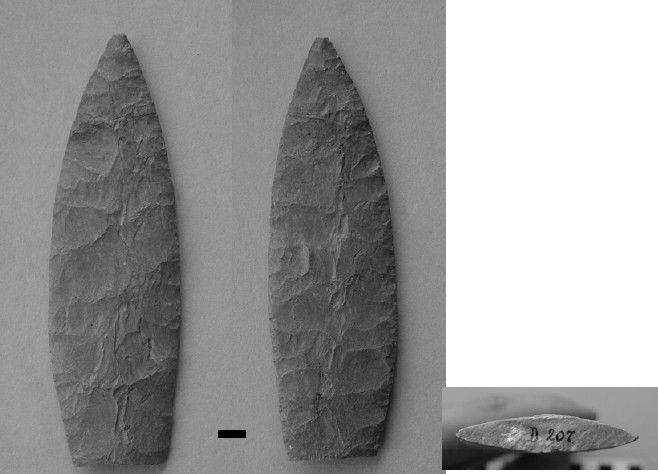
They are further described as being "better crafted and more colourful than other spearheads from the same time and area." Really? These things look like pretty run-of-the-mill unifacial points and/or scrapers to me. Compare them to the following bifacial Still Bay point at the Blombos Schoolhouse site (from Minichillo 2005: 153, Fig. 5.3 - bar = 1cm) and which is of MSA age


The 'python rock' artifacts don't even come close to exhibiting this level of craftsmanship.

The paper in Apollon also states that there are only a few archaeologists working on the African MSA... the flurry of recent publications and presentations at international meetings precisely about that period shows this is not the case at all.

I'll be curious to see how this stands up to critical scrutiny once details about these finds are published in scientific, peer-reviewed journals. In the meantime, you can also check out a very good post on the report on the Remote Central blog and some other comments on Mundo Neandertal (in Spanish) and on John Hawks' blog.

References

Minichillo, T.J. 2005. Middle Stone Age Lithic Study, South Africa: An Examination of Modern Human Origins. Unpublished PhD dissertation, Department of Anthropology, University of Washington.

Wednesday, November 22, 2006

Neanderthal childhood was as long as that of modern humans

Picked this one up on the website of the Montréal daily La Presse. The story (in French) reports on a study by Christopher Dean (University College London) and colleagues from French and Italian institutions which shows, through the use of high-resolution microcomputed tomography on two molars, that childhood was of comparable duration for Neanderthals and modern humans. Digging around the Nature web site, I found the paper in question, by Macchiarelli et al. (2006) in the papers available in advance of press. The authors conclude that

"Our data now allow us to predict M1 emergence time in Neanderthals with more certainty. If about 8mm of root were formed at an average of about 5.7 mmper day at gingival emergence, then this would have occurred at about 6.7 years of age, well within the human range (6.260.8 years (mean 6 s.d.)). This, together with the modern human-like position of the neonatal line, suggests both similar timing of tooth initiation relative to birth in Neanderthals and modern humans, and a predictable extended period between birth and M1 emergence, by which time about 90% of brain volume would have been attained."

While they also mention that that "a more complex enamel–dentine junction morphology and a late peak in root extension rate sets [Neanderthals] apart", their results are in contrast to those previously reported by Fernando Ramirez Rozzi and José Maria Bermudez de Castro (2004) who estimated that Neanderthals reached adulthood around fifteen years of age or so, that is to say, significantly earlier than modern humans. I should note that the Ramirez Rossi and Bermudez de Castro conclusions had already been challenged by Guatteli-Steinberg et al. (2005) who used dental perikymata counts to reocnstruct Neanderthal life history and show that it was similar to that of modern humans.

Macchiarelli et al.'s results provide another thread of evidence that demonstrates that modern humans and Neanderthals may not have been significantly different in terms of their biological development. This has a number of implications about the life history of Neanderthals, the structure of their population and the nature of their knowledge transmission strategies. This is especially interesting in light of a recent paper in the Journal of Human Evolution by Gurven et al. (2006) about the time needed to become a proficient hunter. Based on observations on the Tsimane foragers in the Bolivian Amazon, Gurven et al. suggest that physical maturity alone is not enough to ensure fully proficient hunting (an activity which requires much skill), and that full proficiency might only be attained about 10-20 years after reaching adulthood.

Gurven et al. (2006) therefore do away with the idea that physical maturity is, by itself, sufficient to be a fully proficient hunter. Bocherens et al. (2001, 2005) suggest that at least some Neanderthals were top carnivores, which implies they were able to develop fully competent hunting capacities comparable to those of modern humans (if not actually better ones). The idea that Neanderthals could achieve this level of skill simply by maturing more quickly is therefore seriously undermined by the Gurven et al. (2006) paper, and the new Macchiarelli et al. study suggests that, in fact, there is no need to invoke such improbable scenarios to explain effective hunting among Neanderthals. Now, how this all fits with the debate over Neanderthal longevity and life-history as a whole is another debate, one which I will not broach today...

I have to say that also really love the reconstruction of Neanderthal adult-infant interaction depicted in the La Presse feature, and I had not seen before...


I love how the Neanderthal kid looks kinda lost or detached in this one, but then again, I'd probably look like that myself if I was left alone with a guardian that looked as haggard as that adult Neanderthal!

References

Bocherens, H., M. Toussaint, D. Billiou, M. Patou-Mathis, D. Bonjean, M. Otte, and A. Mariotti. 2001. New isotopic evidence for dietary habits of Neandertals from Belgium. Journal of Human Evolution 40:497-505.

Bocherens, H., D. G. Drucker, D. Billiou, M. Patou-Mathis, and B. Vandermeersch. 2005. Isotopic evidence for diet and subsistence pattern of the Saint-Césaire I Neanderthal: review and use of a multi-source mixing model. Journal of Human Evolution 49:71-87.

Guatelli-Steinberg, D., D. J. Reid, T.A. Bishop, and C. S. Larsen. 2005. Anterior tooth growth periods in Neandertals were comparable to those of modern humans. PNAS 102:14197-14202

Gurven, M., H. Kaplan, and M.Gutierrez. 2006. How long does it take to become a proficient hunter? Implications for the evolution of extended development and long life span. Journal of Human Evolution 51:454-470.

Macchiarelli, R., L. Bondioli, A. Debénath, A. Mazurier, J.-F. Tournepiche, W. Birch, and C. Dean. 2006. How Neanderthal molar teeth grew. Nature: doi:10.1038/nature05314

Ramirez Rossi, F.V., and J. M. Bermudez de Castro. 2004. Surprisingly rapid growth in Neanderthals. Nature 428:936-939.

Tuesday, November 21, 2006

El Mirón Cave - Lawrence Straus ASU Lecture

It's a pretty paleo-heavy fall semester for colloquium speakers at ASU, and last Friday, we had the pleasure of having Prof. Lawrence Guy Straus (University of New Mexico) talking to a packed lecture hall about his ongoing project with M. R. Gonzales Morales (Universidad de Cantabria) at El Mirón Cave. This is one impressive site, folks, with a stratigraphy spanning uninterrupted the whole gamut from the Mousterian to the Bronze Age, and having yielded, among other things, the oldest reliably dated evidence for Neolithic lifeways in northern Atlantic Spain.

Of more direct Paleolithic import was Straus' discussion of some of the Magdalenian art found in the cave. This includes notably the following scapula bearing an incised deer


This is a motif that has been found on similar incised artifacts in other neighboring sites, and bears resemblance to parietal depictions of deer found in neighboring Magdalenian sites as well. This has enabled Straus and his colleague to hypothesize the existence of a relatively tightly bound cultural network defined, among other things, on the basis of shared iconography and stylistic conventions. 16,000 years ago. Very, very neat stuff.

In addition, a sondage at the bottom of the excavated area has revealed the presence of a (so far) undifferentiated Early Upper Paleolithic level dated to about 27 kya (uncalibrated) and Late Mousterian levels going back to 41 kya (uncalibrated). Unfortunately, these lower levels are not very well-known yet, having only been excavated over a very small area, but they're there, which is cool in and of itself. All in all, a fantastic site, one which really gives a good view of diachronic changes in site function, land-use patterns, and 'cultural' traditions. Presented with Straus' usual flair and engaging style (not to mention his intimate familiarity with the Paleolithic record of northern Spain), this was one very informative and very entertaining lecture.

Tuesday, November 14, 2006

Missing Mousterians and Trails of Dead!

Not much time to write these days, but wanted to point out a very good post on Alex Steenhuyse's blog on the recent paper by Dibble and McPherron on the "Missing Mousterian" in Current Anthropology. Though Alex is not completely bias-free (n'est-ce pas?), he is very, very right in pointing out the importance of the approach taken by Dibble & McPherron (2006) to get a more thorough understanding of Neanderthal lifeways... good paper, I've read it, but haven't had a chance to blog about it given how hectic everything is these days...

In other news, So Divided, the latest record by rock juggernauts "... And You Will Know Us By The Trail of Dead" came out today... go buy it! It's fantastic, phenomenal even!! What's the relevance of this on a blog concerned with archaeology and anthropology, you may well ask... well, I have it on good authority that Trail of Dead's lead singer of the band used to be an anthropology major at UT Austin. So there you have it!

References

Dibble, H. L., and S. McPherron. 2006. The Missing Mousterian. Current Anthropology 47(5): 777-803.

Tuesday, November 07, 2006

Elections!

If you can vote in the US today... vote, vote, vote!!!

Monday, October 30, 2006

Arthur Machen and the Paleolithic

Arthur Machen was a great writer who influenced many early 20th Century horror and fantastic fiction authors, such as, for instance, H. P. Lovecraft. His stories are still very entertaining reads today and, because most are set in Victorian England, they coincide temporally with the development of anthropology and archaeology as disciplines. This, and the fact that Machen often drew his protagonists from the small bourgeoisie leads to some really neat vignettes, such as this one, from The Red Hand, when two gentlemen taking an evening stroll come upon a murder site and alert the police.

"The three lanterns were flashing here and there, searching for more evidence, and in the gleam of one of them Dyson caught sight of an object in the road, to which he called the attention of the policeman nearest to him.

'Look, Phillipps,' he said, when the man had secured it and
held it up. 'Look, that should be something in your way!'

It was a dark flinty stone, gleaming like obsidian, and shaped to a broad edge something after the manner of an adze. One end was rough, and easily grasped in the hand, and the whole thing was hardly five inches long. The edge was thick with blood.

'What is it Phillipps?' said Dyson; and Phillipps looked hard at it.

'It's a primitive flint knife,' he said. 'It was made about ten thousand years ago. One exactly like this was found near Abury in Wiltshire, and all the authorities gave it that age.' "


A Paleolithic stone tool used as a murder weapon in 19th Century London! How cool is that as a hook?! And the rest of the story gets even better, with some hand prints on a wall, and more! Phenomenal reading!

References

Machen, A. 1906. The Red Hand. In The House of Souls. E. Grant Richards, London

New paper on Paglicci's EUP levels

The latest L'anthropologie is dedicated to the Upper Paleolithic and contains a paper by A. Palma di Cesnola (U of Siena) on the proto-Aurignacian and early Gravettian layers (24-22) of Grotta Paglicci, on the Gargano Promontory in Apulia, Italy. The site is important for a number of reasons, including the fact that it contains the earliest Aurignacian assemblage in southern Italy (ca. 34,000 BP, uncalibrated). This paper is a summary (in French, with an abstract and figure captions in English) of a the results of the excavations at Paglicci by the Prehistoric Ecology Section of the University of Siena in the 80's and 90's, recently published as a full-length monograph in Italian (Palma di Cesnola 2003a).

Palma di Cesnola (2006) provides a largely typological description of the lithic industries from levels 24-22 along with summary description of their chronological, sedimentary and zooarchaeological records. This is done using G. Laplace's analytical typology. There is unfortunately little information about the debitage or cores of those series, or about the raw materials exploited for their manufacture, although it seems fair to assume, on the basis of information provided in the monograph (i.e., Palma di Cesnola 2003b) that the only exploited lithotype comes from outcrops located about 30 km away from the site. Overall, the Aurignacian levels appear relatively poor in retouched tools compared to the abundant assemblages from the early Gravettian, although it bears emphasizing that those levels appear to have so far only been excavated over an area of about 7-8 square meters (Boscato 2003: Figure 4).

Of interest in the paper is the description of the Paglicci-type (or "PA 24 A1"-type) retouched bladelet that characterizes the backed bladelets of the top of the proto-Aurignacian sequence at Paglicci, while the base of the sequence is characterized by more classic Dufour types. This is interesting because Palma di Cesnola attributes the development of this new bladelet type to the result of proto-Aurignacian (or more precisely what he terms the "marginally backed bladelet Aurignacian") groups who originally made Dufour bladelets settling in "peculiar" contexts in meridional Italy where "under conditions of relative isolation, they would have created specialized and completely new tools" (2006: 366). He sees the Castelcivita sequence (Gambassini 1997) corroborating such an interpretation since at that site too, a Dufour level is overlain by a proto-Aurignacian level characterized by a distinct bladelet type, in that case the "Castelcivita bladelet," which has also been identified at the comparatively recent open-air Aurignacian site of Serino (Accorsi et al. 1979).

Palma di Cesnola also describes Paglicci's rich early Gravettian industries that date back to about 28,000 BP (uncalibrated) and he subsequently presents an overview of the earliest Gravettian in Italy, mentioning that unpublished dates now show the Gravettian to have been present in the Veneto about 30-31,000 BP uncalibrated (Palma di Cesnola 2006: 368). These data suggest that the issue of the origins and diffusion of the Gravettian in Italy will be an interesting topic to keep track of , and that some previous ideas about these processes might well have to be rethought in the coming years.

Overall, the paper's a good summary of those important assemblages, though it's a pity that information on the debitage and cores is missing. For anyone wanting to get an in-depth perspective on those assemblages, I highly recommend consulting the edited site report which comprises detailed analyses of pretty much all aspects of the archaeological record of layers 24-22 (Palma di Cesnola 2003a).

References

Accorsi, C., E. Aiello, C. Bartolini, L. Casteletti, G. Rodolfi, and A. Ronchitelli. 1979. Il Giacimento di Serino (Avellino): Stratigrafia, Ambienti, e Paletnologia. Atti della Società Toscana di Scienze Naturali A 86:435-487.

Boscato, P. 2003. I macromammiferi dell'Aurignaziano e del Gravettiano antico di Grotta Paglicci. In Paglicci. LÂ’Aurignaziano e il Gravettiano antico (A. Palma di Cesnola, ed.), pp. 49-62. Claudio Grenzi Editore, Foggia, Italy.

Gambassini, P. (editor). 1997. Il Paleolitico di Castelcivita, culture e ambiente. Materiae no.5. Electa, Naples.

Palma di Cesnola, A. (editor). 2003a. Paglicci. L'Aurignaziano e il Gravettiano antico. Claudio Grenzi Editore, Foggia, Italy.

Palma di Cesnola, A. 2003b. Il sito. In Paglicci. LÂ’Aurignaziano e il Gravettiano antico (A. Palma di Cesnola, ed.), pp. 13-14. Claudio Grenzi Editore, Foggia, Italy.

Palma di Cesnola, A. 2003c. LÂ’Aurignaziano dello strato 24. In Paglicci. LÂ’Aurignaziano e il Gravettiano antico (A. Palma di Cesnola, ed.), pp. 111-138. Claudio Grenzi Editore, Foggia, Italy.

Palma di Cesnola, A. 2006. LÂ’Aurignacien et le Gravettien ancien
de la grotte Paglicci au Mont Gargano. L’anthropologie 110: 355–370.